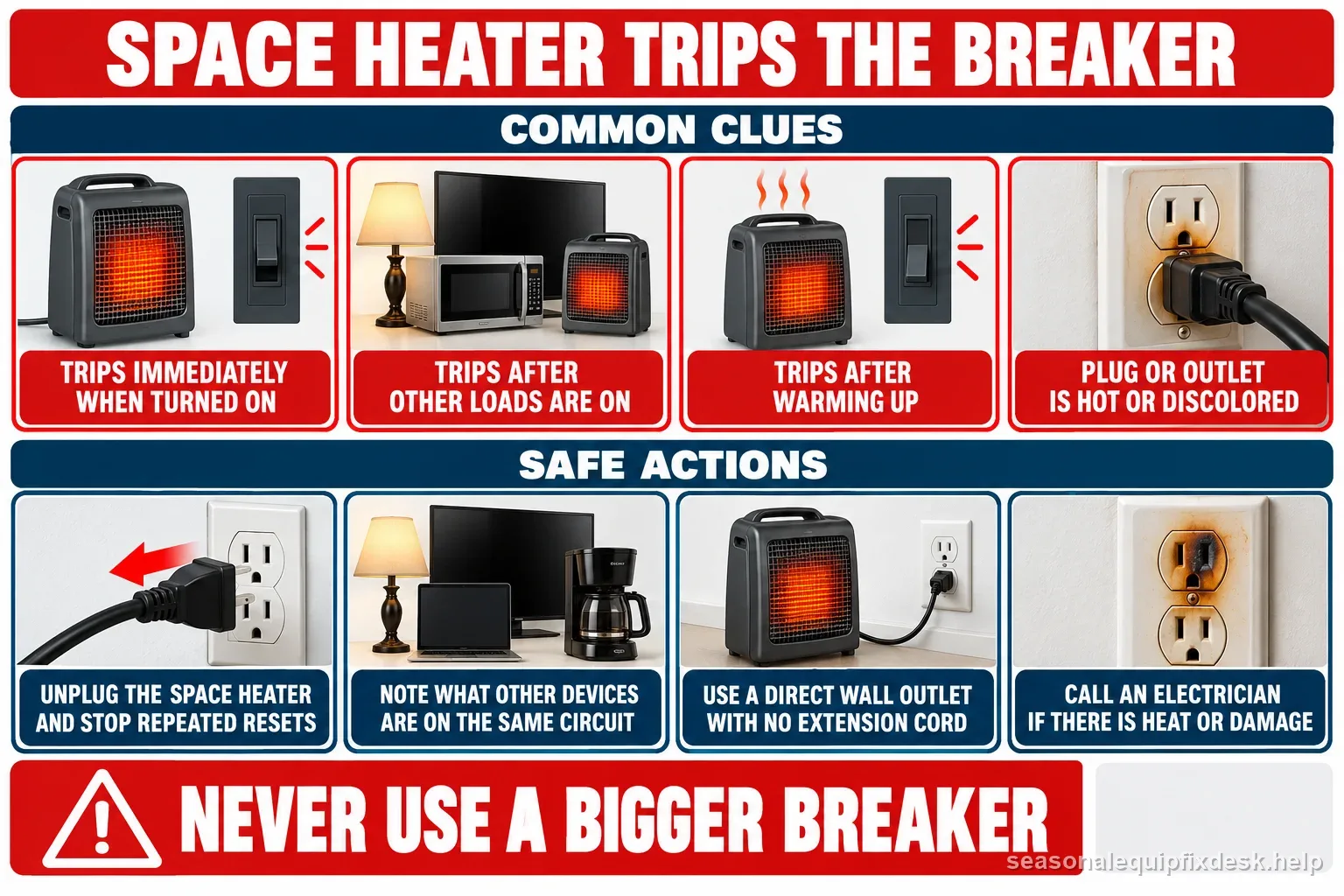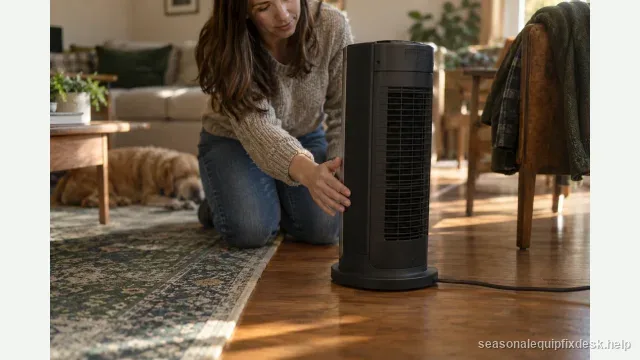
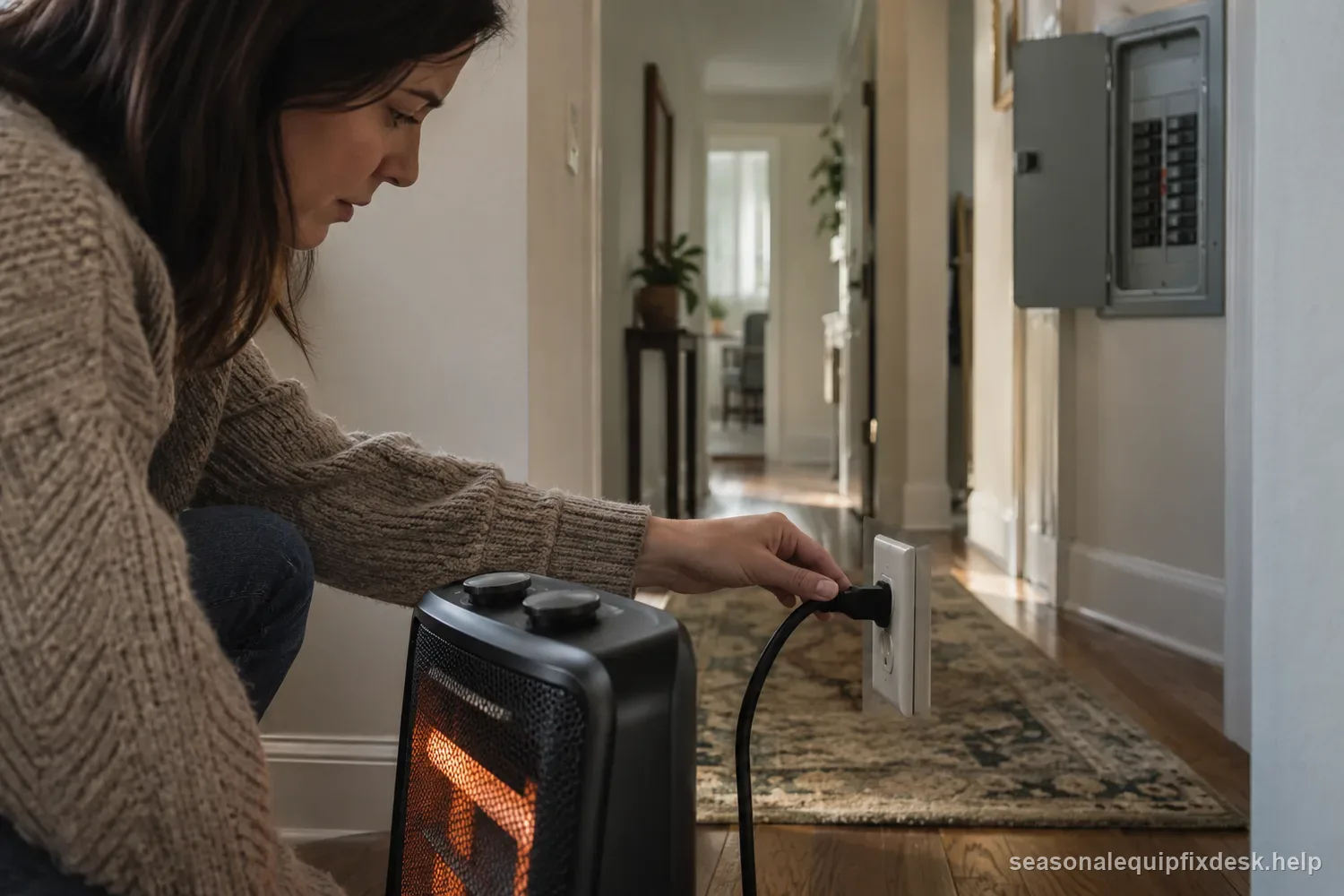
Quick answer: Stop repeatedly resetting the breaker. First determine what else is on the same branch circuit and whether the heater is connected directly to a wall receptacle. A high-wattage heater can push a shared circuit over its limit, but an immediate trip can also indicate a damaged heater, cord, plug, receptacle, or wiring fault. The breaker is protection, not an inconvenience to defeat.
A breaker trip plus a burning odor is a stop-use combination. See the heater odor safety checks and do not keep resetting the circuit.
A tripped circuit and a heater that reaches its thermostat target are different symptoms. Use the space heater thermostat diagnostic order only for normal cycling or setpoint complaints; do not keep resetting a breaker.
For a radiator-style heater, compare the external plug, thermostat, and model-specific warm-up checks before returning it to use; stop for a hot or damaged cord. See the oil-filled radiator safety checks guide for the matching checks.
| Trip timing | Possible issue | Safe response |
|---|---|---|
| Only with other loads | Shared circuit overload | Unplug heater; note other loads |
| Immediately on heat | Heater or circuit fault | Do not reset repeatedly |
| Hot plug or outlet | Loose or damaged connection | Stop using; electrician |
| Trips on another circuit | Heater fault more likely | Stop and contact service |
Start with the nameplate watts and the branch, not the breaker handle
Many portable electric heaters draw substantial current on high heat. The exact load is printed on the nameplate. Note which lights and receptacles lose power when the breaker opens; that identifies other loads on the same branch more reliably than guessing from room locations.
Do not upsize the breaker because a heater trips it. Breaker rating must match the branch-circuit wiring and installation. Changing protection without an electrical load calculation can create a fire hazard in the walls.
- Confirm mode, thermostat setting, and the observed symptom.
- Check placement, airflow, and the power connection externally.
- Compare the behavior with the relevant control or safety feature.
- Run only the safe retest described for this complaint.
- Stop using the unit when the article identifies a stop-use condition.
Remove extension cords and power strips from the test
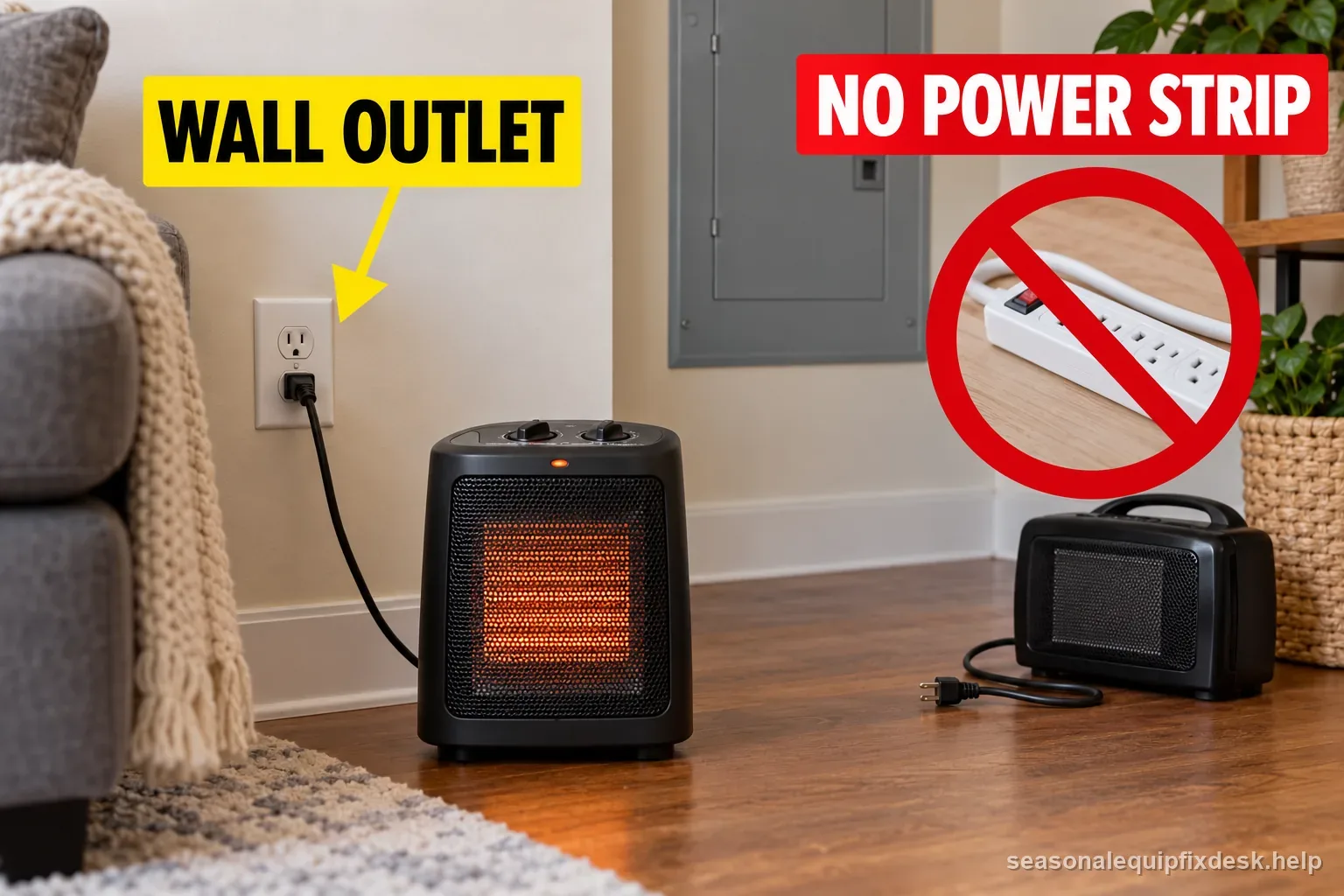
CPSC recommends plugging electric space heaters directly into a wall outlet, never an extension cord or power strip. Extra plug interfaces can overheat, and a power strip may have its own overload protection that trips before the panel breaker. A direct-wall connection eliminates those variables and follows the safety guidance.
A shared circuit often reveals itself by timing
If the heater runs until a microwave, hair dryer, vacuum, toaster, or other high-wattage appliance starts, overload is the leading clue. Turn the heater off and redistribute loads appropriately rather than using the breaker as a recurring switch.
A circuit that trips after several minutes with only the heater running needs a different look. Heat at a loose connection, a heater drawing abnormal current, or a breaker/circuit issue may be involved.
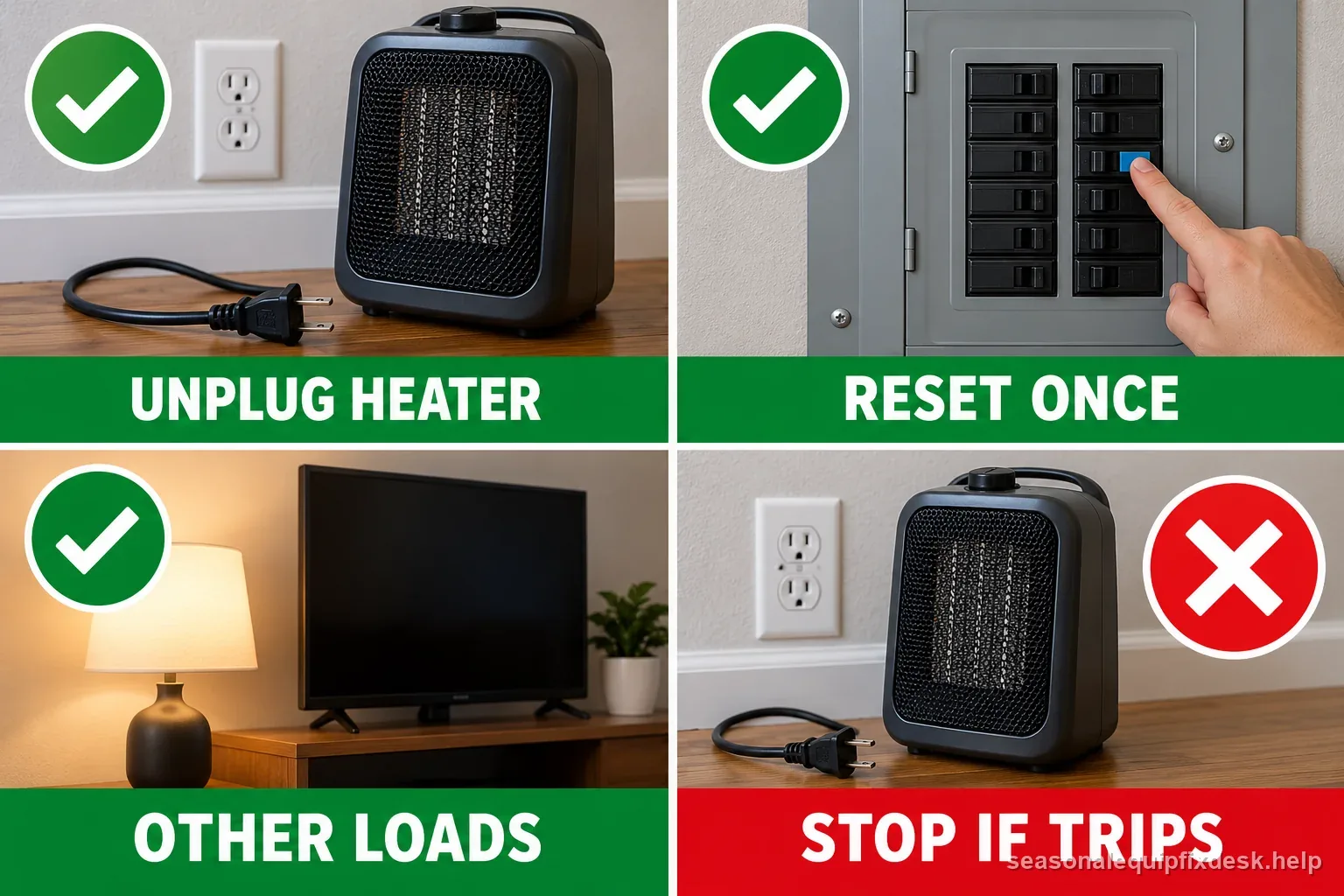
An immediate trip is a stop-use symptom
If the breaker opens the moment the heater is switched to heat, unplug the heater and do not keep trying. An internal short, damaged cord, moisture, failed heating element, or wiring fault can cause a rapid trip. Repeated energizing adds stress and can worsen damage.
Inspect the plug and receptacle with power removed
After unplugging the heater, look for darkened blades, melted plastic, a loose receptacle grip, scorch marks, or odor. If the wall outlet shows heat damage, stop using it and have an electrician evaluate the receptacle and branch circuit. A heater should not be used as a diagnostic load on a questionable outlet.
If only the heater plug is damaged, retire or properly service the heater. Do not fit a generic replacement cord unless the manufacturer provides the correct rating, strain relief, and repair method.
Breaker type matters, but the fix is not to defeat it
A breaker may include overcurrent protection only or may also incorporate GFCI/AFCI functions depending on the circuit. Nuisance-looking trips can have different causes, including leakage or arcing that an ordinary overload calculation will not explain. Record any trip indicator the breaker provides and give that information to an electrician.
| What lost power | Observation | Safe next step |
|---|---|---|
| Heater and other devices | They stop together when another load starts | Unplug heater; record the other device; avoid another combined-load test |
| Heater only | Breaker trips at heat startup or after warm-up | Unplug and contact manufacturer service/electrician |
| Outlet or plug looks hot/damaged | Discoloration, looseness, odor, melting, or crackling | Stop use; leave the circuit off if needed; call an electrician |
| Breaker remains tripped without heater | Normal loads removed but circuit will not reset normally | Leave it off; electrician evaluation |
| What happens | Likely branch | Safe action |
|---|---|---|
| Breaker trips as heater turns on | Heater, cord, or outlet fault | Unplug and stop repeated resets |
| Trips when other appliances start | Shared branch load | Note which devices were operating |
| Trips after the heater warms | Heat-related fault or overload | Stop use and record the timing |
| Plug or receptacle is hot or discolored | Connection hazard | Do not reuse; contact a qualified electrician |
A safe load-isolation sequence
- Unplug the heater and let the breaker remain off briefly if the circuit or receptacle is hot.
- Identify other devices that lost power and switch off high-wattage loads on that branch.
- Inspect the heater cord, plug, and receptacle for damage.
- Only if there is no heat damage, odor, looseness, or visible defect, follow the exact manufacturer’s instructions for at most one attended retest at the documented low setting.
- If the breaker trips again, leave it off, unplug the heater, and arrange qualified evaluation. Do not repeat the test.
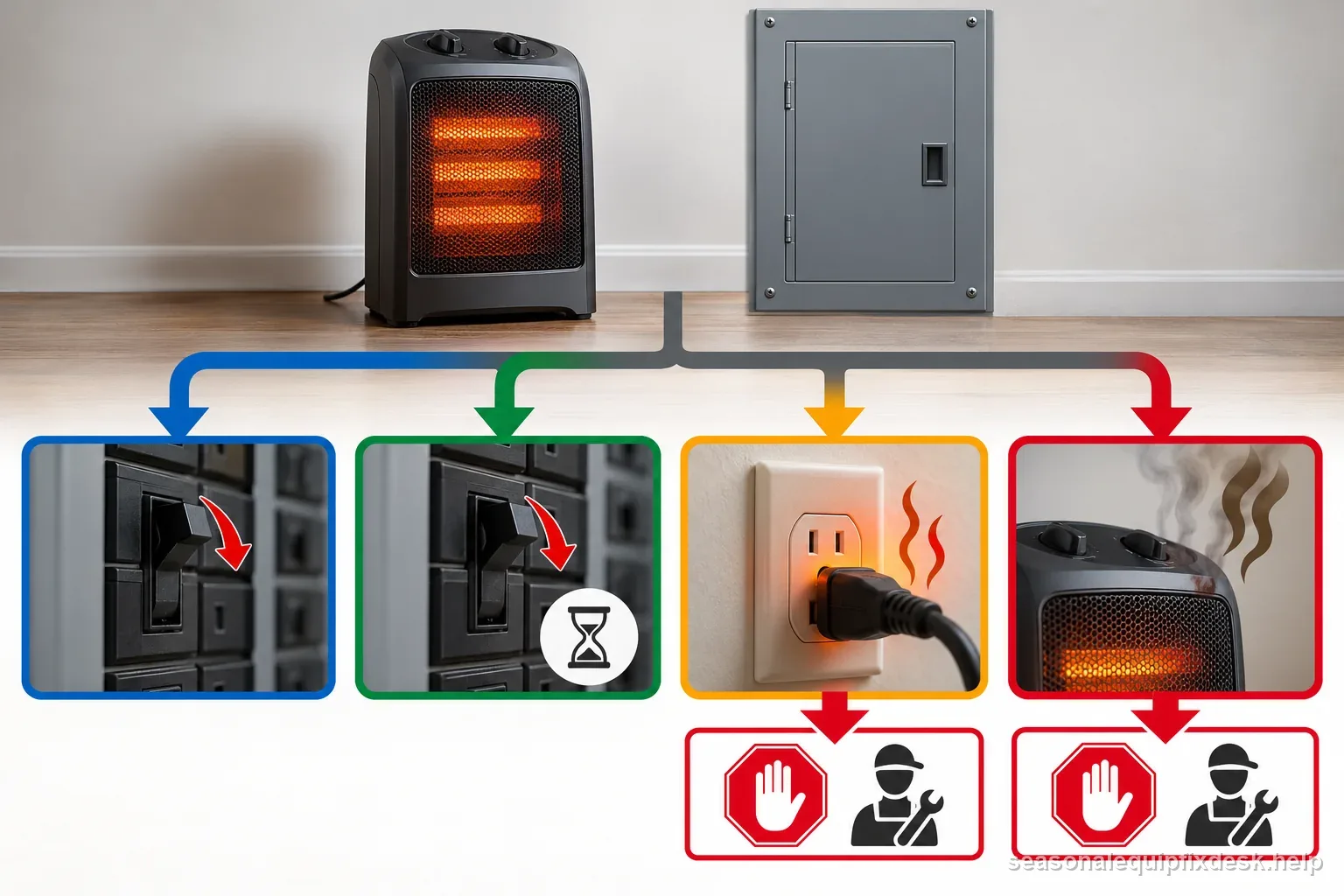
Do not use a different room to hide a heater fault
Do not move a heater that trips, smells burned, has a hot plug, or shows damage to another outlet to keep testing it. Leave it unplugged and have the heater and circuit assessed by qualified service.
Why a warm breaker or outlet changes the decision
Normal circuit components can become slightly warm under load, but obvious heat, discoloration, odor, crackling, or looseness is not something to monitor for another hour. Disconnect the heater. Electrical connections that overheat require correction before any high-current appliance is used there.
When an electrician is the next step
Call an electrician when the breaker trips with multiple normal loads removed, the receptacle is loose or heat-damaged, the breaker shows AFCI/GFCI fault indications you cannot resolve from the panel instructions, or the circuit history is unknown. Do not replace a breaker with a larger one or bypass protective devices.
- Initial symptom and conditions
- Controls, settings, and supply checked
- Inspection finding before adjustment
- Single change made and result
- Any stop condition or unresolved fault
When the heater itself should be retired
Retire or professionally service the heater when its cord or plug is damaged, it trips more than one suitable circuit, there is an immediate trip on heat mode, or the cabinet smells burned. CPSC’s direct-wall guidance is the minimum safe setup; a heater that cannot operate there without opening protection should not be kept in service.
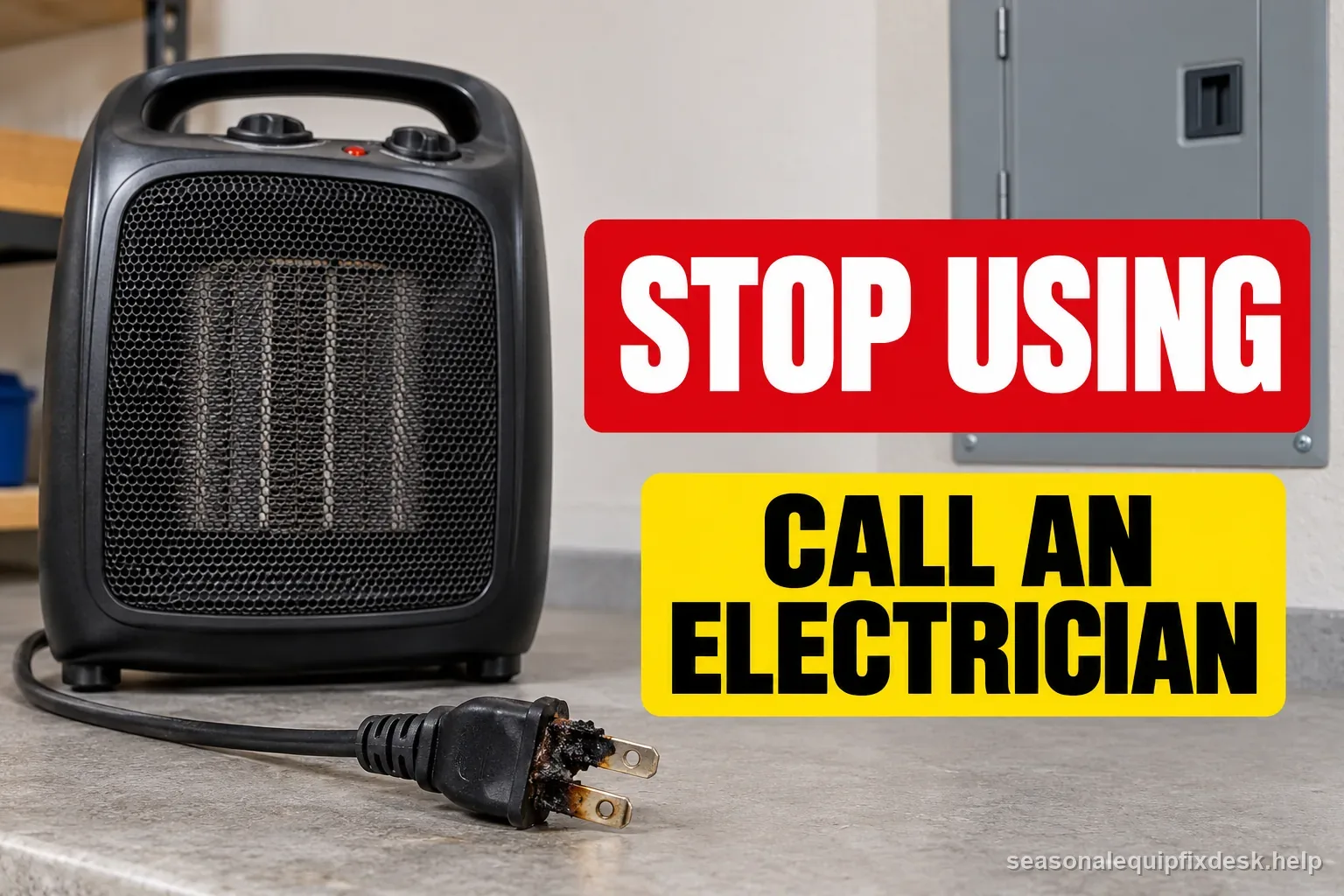
Trip time is useful evidence for an electrician
Write down whether the breaker opens instantly, after several minutes, or only when another appliance starts. Also note the heater’s nameplate watts, heat setting, and which other outlets went dead. An immediate trip and a delayed combined-load trip are not equivalent electrical symptoms. Providing that timing can shorten professional diagnosis without opening the heater or panel yourself.
If the panel breaker is hot, will not reset normally after loads are removed, or shows visible damage, leave the circuit off and call an electrician. The goal is not to prove whether the heater can make it through one more cycle; it is to preserve the protective function of the branch circuit.
Two label calculations explain why shared loads matter
Worked example 1: Dimplex lists model DB4P1500W at 1,500 W and 120 V. Using current = watts ÷ volts gives 1,500 ÷ 120 = 12.5 A for that model. This is a nameplate example, not a statement that a particular branch can safely supply it; the electrician must assess the installed wiring and other loads.
Worked example 2: For an arithmetic illustration only, if a heater label says 1,500 W and a separate appliance label says 900 W, their combined stated load is 2,400 W; at 120 V, 2,400 ÷ 120 = 20 A. Do not recreate this combination to test a breaker. Record the labels and which devices were on when the trip occurred, then follow the heater maker’s safety directions.
If a heater trips and then runs its fan without heat, see safe checks for a space heater with no heat.