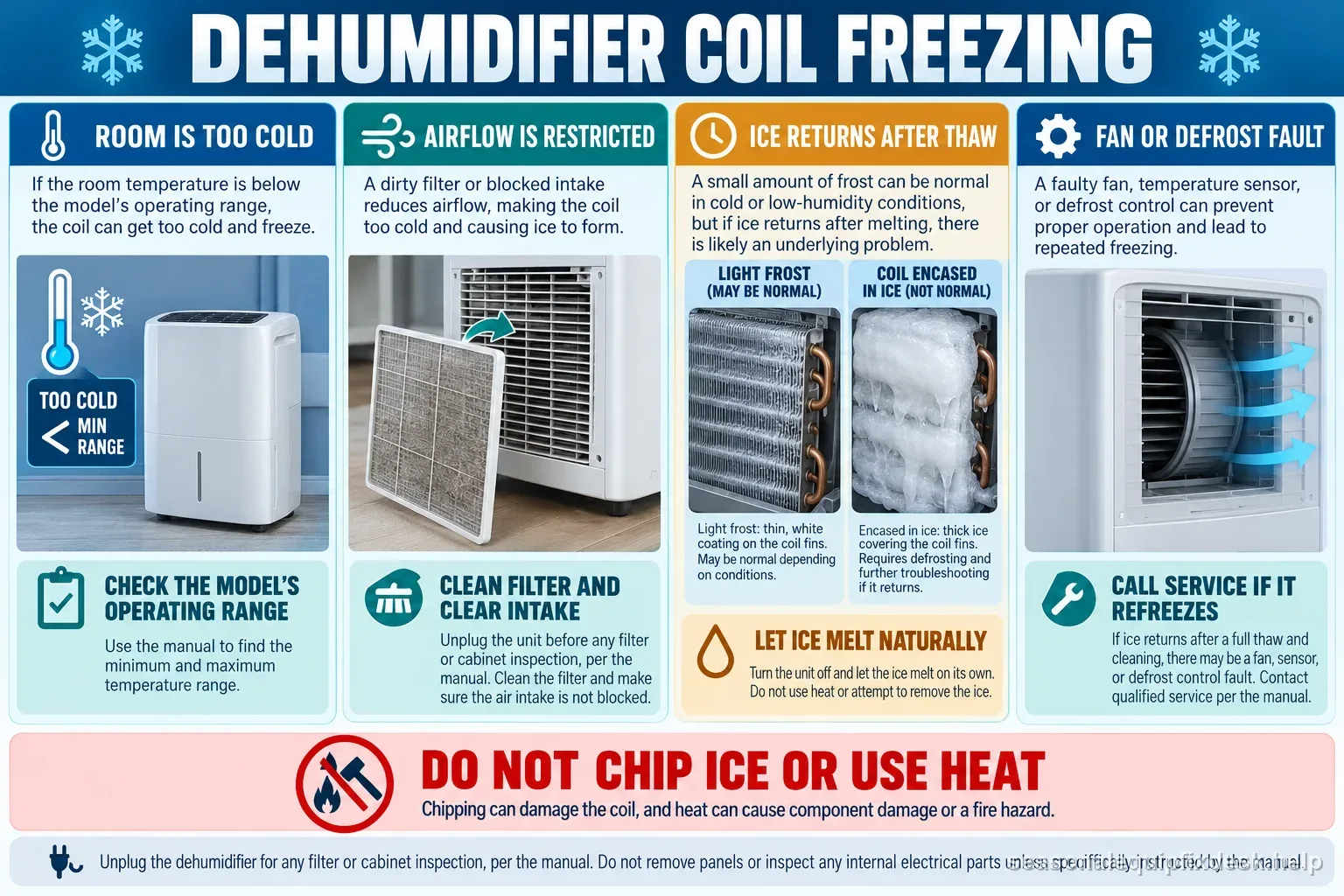
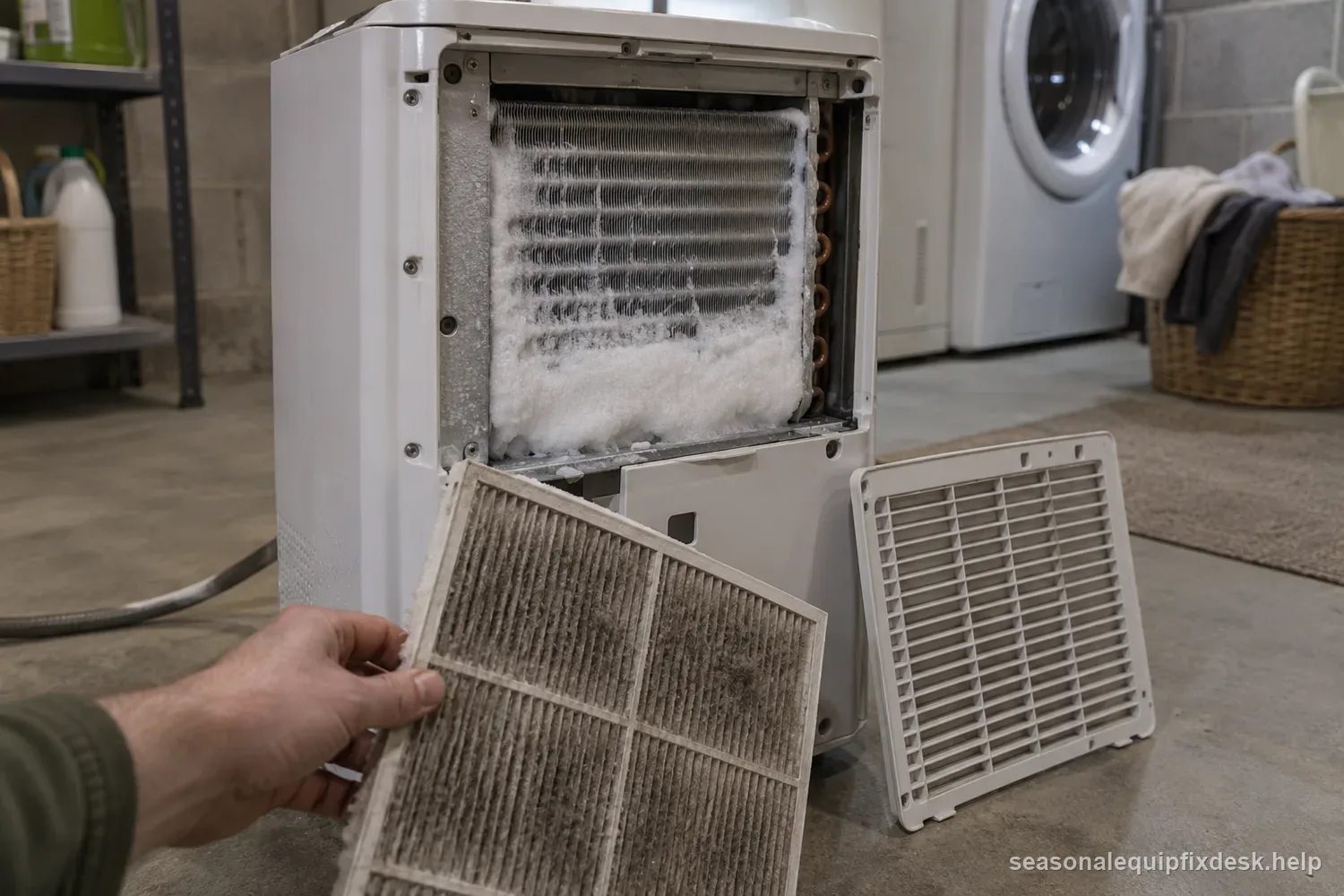
Quick answer: Light frost can be part of normal dehumidifier operation, but a coil packed in ice is not. Start with room temperature and airflow. A cold room, dirty filter, blocked intake, or poor clearance can drop the evaporator below freezing faster than the unit can defrost it. If those conditions are correct and heavy ice returns, a sensor or sealed refrigeration fault moves higher on the list.
If the display and fan never start after a normal shutdown, use the dehumidifier no-power sequence before treating ice on the coil as the only problem.
A unit that runs but leaves the bucket empty can be explained by setpoint, room temperature, airflow, or drainage before the coil itself is faulty. See the dehumidifier that runs without collecting water guide for the matching checks.
| Coil condition | Possible cause | Safe response |
|---|---|---|
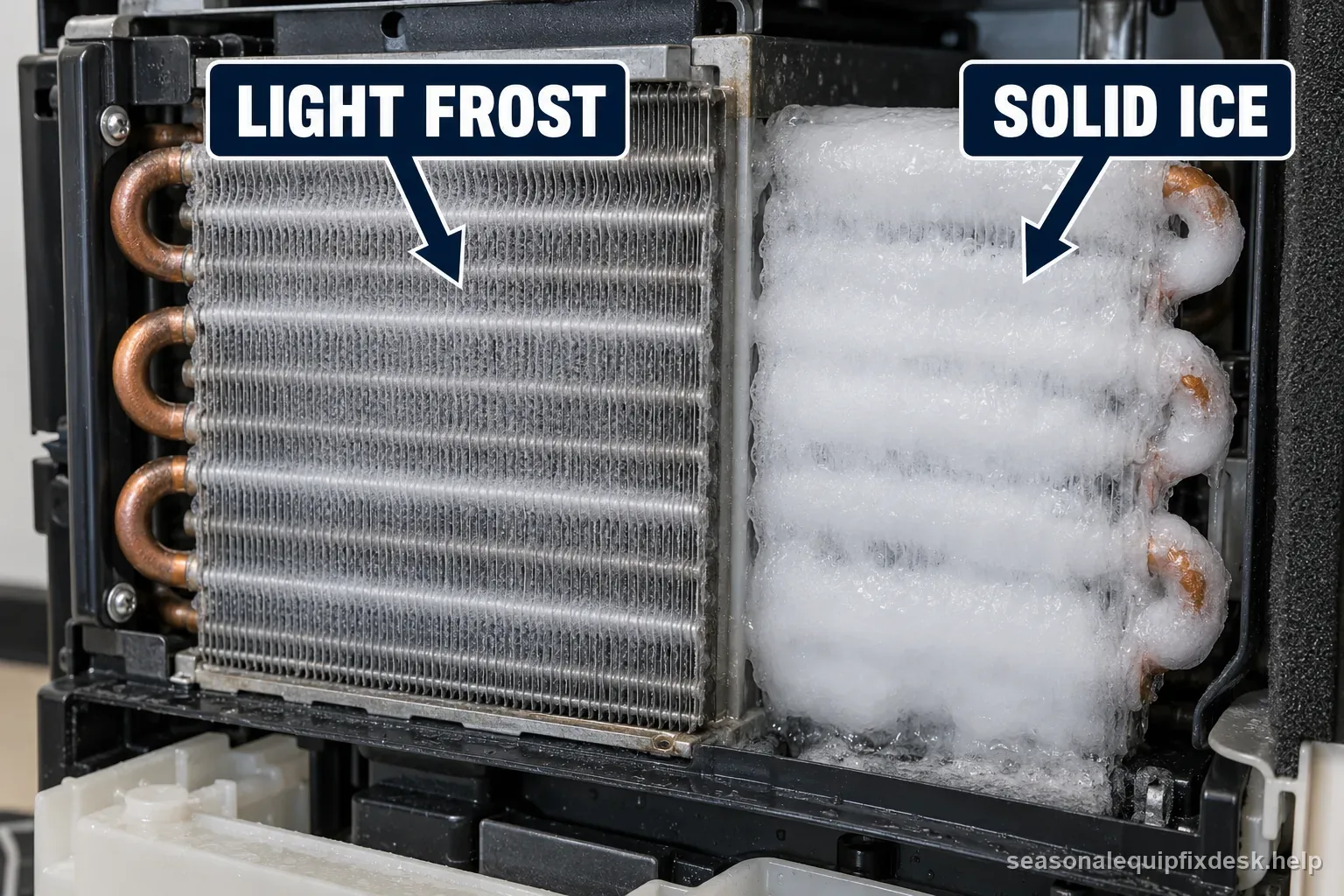
| Brief light frost | Near-freezing coil or cool room | Allow normal frost-control cycle |
| Heavy ice across coil | Low room temperature or restricted airflow | Turn off, unplug, fully defrost |
| Frost returns after cleaning | Clearance, sensor, fan, sealed-system fault | Use manual; arrange service |
| Water after defrost | Melted ice draining from cabinet | Protect floor; keep controls dry |
Distinguish a thin frost film from an ice block
Frigidaire notes that light frost can appear under some normal conditions because the evaporator operates close to freezing. The unit should detect frost, stop the compressor as needed, and allow the coil to warm. Heavy ice that thickens over repeated cycles, covers large sections of the coil, or returns quickly after thawing deserves diagnosis.
Measure the room temperature before touching the cabinet
Portable dehumidifiers have lower ambient-temperature limits. Frigidaire’s current support article cites 41°F as the low limit for affected models. An unheated basement or garage can spend hours near that range overnight even when daytime temperature seems acceptable. Use the exact owner manual for your model’s minimum.
If the room is too cold, do not try to defeat defrost. Raise the room temperature or use equipment designed for cooler spaces.
Airflow problems create their own freeze cycle
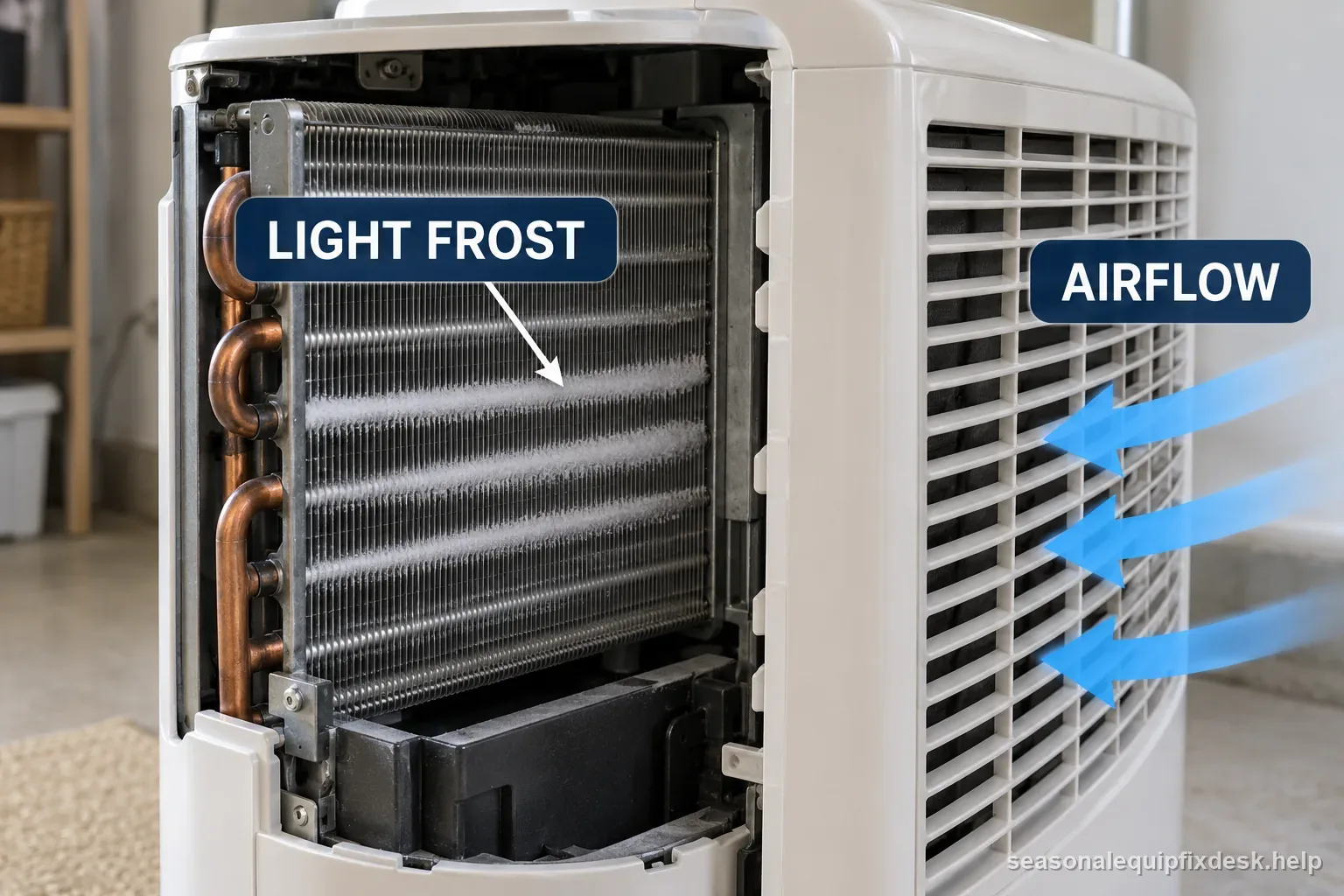
Unplug the unit and remove the filter. If it is coated with lint or dust, clean or replace it as specified. Inspect the air inlet and outlet for boxes, curtains, wall proximity, pet hair, or debris that limits flow. The evaporator needs a steady stream of room air to absorb heat; starve that airflow and the coil can become colder while moisture freezes instead of draining.
Restore the required cabinet clearance. A dehumidifier pushed tightly into a corner can recirculate its own discharge or restrict inlet area even when the filter itself is clean.
Let the ice melt naturally before judging the next cycle
Turn the unit off and disconnect power. Allow the coil to thaw completely with a towel or tray ready for runoff. Do not chip ice with a screwdriver, knife, or heat gun. The aluminum fins and refrigerant tubes are easy to damage, and a punctured coil converts a cleaning problem into a sealed-system failure.
Once thawed, straighten only superficial fin damage with an appropriate fin comb if the manufacturer permits. Do not bend tubing or probe between sections aggressively.
A clean coil that refreezes unevenly tells a different story
Observe the frost pattern during the next controlled run. Uniform light frost that later clears suggests the defrost logic is working. Ice concentrated on a small section while the rest of the coil stays comparatively warm can indicate abnormal refrigerant flow or charge. That pattern is service evidence, not a cue to add refrigerant yourself.
Check whether the compressor ever receives a defrost pause
Many portable units use a coil-temperature sensor to interrupt the compressor while the fan continues moving warmer room air across the frost. If the coil becomes a solid block and the compressor never pauses under conditions where the model should defrost, the sensor, its mounting, wiring, or control may be suspect.
Do not jump the sensor or force continuous compressor operation. The protection is there to prevent a frozen evaporator from remaining locked in an ineffective state.
Continuous mode can expose a marginal condition
A very low humidity target or continuous setting keeps the refrigeration cycle working harder than a moderate setpoint. Frigidaire recommends moving away from continuous mode in some frost-troubleshooting cases. For diagnosis, select a normal humidity target and see whether the unit can cycle and defrost correctly.
A controlled freeze test
- Thaw the coil fully with power disconnected.
- Clean the filter and restore manufacturer clearances.
- Record room temperature and humidity.
- Choose a normal humidity target rather than the most aggressive continuous setting.
- Run the unit and note when frost first appears, whether the compressor pauses, and whether the frost clears.
- Stop if heavy ice returns before the unit completes a normal defrost cycle.
Why ice also reduces water collection
Once the coil is buried in ice, room air cannot contact the evaporator efficiently and liquid water cannot drain normally. The fan may still sound healthy, yet bucket collection falls. Fixing the reason for icing is therefore more useful than treating “no water” and “frozen coil” as two unrelated faults.
- Initial symptom and conditions
- Controls, settings, and supply checked
- Inspection finding before adjustment
- Single change made and result
- Any stop condition or unresolved fault
When the diagnosis belongs to service
Call for service or replace the appliance when the room is within range, airflow is clean, the coil is fully thawed, and heavy icing still returns with abnormal frost distribution or no apparent defrost response. Refrigerant charging, sealed-system opening, and energized sensor-board testing are not routine homeowner tasks.
Some light frost can appear briefly because the evaporator runs near freezing, and frost controls may pause the compressor to defrost it. Heavy ice or repeated frosting after a full thaw, clean filter, and clear airflow is a service clue; do not chip the coil, use a hair dryer, or open the refrigerant system.
Dirty evaporator fins can remain restricted after the filter is cleaned
A neglected filter sometimes allows fine dust to reach the coil face. Even after the filter looks clean, a matted evaporator can still restrict airflow and promote frost. Inspect the accessible coil surface with power disconnected. If the model permits coil cleaning, use the stated method and avoid soaking motors, controls, or sensors. Deeply embedded dirt or bent fins across a large area can justify professional cleaning rather than aggressive brushing.
After cleaning, watch both frost and drainage. Meltwater should leave the coil and reach the drain pan instead of refreezing in a blocked trough. A clogged drain does not usually create the original cold coil, but retained water and ice around the lower coil can make a marginal freeze problem look worse.