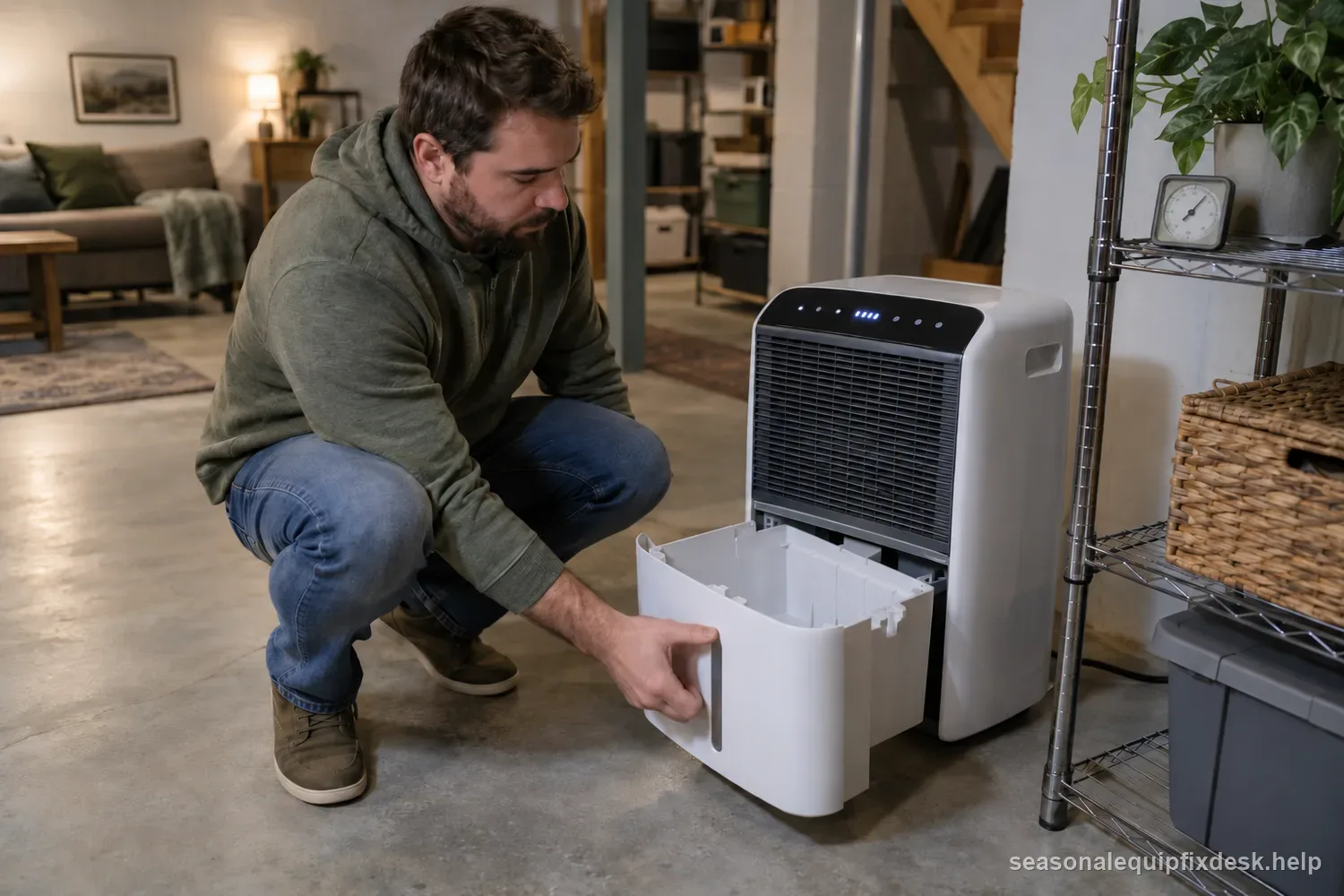
Quick answer: First decide whether the machine has a reason to collect water. If room humidity is already below the setpoint, an empty bucket can be normal. If the room is clearly damp and the fan runs but the bucket stays dry for hours, check the humidity setting, ambient temperature, filter and airflow, compressor behavior, and whether water is being sent through a hose instead of into the bucket.
A unit that never powers on needs the separate dehumidifier no-power checks, including outlet, bucket seat, and restart delay.
| Observation | Check first | What it tells you |
|---|---|---|
| Room RH below target | Compare room reading with setpoint | Compressor may be cycling normally |
| Fan runs; no bucket water | Mode, bucket seat, filter, room temperature | Airflow and controls matter |
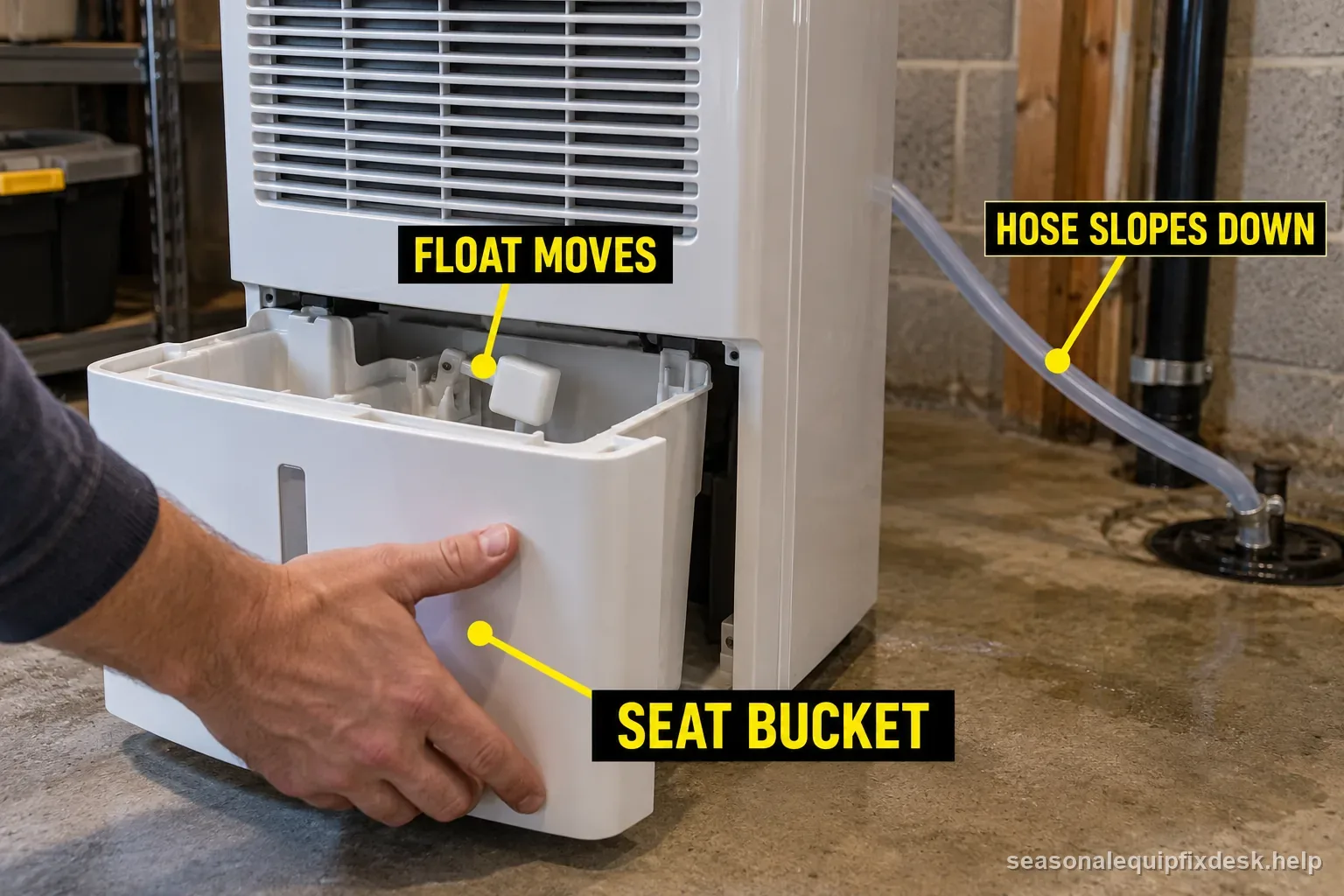
| Continuous drain used | Hose slope, kink, plug, outlet height | Water may bypass or back up |
| Never collects under demand | Reset per manual; check error light | Warranty/service may be needed |
Confirm the room is humid enough to demand extraction
A dehumidifier is controlled by relative humidity, not by how damp a basement feels. GE specifically notes that a unit will not collect water when room humidity is below the selected level. Compare the display with a separate hygrometer and temporarily choose a lower humidity target or continuous mode if the model provides it.
Give the unit enough time after moving or changing settings. Short observations can be misleading because compressor protection delays may prevent an immediate restart.
- ObserveIdentify the humidifier type and the exact symptom.
- InspectCheck the tank, base, water path, and relevant sensor or output part.
- IsolateCheck scale, wick, setting, or placement for this model.
- Retest or stopRun the controlled test described for the complaint. Stop if the remaining fault involves electronics or unsafe leakage.
Fan noise does not prove the compressor is running
Many dehumidifiers keep the fan operating for circulation or sensor sampling while the compressor is off. After the delay period, listen for the deeper compressor sound and feel whether the air leaving the unit becomes warmer than room air. A running refrigeration system usually rejects heat into the room as it condenses moisture.
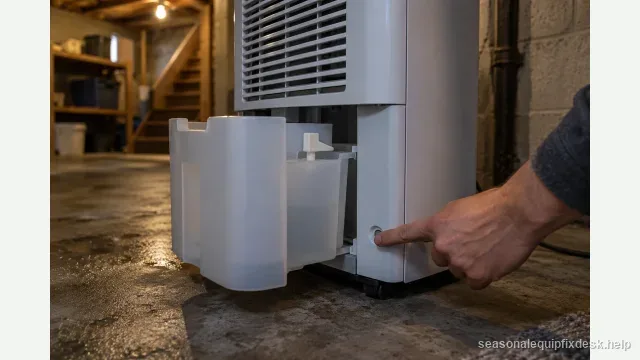
If the fan runs indefinitely with no compressor sound, check the bucket position, full-bucket switch, setpoint, timer, and displayed fault code before assuming sealed-system failure. Some controls will block compressor operation even though the fan still turns.
Room temperature can move the unit into defrost instead of drying
A dehumidifier’s evaporator runs cold. At low room temperatures, frost can form and the machine may cycle the compressor off to defrost. Frigidaire notes that low ambient temperature promotes frost and identifies 41°F as a lower limit in its current support guidance for certain portable dehumidifiers. Your exact model manual controls its permitted range.
If the basement is near the model’s lower temperature limit, warming the space or using equipment designed for cooler operation may be more effective than replacing parts.
Restricted airflow can make the cold coil too cold
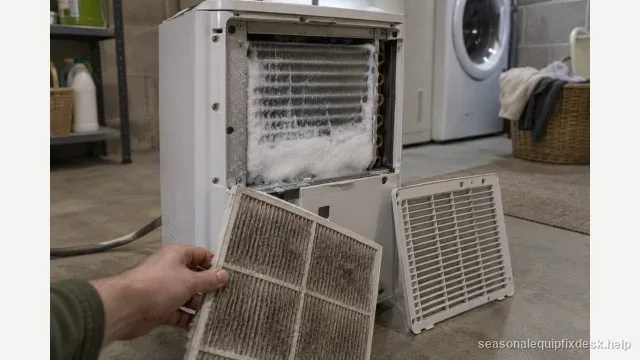
Unplug the dehumidifier and inspect the filter, inlet, and outlet. A loaded filter reduces airflow across the evaporator, which can encourage icing and reduce water collection. Clean the filter using the method in the manual and maintain the clearances specified around the cabinet.
Do not run the unit with the filter removed as a permanent fix. The coil can load with dust, creating a harder-to-clean restriction and reducing heat transfer.
Make sure the water is not bypassing the bucket
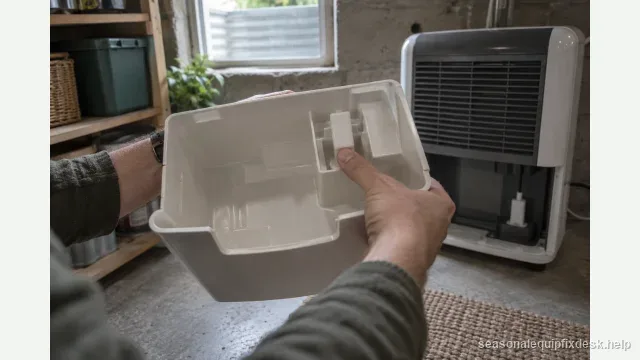
If a gravity drain hose is attached, the bucket may remain empty even when the unit is working. Inspect the hose route for a continuous downhill slope, kinks, a loose connection, or a drain end submerged in water. GE’s drain guidance notes that poor routing and hose problems can prevent proper gravity drainage.
For pump-equipped models, use the model’s pump test and hose-height limits. Do not judge extraction solely by the bucket level when an alternate drain path is active.
Use coil behavior as evidence
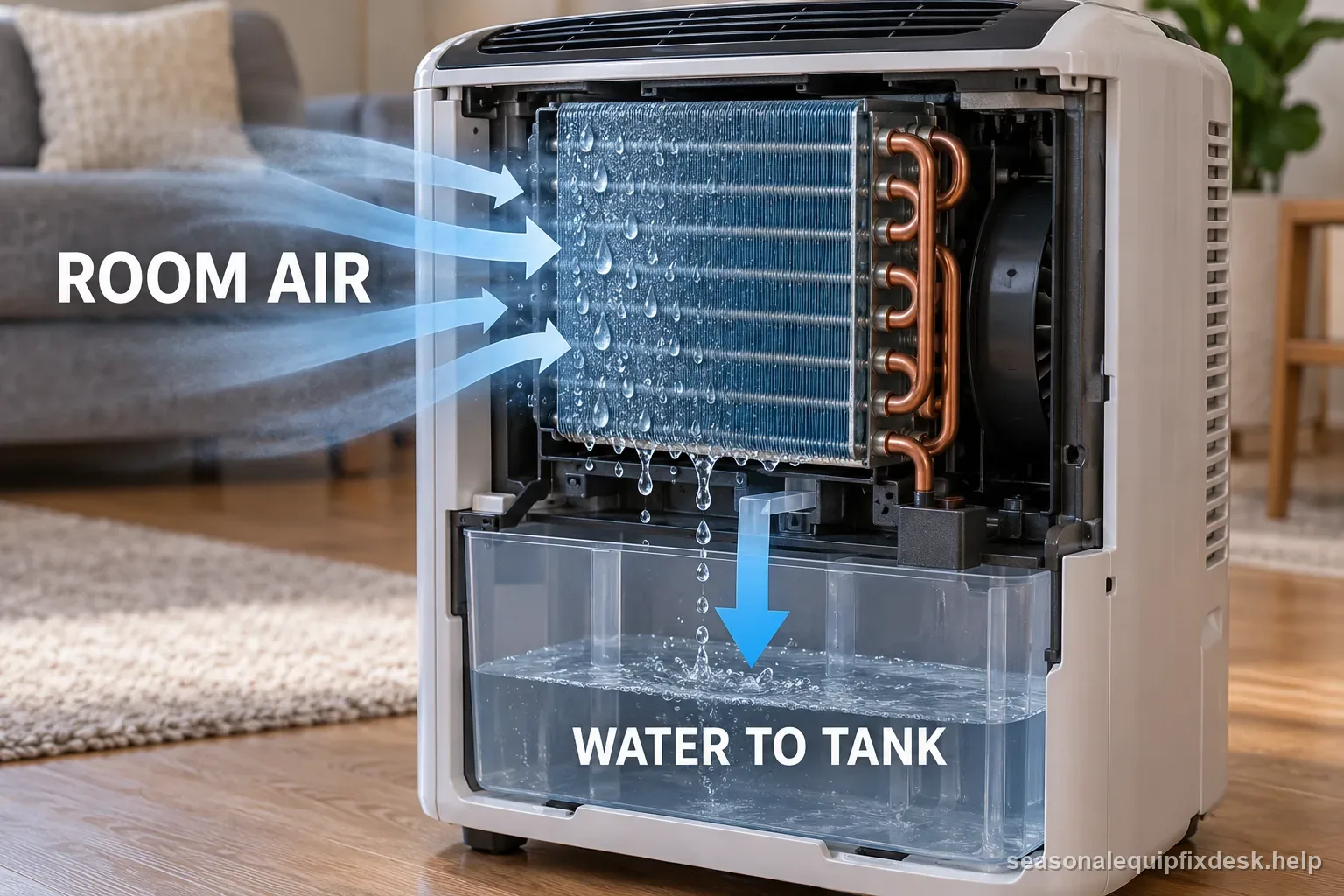
- Coil becomes cold and sweats, water reaches bucket: refrigeration cycle is functioning; compare extraction rate with room humidity and temperature.
- Coil frosts heavily: clean airflow restrictions and verify the room is within the operating temperature range.
- Fan runs but coil never gets cold: confirm compressor demand and delay; then move toward compressor/start/control or sealed-system service.
- Compressor repeatedly clicks and stops: disconnect and service rather than repeatedly cycling power.
- Oily residue or damaged refrigerant tubing: stop DIY work; sealed-system repair is for qualified service.
A reset is a diagnostic step, not a repair
GE suggests disconnecting power for about 30 seconds as an initial reset on some units that are not collecting water. A reset can clear a control state, but it does not fix low refrigerant, a failed compressor, blocked airflow, or a bad sensor. If the symptom immediately returns under known humid conditions, continue with evidence rather than repeating resets.
Do a measured two-hour test
- Place the unit level with clean filter and required clearance.
- Close nearby doors and windows so outdoor moisture does not continuously change the test.
- Record room temperature and relative humidity from a separate meter.
- Set a humidity target clearly below the measured room value and allow any compressor delay to expire.
- After two hours, record whether the compressor ran, whether the coil became cold, and how much water appeared in the bucket or drain.
That log is enough to separate a no-demand condition from a refrigeration problem. It is also useful information for warranty support.
A humidifier can operate without visible mist or measurable room change. Identify the design and symptom before replacing a cartridge or treating an indicator as a universal code.
When replacement or service is the better next step
Stop if the compressor will not run despite correct controls, the coil never cools, the unit shows a persistent fault code, refrigerant tubing is damaged, or electrical parts overheat. Many portable dehumidifiers are not economical homeowner repairs once the sealed refrigeration system or control board fails.
GE notes that a unit may collect no water when room humidity is already below its setting, and Frigidaire distinguishes bucket collection from continuous drain setup. Test in a closed, humid room with the target below measured humidity; check the bucket and hose before concluding the sealed system has failed.
Compare inlet and outlet air instead of relying on bucket volume alone
During active dehumidification, room air crosses a cold evaporator and then a warm condenser. That sequence often makes discharge air feel warmer and drier than inlet air. You do not need to open the cabinet to use this clue: note whether the compressor is audibly running and whether the outlet temperature changes after several minutes. Fan-only airflow with no temperature change is evidence that the refrigeration stage may not be active.
Do not expect the same water volume every day. Extraction falls as room humidity falls and changes with temperature. The meaningful failure is a damp room with confirmed humidity demand, correct airflow, and no refrigeration response—not simply “today’s bucket has less water than yesterday’s.”
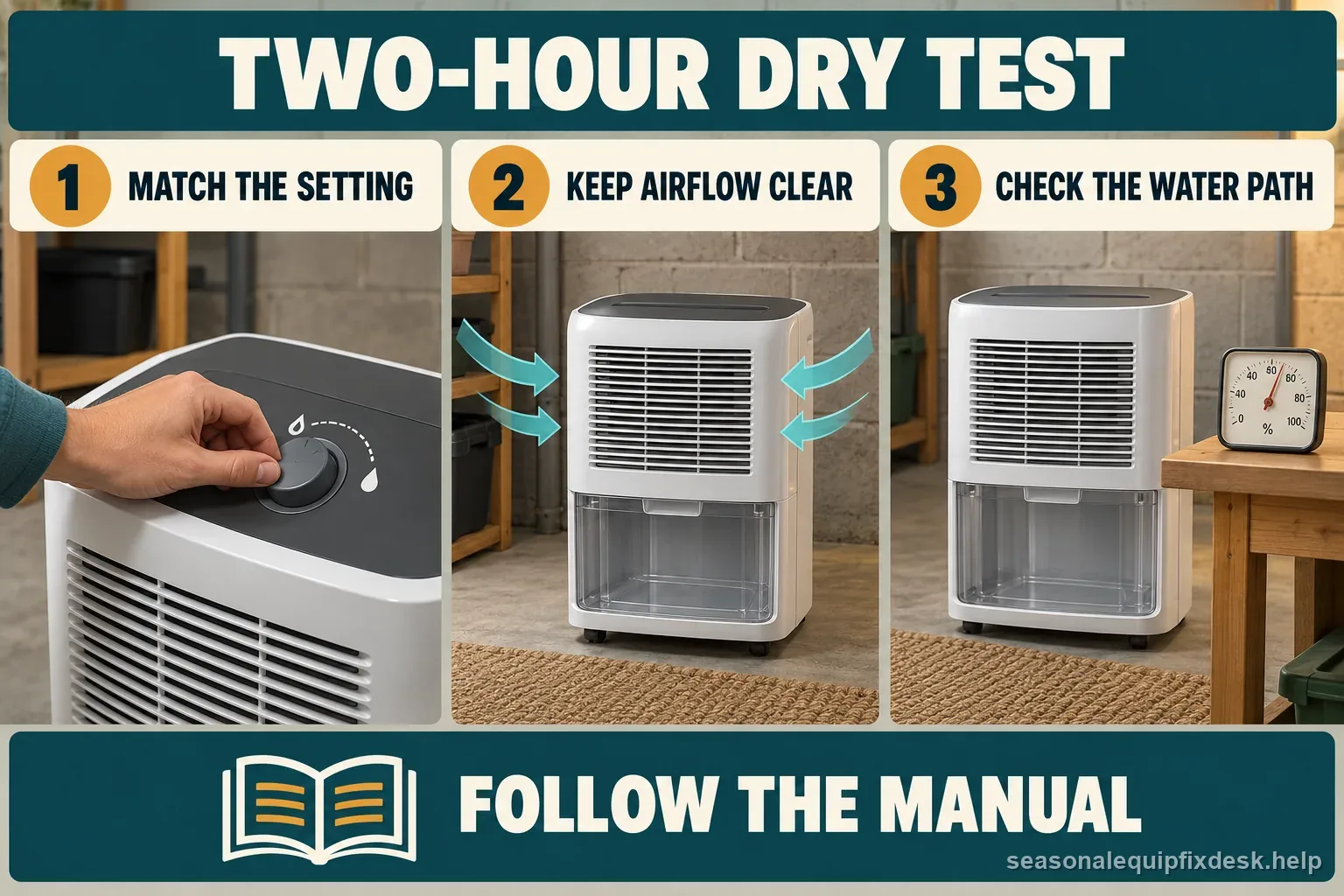
Use this as a visual summary; follow the exact equipment owner manual for any operation or maintenance.