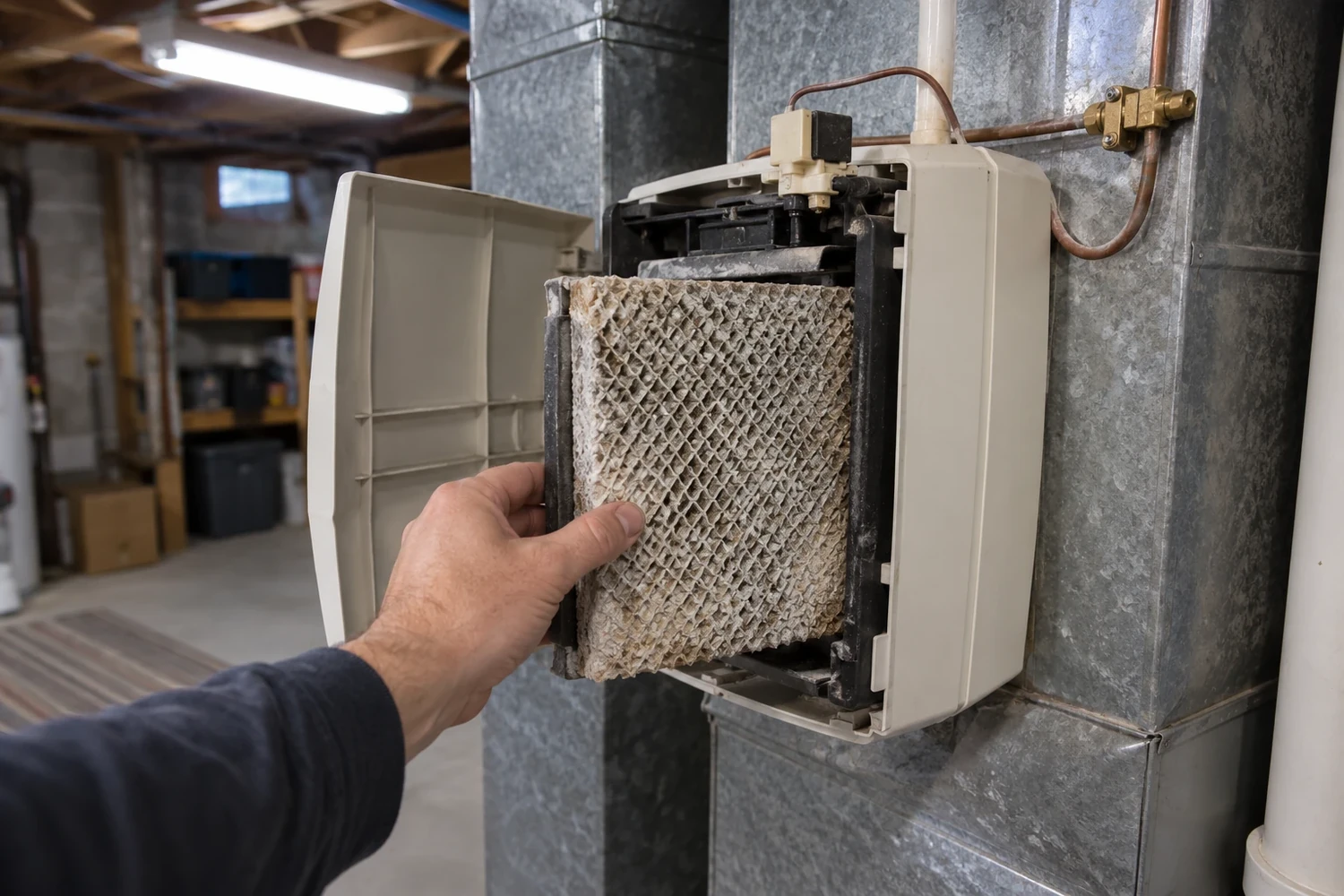
Quick answer: A furnace-mounted (whole-house) humidifier is not the same machine as a portable ultrasonic or evaporative unit, and it fails differently. It only produces humidity while three conditions are all true at once: the furnace blower fan is running, the humidistat is calling for more moisture than the room currently has, and water is actually reaching the water panel. Confirm those three before opening anything up.
Furnace humidifiers mount to the supply or return plenum and use the furnace's own airflow to evaporate water across a pad, or bypass a small amount of duct air across a rotating water panel. Because they depend on the furnace fan, a furnace humidifier that seems dead during a mild week when the furnace barely runs is not necessarily faulty — check whether the fan is cycling at all first.
Which type you actually have changes the check
Bypass humidifiers use house static pressure to push a small amount of heated duct air across a stationary water panel, then return that humidified air to the return duct — they have no fan of their own and rely entirely on the furnace blower's pressure differential. Fan-powered units add their own small fan to push air across the panel, which lets them humidify slightly more air per cycle but adds a second motor that can fail independently of the water side. Drum-style units rotate a foam-covered drum partly submerged in a water reservoir. Knowing which type is mounted on your furnace tells you whether a second, separate fan motor is even a possible failure point before you start checking water flow.
Step 1: confirm the fan is actually running
Most residential furnace humidifiers only humidify while the furnace blower is moving air, because that airflow is what carries moisture into the house. According to the manufacturer's own FAQ guidance, the humidifier control requires the HVAC system fan to be operating, a water supply, and a heat source in order to create humidity. If the thermostat fan setting is on "auto" and the furnace is not actively heating, a bypass-style humidifier will do nothing — that is normal operation, not a fault.
Step 2: listen for the solenoid valve
The water solenoid is the small electrically-controlled valve that opens the water line to the distribution tray or water panel. Increase the humidistat's setpoint while the furnace fan is running and listen at the valve body. Official guidance states that if the water solenoid valve does not make a clicking sound when the humidity level is increased while the HVAC system fan is operating, the solenoid valve may require replacement. No click at all with the fan confirmed running points at the solenoid, its wiring, or the transformer feeding it — not at the water panel.
Step 3: check the water panel and saddle valve
If the solenoid clicks but no water reaches the unit, the blockage is downstream. The saddle valve — a small fitting that pierces a copper water line to tap a supply — can have its own pierced orifice clog with sediment over time, and an inline strainer or filter on the same line can clog independently. The water panel (evaporator pad) itself is a seasonal wear item: it is designed to be used for one humidifier season and replaced, not reused indefinitely. A panel loaded with mineral scale from hard water will not pass water evenly even when the solenoid and supply line are both working correctly.
When the complaint is leaking instead of no output
Furnace humidifiers that drain to a floor drain or condensate line use a deliberate flushing action rather than being a sealed system. Bypass, drum, and fan-powered drain-through models are designed so that the water going down the drain line serves the function of flushing away mineral deposits — some visible water at the drain during operation is by design, not a leak. A genuine leak is usually one of three things instead: a cracked or warped water panel that no longer seats in its frame, a drain line that is kinked, frozen, or blocked and backing water up into the cabinet, or a saddle-valve fitting that was never fully seated when it was installed and is weeping at the puncture point.
Where a drum-style unit leaks differently
A drum humidifier's reservoir uses a float mechanism, similar in concept to a toilet tank float, to hold a fixed water level. A stuck or misadjusted float valve can let the reservoir overfill past its designed level, and once water rises above the drum housing's seal line it will find a way out around the drum shaft or the reservoir seam rather than through a drain line at all. If the leak point traces to the base of the unit rather than a drain hose, check the float and its water-level adjustment before assuming a cracked reservoir.
Seasonal timing matters
Because the water panel is a single-season consumable and the unit sits idle and dry for most of the year, both "stopped working" and "suddenly leaking" complaints cluster at the start of heating season, right after the humidifier is switched back on for the first cold snap. If the unit worked fine last winter and was simply turned off for summer, start with a fresh water panel and a solenoid test before assuming a mechanical failure — a full season of dry mineral crust sitting in the old panel is the single most common cause of a "working last year, dead this year" complaint.
What not to do
Do not bypass the humidistat or wire the solenoid to stay open continuously to "force" output — a stuck-open solenoid combined with a failed overflow drain is a water-damage risk, not a fix. Do not increase the humidistat far past the manufacturer's recommended range to compensate for a weak unit; excess indoor humidity in winter condensates on cold windows and inside exterior walls, which is a moisture problem in its own right. If the fan runs, the solenoid clicks, and the panel is fresh but output is still weak, the fault has narrowed enough that a technician visit is more useful than continuing to guess.
A start-of-season routine that catches most of this before it's a complaint
Because the water panel, the solenoid, and the saddle valve all sit idle and dry through the off-season, the single most effective thing a homeowner can do is treat the first cold week of the year as a scheduled inspection rather than waiting for a symptom. Replace the water panel before the season starts rather than after output looks weak, since a panel that's been sitting dry all summer often looks fine by eye while already being partially clogged with the mineral scale left behind from last winter's water. Run the solenoid test — humidistat up, furnace fan running, listening for the click — as part of that same visit, since it takes under a minute and rules out the single most common electrical fault before it has a chance to show up as a cold, dry house in January.
It's also worth checking the saddle valve's own shutoff at the same time, opening and closing it once to confirm it isn't seized from a full season of disuse, and inspecting the drain line for any visible kinking where it exits the humidifier cabinet, particularly if the line runs through an unheated space where a full freeze could have deformed the tubing over the summer. None of these checks require removing the humidifier from the furnace or any specialized tools — a flashlight, the humidistat dial, and about ten minutes is enough to turn most furnace-humidifier complaints from a mid-winter emergency call into something ruled out before the first cold snap ever arrives.
When to bring in an HVAC technician instead of continuing to self-diagnose
The checks in this guide cover the parts a homeowner can safely access and test without opening the furnace cabinet itself: the fan requirement, the solenoid's click, the water panel's condition, and the visible drain and saddle-valve connections. If those are all confirmed and the unit still isn't performing — or if diagnosing the issue would require opening the furnace's own control board or tracing low-voltage wiring back through the cabinet — that's the point where a licensed HVAC technician is the more appropriate next step rather than continued self-diagnosis, both for safety around the furnace's electrical and gas components and because a technician can pressure-test the water supply line in ways that aren't practical with household tools.