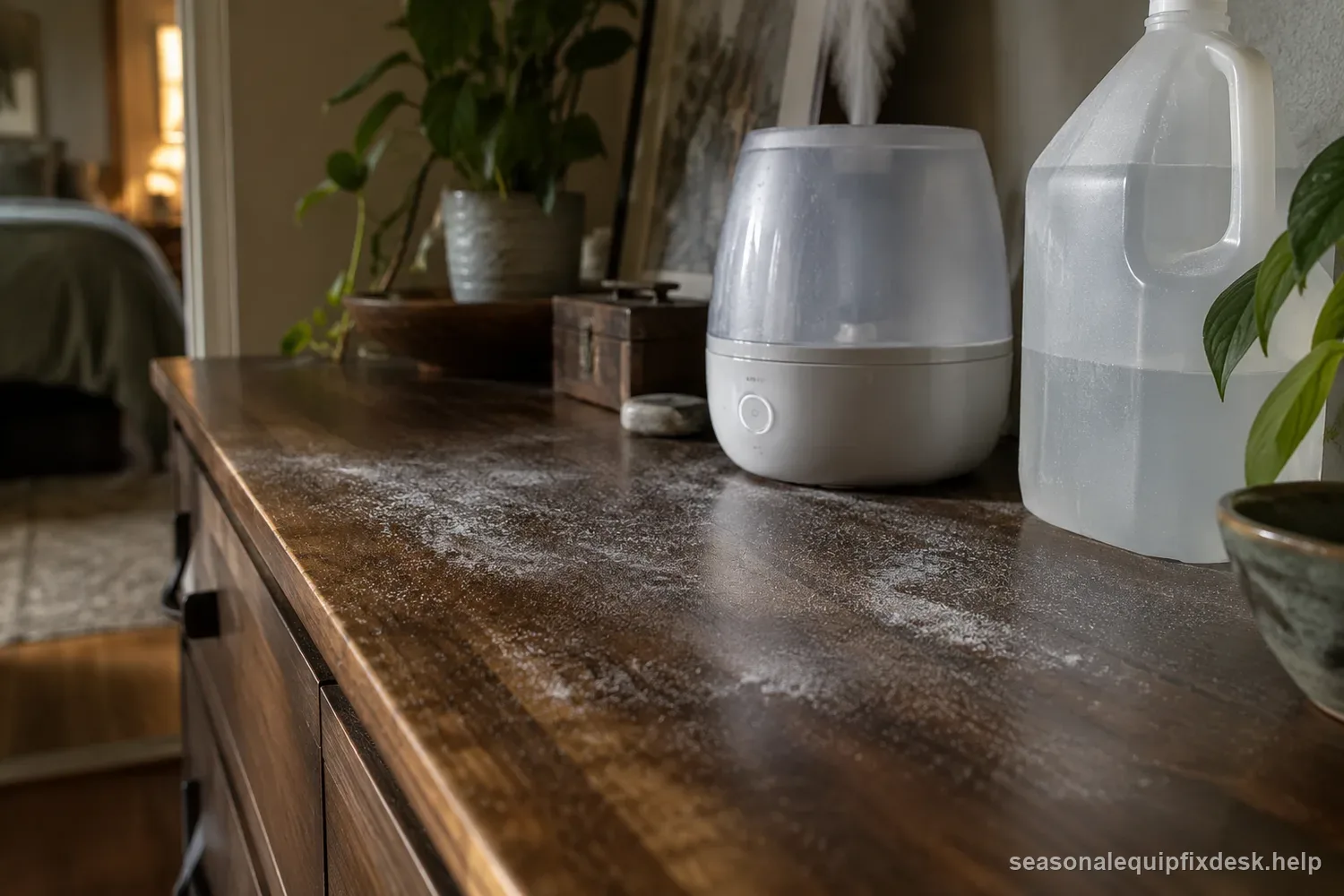
Quick answer: White dust around an ultrasonic or impeller humidifier is usually a mineral clue, not proof that the machine is dirty or growing mold. EPA notes that these designs can disperse minerals from tank water into room air. The fastest controlled test is to clean the unit, switch to bottled water labeled distilled, and see whether new residue drops sharply over the next few days.
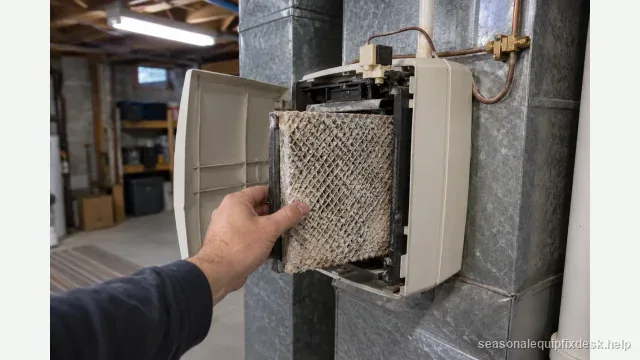
These mineral checks apply to portable room humidifiers. For powder or water around a duct-mounted unit, first identify the source with the whole-house furnace humidifier leak and output checks, since its drain flow can be normal while a cabinet leak is not.
Start by confirming what kind of humidifier is making the residue
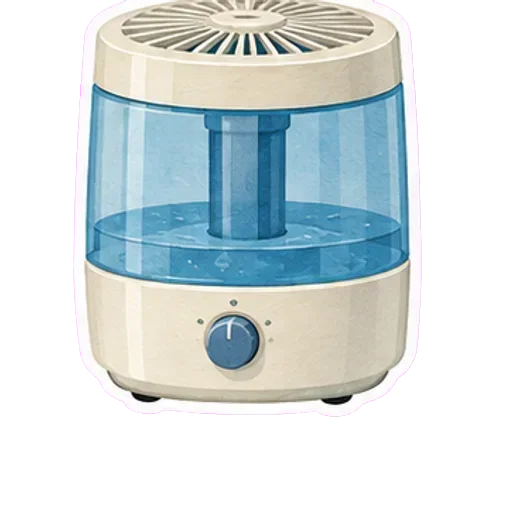
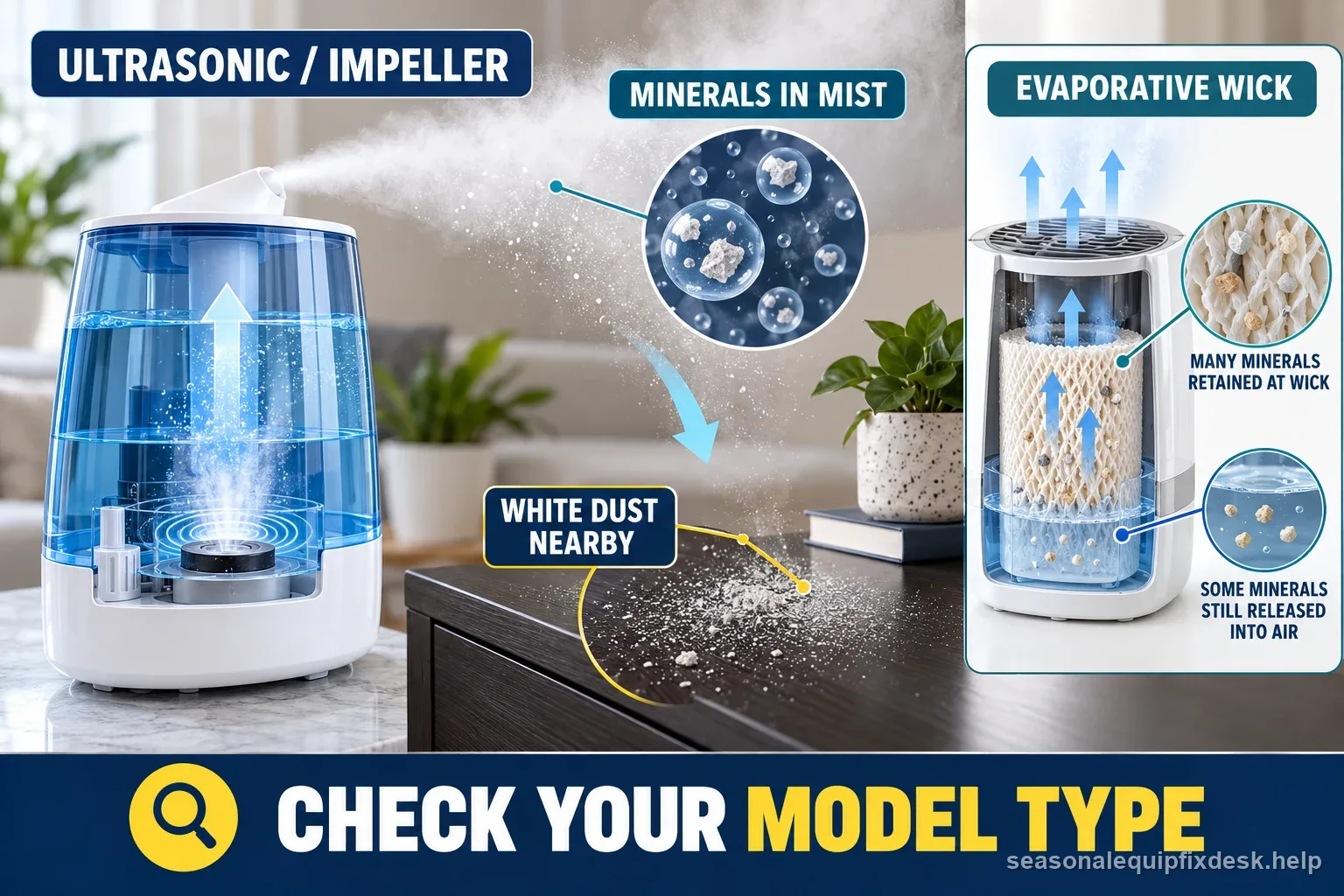
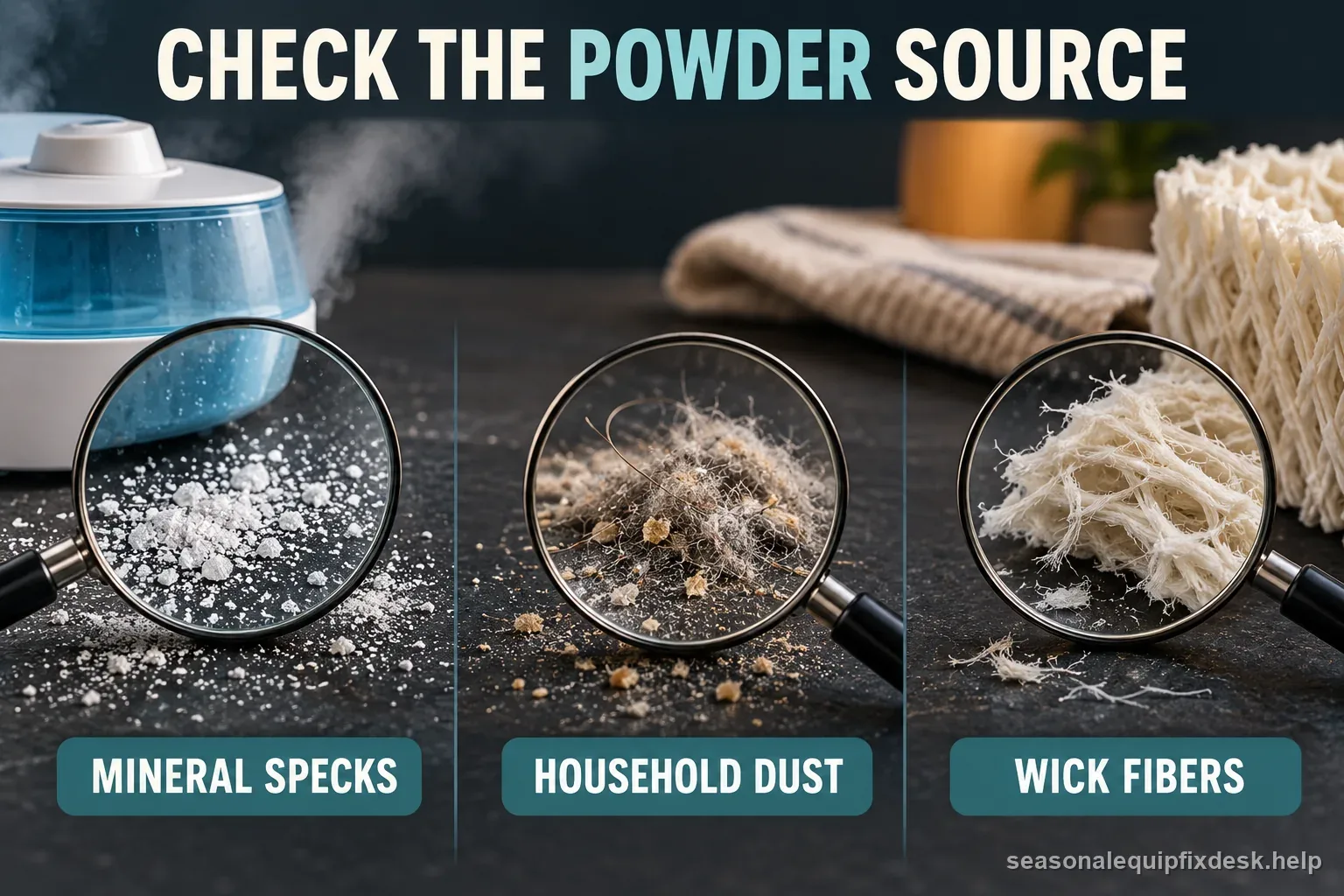
Ultrasonic and impeller units can aerosolize dissolved minerals because droplets leave the machine carrying what was in the water. Evaporative humidifiers behave differently: water is held in a wick while air passes through it, so EPA does not expect them to disperse substantial mineral dust. If an evaporative unit is surrounded by powder, investigate ordinary household dust, wick debris, or another source before blaming water minerals.
| Humidifier design | Mineral dust tendency | What to try |
|---|---|---|
| Ultrasonic cool mist | Can aerosolize dissolved tank minerals | Use lower-mineral water and maintain cleaning schedule |
| Impeller cool mist | Can disperse minerals into the air | Compare distilled water; clean the tank regularly |
| Evaporative wick | Generally disperses fewer minerals | Check wick debris or ordinary household dust |
| Steam vaporizer | Generally disperses fewer minerals, but heats water | Consider burn risk and follow the manual; not a default recommendation |
| Any design with wet surfaces | Output may exceed room’s moisture needs | Reduce setting and monitor room humidity/condensation |
Do the distilled-water A/B test before buying cartridges
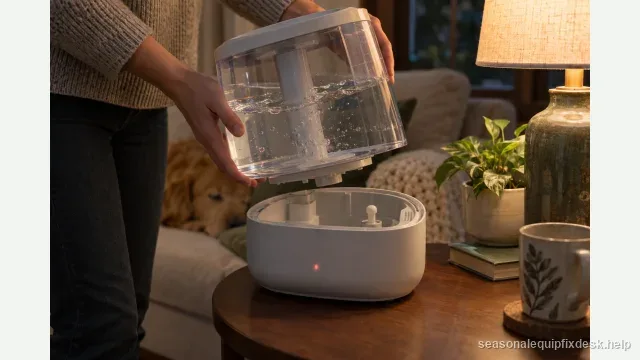
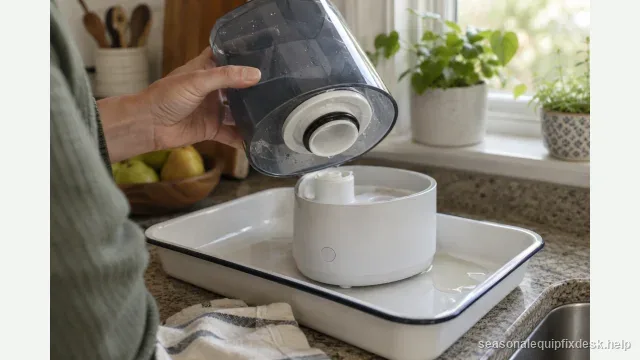
Empty the tank and base, clean them according to the manufacturer’s instructions, and rinse thoroughly. Then run the humidifier with distilled water under roughly the same output setting and room conditions used when the dust appeared. Clean the nearby furniture first so old residue is not mistaken for new deposition.
If new white powder falls dramatically, the original water source is the strongest clue. Distilled water normally contains far fewer dissolved minerals than typical tap water. Bottles marked spring, artesian, or mineral water are not substitutes; EPA specifically distinguishes those from demineralized water.
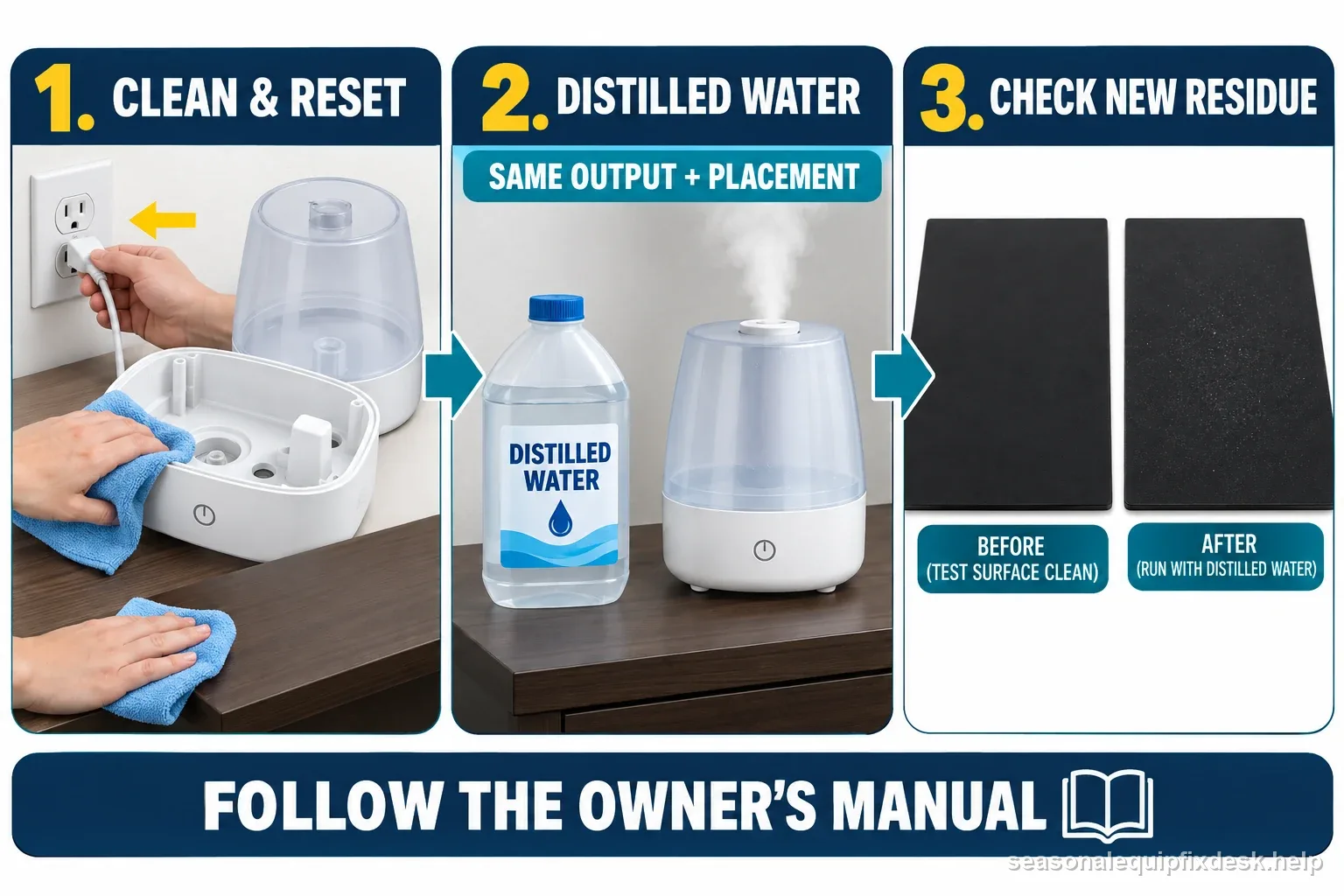
RTINGS’ controlled comparison also varied water mineral content while keeping the ultrasonic unit and test conditions consistent. That supports the same practical method: clean the nearby surface, hold output and placement steady, then compare a low-mineral water source. A small room-to-room test is more informative than changing water, output, cartridge, and cleaning method all at once.
A cartridge is not a guaranteed cure
Some humidifiers accept demineralization cartridges, cassettes, or filters. EPA notes that the mineral-removal performance of these products can vary. Use only the media recommended for the exact model and replace it on the manufacturer’s schedule. If white dust returns well before the stated interval, water hardness and output rate may be overwhelming the media.
Do not improvise by putting water-softener salt, vinegar, cleaning chemicals, or unrelated filters in the operating tank. Descaling is a separate maintenance step and cleaning solution should be rinsed away before the humidifier is used again.
Scale inside the base and dust outside are related clues
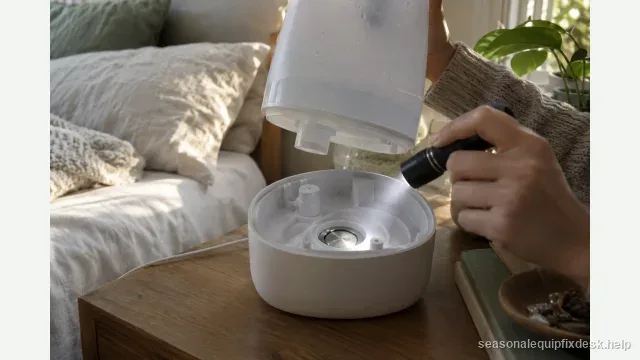
Hard mineral crust in the reservoir or around an ultrasonic transducer indicates the same dissolved solids are concentrating inside the appliance. Scale can reduce mist output and make cleaning harder. EPA recommends regular cleaning and removing scale; the model manual should determine which surfaces can be brushed, soaked, or exposed to descaler.
If the atomizing disc has a delicate coating, never scrape it with metal. A cleaner that is safe for a plastic reservoir may not be appropriate for every sensor, gasket, or plated surface.
Output setting and placement control where the minerals land
High output does not create the minerals, but it can put more mineral-bearing droplets into the room. Aim the nozzle away from walls, electronics, finished wood, and bedding. If the room is already humid, reduce output rather than running a large plume continuously. EPA’s indoor-air guidance generally favors keeping indoor relative humidity below 60 percent, with roughly 30 to 50 percent often cited as an ideal range.
Use this as a visual summary; follow the exact equipment owner manual for any operation or maintenance.
Do not label every pale residue as “white dust”
Mineral dust is typically dry and powdery, and its appearance should track humidifier use. Sticky film, fuzzy growth, dark spotting, or residue limited to one furniture finish may have another cause. If the material appears biological or is associated with water damage, treat that as a moisture problem rather than assuming a water-quality switch alone will solve it.
A useful check is location. Mineral deposition is usually heavier near the humidifier and in the mist path. Uniform dust across rooms may simply be household particulate. Wipe a defined test surface, run only the humidifier under controlled conditions, and compare the same spot later.
Cleaning frequency matters even after the dust disappears
Switching water does not remove the need for hygiene. EPA advises emptying and refilling portable humidifiers frequently and cleaning them on a regular schedule because standing water can support microorganisms. At the end of the season, clean and dry the unit before storage and discard used filters or demineralization media as the manufacturer directs.
A practical decision tree
- Dust disappears with distilled water: manage water mineral content; the humidifier itself may be functioning normally.
- Dust persists with distilled water: clean the room and unit, then verify whether the residue is really coming from the humidifier.
- Dust plus heavy transducer scale: descale to the manual and retest output; do not scrape delicate parts.
- Dust plus wet surfaces or window condensation: reduce humidifier output and reassess room humidity before continuing.
- Cartridge-equipped model still creates dust: verify cartridge type, age, seating, and manufacturer replacement interval rather than stacking extra media.
Distilled or low-mineral water can reduce mineral dispersion, but it does not sanitize the tank. Empty, rinse, clean, and dry the humidifier on the EPA and manufacturer schedule.
Water hardness changes how quickly the problem returns
Two homes using the same humidifier can have very different residue because dissolved-mineral concentration varies by water supply. If the distilled-water comparison solves the problem, there is no need to invent a mechanical fault. If you later return to tap water, document how many days it takes for residue and scale to reappear. That interval is useful when deciding whether distilled water or the manufacturer’s approved cartridge is the more practical routine.
Do not use the absence of visible dust as proof the tank is hygienic. Mineral control and microbial control are separate maintenance jobs: use low-mineral water when appropriate, but still empty, clean, rinse, and dry the appliance on schedule.
If output is absent rather than dusty, use the ultrasonic-versus-evaporative checks before replacing a filter.
Mineral scale can also restrict water-level movement; if a red warning remains with a full tank, use the red water-light diagnostic order.
For the matching drive or fuel symptom, see water escaping around a humidifier base.

Use this as a visual summary; follow the exact equipment owner manual for any operation or maintenance.