Quick answer: If the engine runs cleanly but the blades don't move when the throttle is engaged, the fault is downstream of the engine — in the clutch, gearbox, or the blades themselves — not in the fuel or ignition system. Do not chase carburetor or spark theories for this specific symptom; they explain a no-start or a rough-running engine, not a healthy engine with stationary blades.
Rule out jammed blades first
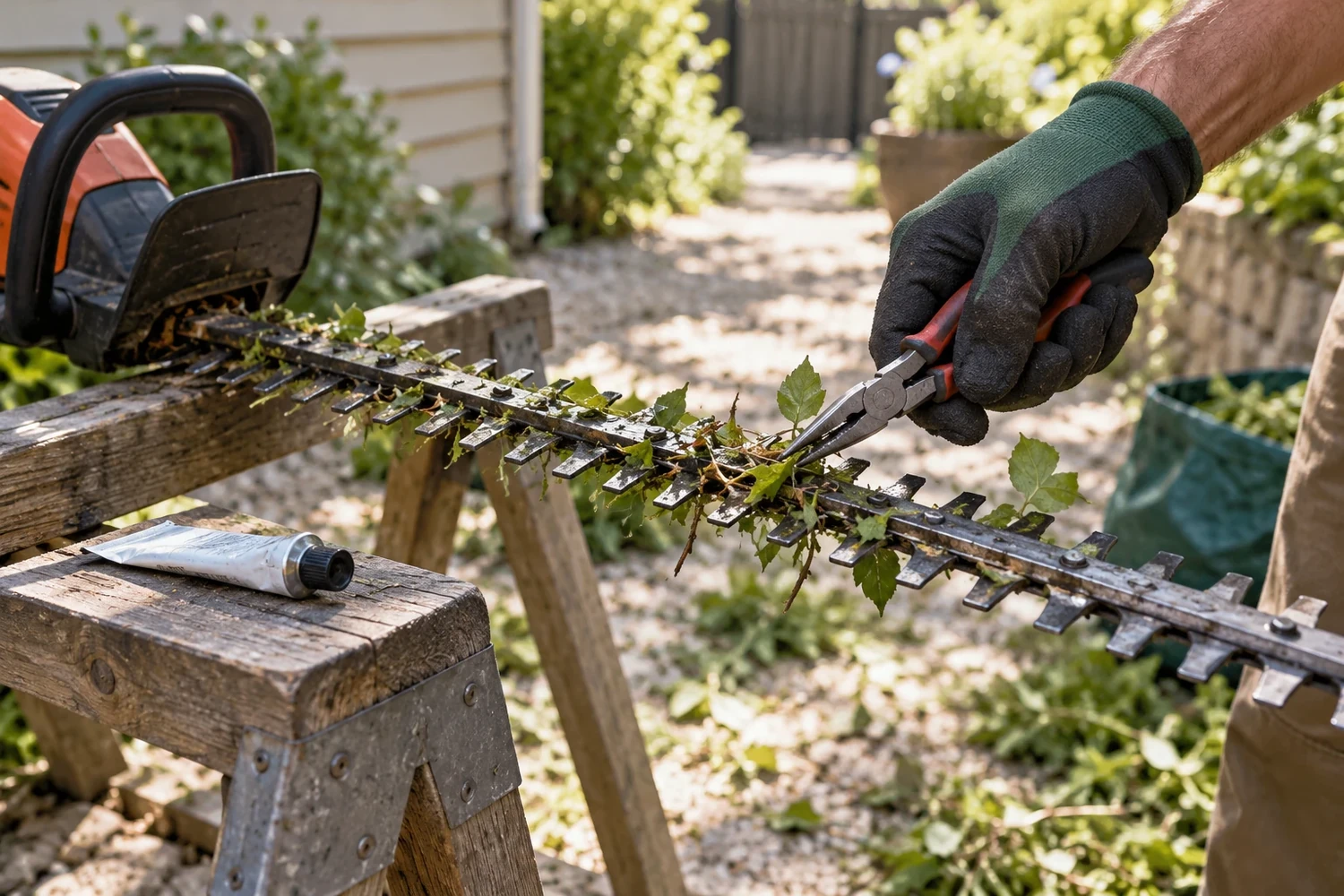
Debris like twigs, leaves, or dried sap can stop the blades from moving, and even a small amount of buildup wedged between the two cutting bars can be enough to stall them completely while the engine keeps running normally. With the engine off and, for battery models, the battery removed, carefully inspect between the blade teeth for anything lodged there and clear it by hand.
Dry or resinous blades create real friction
Dry or gummed-up blades create friction and may stop completely, particularly on gas models that have sat with old, sticky fuel residue nearby or after sap-heavy trimming without cleanup. Clean the blades with a cloth or brush and apply the manufacturer's recommended blade lubricant or a light oil before assuming a mechanical failure — a dry, high-friction blade set can bind hard enough to stall a small gearbox that would otherwise turn it without issue.
Check for bent teeth or visible blade damage
Bent teeth or other visible damage can prevent the blades from moving correctly even with a fully functional clutch and gearbox behind them. Inspect the full length of both blades for impact damage, not just the tips — a single bent tooth deep in the blade run can bind the whole assembly.
The clutch is the most common true mechanical fault
On gas hedge trimmers, the clutch sits on the crankshaft and engages the gearbox once the engine reaches a certain rotational speed, similar in principle to a chainsaw's centrifugal clutch. If the engine runs and revs normally at idle and at throttle but the blades still never engage, a broken or improperly tensioned clutch is the leading remaining explanation, since it's the one component sitting directly between a confirmed-good engine and a confirmed-clear, confirmed-lubricated blade set.
Check the gearbox grease, not just the blade oil
Separate from the exposed blade lubrication, the small gearbox that converts the crankshaft's rotation into the blades' side-to-side reciprocating motion has its own internal grease fill, which most manufacturers recommend checking or replenishing once or twice per season through a small fill plug. A gearbox that's run dry of internal grease can bind, run unusually hot, or eventually strip its internal gears — a fault that shows up as slow or absent blade motion under load even when the clutch itself is confirmed to be engaging correctly.
Electric and battery models: check power delivery, not the drivetrain, first
For corded or cordless electric hedge trimmers, verify battery charge or cable and cord connections before assuming a mechanical fault, since a partial power problem on an electric motor can present as sluggish or absent blade movement without the same clutch-engagement logic that gas models use. A battery that reads charged but delivers a weak connection at the contacts can starve the motor of enough current to turn the blades under load even while it sounds like it's running.
A practical test order
- With the engine or motor off, inspect and clear any debris jammed between the blade teeth.
- Clean and lubricate the blades if they show dryness, sap, or resin buildup.
- Inspect the full blade length for bent teeth or impact damage.
- Check the gearbox grease level through its fill plug if the manual calls for periodic servicing.
- On gas models, confirm the engine reaches normal running speed, then listen and feel for whether the clutch is engaging at all as RPM increases.
- On electric/battery models, confirm secure power connections before suspecting the gearbox.
If blades are clean, undamaged, lubricated, the gearbox grease is adequate, and the clutch still never engages on a gas model, that's a gearbox or clutch repair — not a cleaning or fuel job — and is usually worth a shop visit unless you're comfortable with small-engine drivetrain disassembly.
End-of-day blade care prevents most of this
Resin, sap, and compacted plant matter are much easier to remove from warm blades right after use than once they've dried and hardened overnight, and a quick wipe-down with a cloth after each trimming session, followed by a light coat of blade oil before storage, meaningfully reduces how often a hedge trimmer develops the dry-friction stall covered above. Storing the trimmer with its blade guard on protects the cutting edges from incidental damage between uses, which also reduces how often bent-tooth binding shows up as a mid-season surprise.
An impact can cause this even without visible blade damage
A hedge trimmer that only shows this symptom after being dropped, or after striking a fence rail, a hard branch, or a masonry edge, deserves a closer look at the gearbox housing itself for cracking, since an impact hard enough to jar the clutch loose can sometimes also stress the housing that holds the gearbox aligned to the crankshaft — a fault that can exist even when the blades themselves show no obvious bend or damage from the same impact. This is worth checking specifically because it's easy to focus entirely on the blades after a hard knock and miss a housing crack that's the actual reason the drivetrain won't transmit power properly afterward.
Fuel condition matters here too, indirectly
For gas models, draining or treating fuel before off-season storage affects more than just starting reliability. Gummy, varnished fuel residue near the carburetor can reduce how consistently the engine reaches and holds the RPM the centrifugal clutch needs to fully engage, even though the clutch itself is a purely mechanical part with no direct connection to the fuel system. An engine that idles roughly or hunts for RPM because of stale fuel may reach the clutch's engagement speed only intermittently, which can look exactly like a mechanical clutch problem until the fuel system is addressed first. Rule out stale fuel with a quick idle-and-throttle check before disassembling anything mechanical, since it's the cheaper and faster thing to eliminate.
Battery-powered hedge trimmers follow a shorter version of this logic
Cordless hedge trimmers skip the clutch entirely — the motor drives the blade linkage directly, so a stalled blade set with a running motor points almost exclusively at debris, dry blades, or physical blade damage rather than a clutch or fuel question. If a battery model's blades won't move despite a confirmed-charged battery and a motor that audibly spins up when the trigger is pulled, listen closely for whether the motor sounds like it's spinning freely (a sign the blade linkage itself has disconnected or stripped) or straining against resistance (a sign of a genuine jam). A motor that spins freely with no resistance and no blade motion at all is a mechanical linkage failure inside the housing, which on most sealed cordless trimmer bodies is a manufacturer repair rather than a home fix, since reaching the linkage usually means opening a housing that isn't designed to be serviced by the end user.