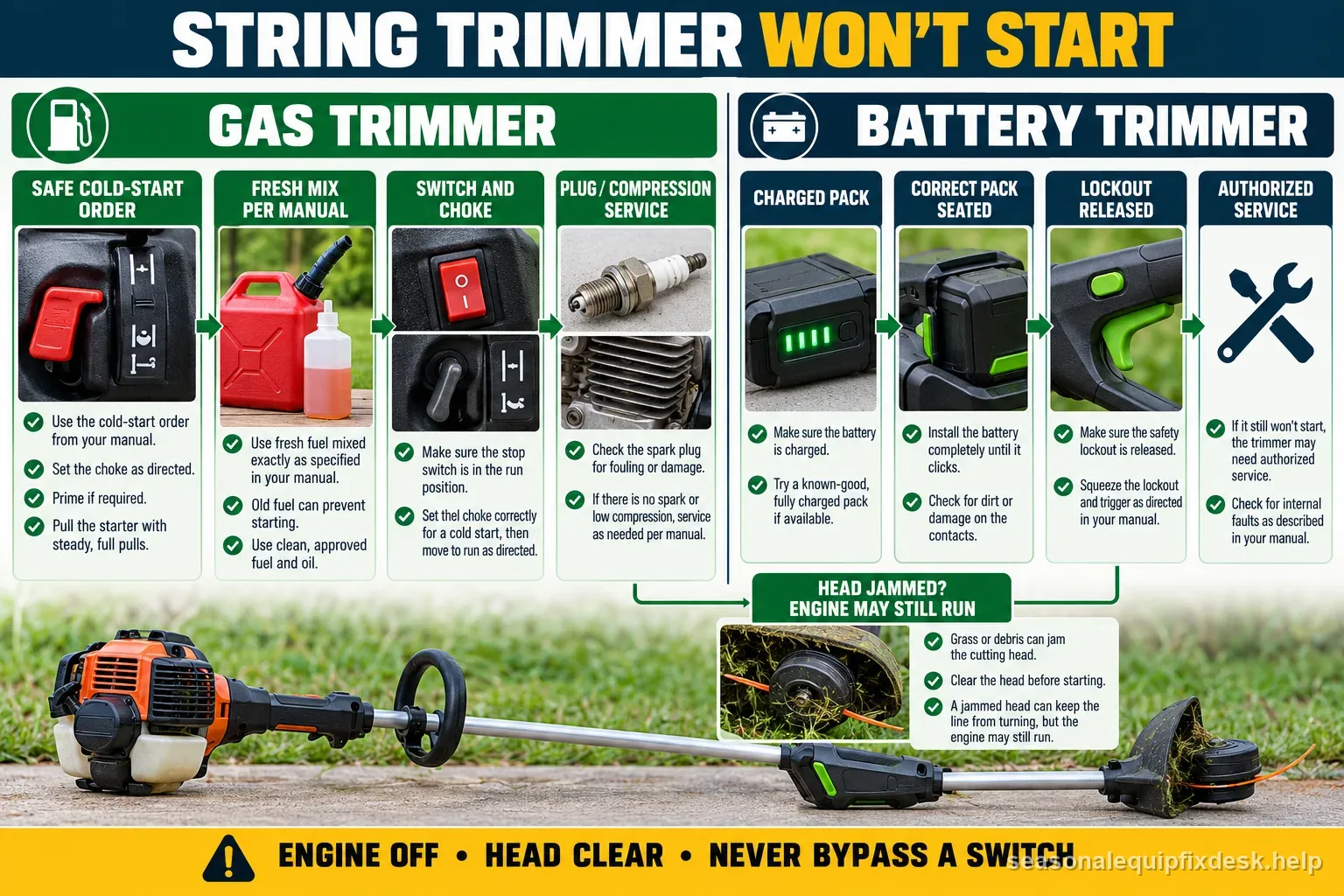
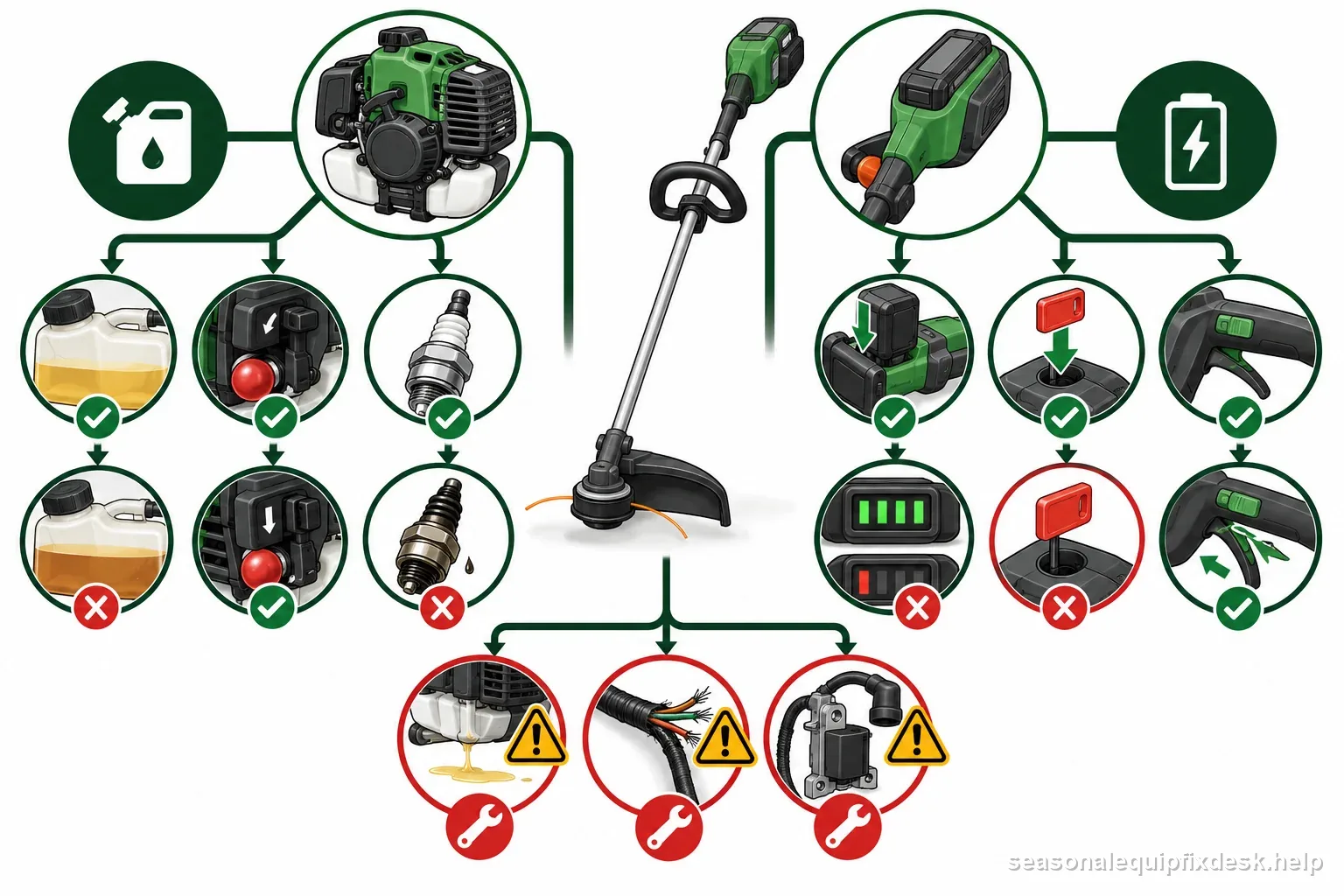
Quick answer: First identify gas versus battery. A petrol trimmer needs the correct fresh fuel mix, start-switch position, air-purge/choke procedure, spark, and compression. A battery trimmer needs a charged compatible pack, correct seating, start/lockout inputs, and a head/shaft that is not mechanically jammed. Do not apply a carburetor checklist to a battery unit or a battery-reset checklist to a flooded two-stroke engine.
Put the trimmer on the ground in a stable starting position with the cutting attachment clear of people and objects. Wear eye protection and the PPE required by the operator manual. Shut down and remove the battery or disconnect ignition before handling the head, guard, shaft, or line-cutting area.
| Machine type | First observations | Do not assume |
|---|---|---|
| Gas trimmer | Start switch, exact cold/hot sequence, fresh correct mix, primer/choke position | More choke is always better; repeated choke pulls can flood it |
| Battery trimmer | Compatible charged pack, full seating, safety key, trigger lockout | A dead tool always means the motor failed |
| Either type | Guard, head, and shaft appear intact and unobstructed | Removing the guard or attachment is a valid start test |
Before inspection, switch off and remove the pack or disable ignition as the manual directs. Let hot parts cool; keep hands away from the head and stop for fuel leaks or damaged cords.
Petrol trimmer: the cold-start sequence is part of the diagnosis
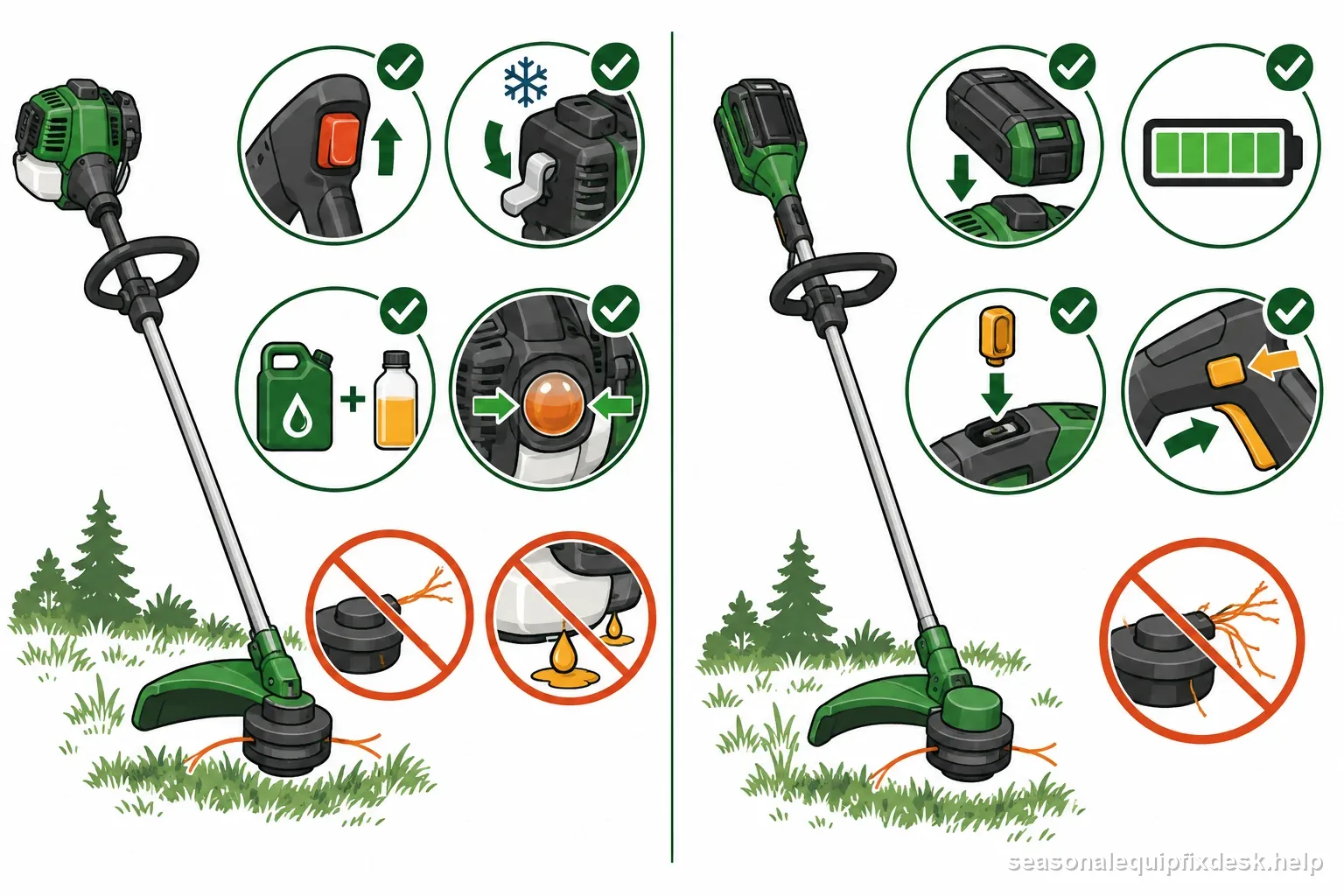
Husqvarna’s current trimmer/brushcutter guidance uses the primer or air-purge bulb, then choke, then pulling until the engine fires before moving the choke toward run and starting fully. Exact details differ by model. If the engine gives one brief fire, that is the signal to advance the sequence rather than adding more full choke.
A warm engine generally needs less enrichment. If a trimmer ran five minutes ago and now refuses to restart, use the model’s hot-start procedure instead of repeating a cold start. Husqvarna publishes separate hot-start guidance for petrol trimmers because heat changes the starting requirement.
Stop-switch state is a simple branch worth proving early
Before opening the fuel system, verify that any non-spring-assisted stop switch is actually in RUN. Husqvarna specifically calls an active stop switch a cause of a hot restart failure on applicable products. Inspect damaged switches or wiring rather than permanently bypassing the shutdown circuit.
If the control feels intermittent, note whether moving the handle or switch changes the symptom. A trimmer must return to service with a reliable stop function, not merely with the ignition wire disconnected from the switch.
Old or incorrect premix can start poorly even with a full tank
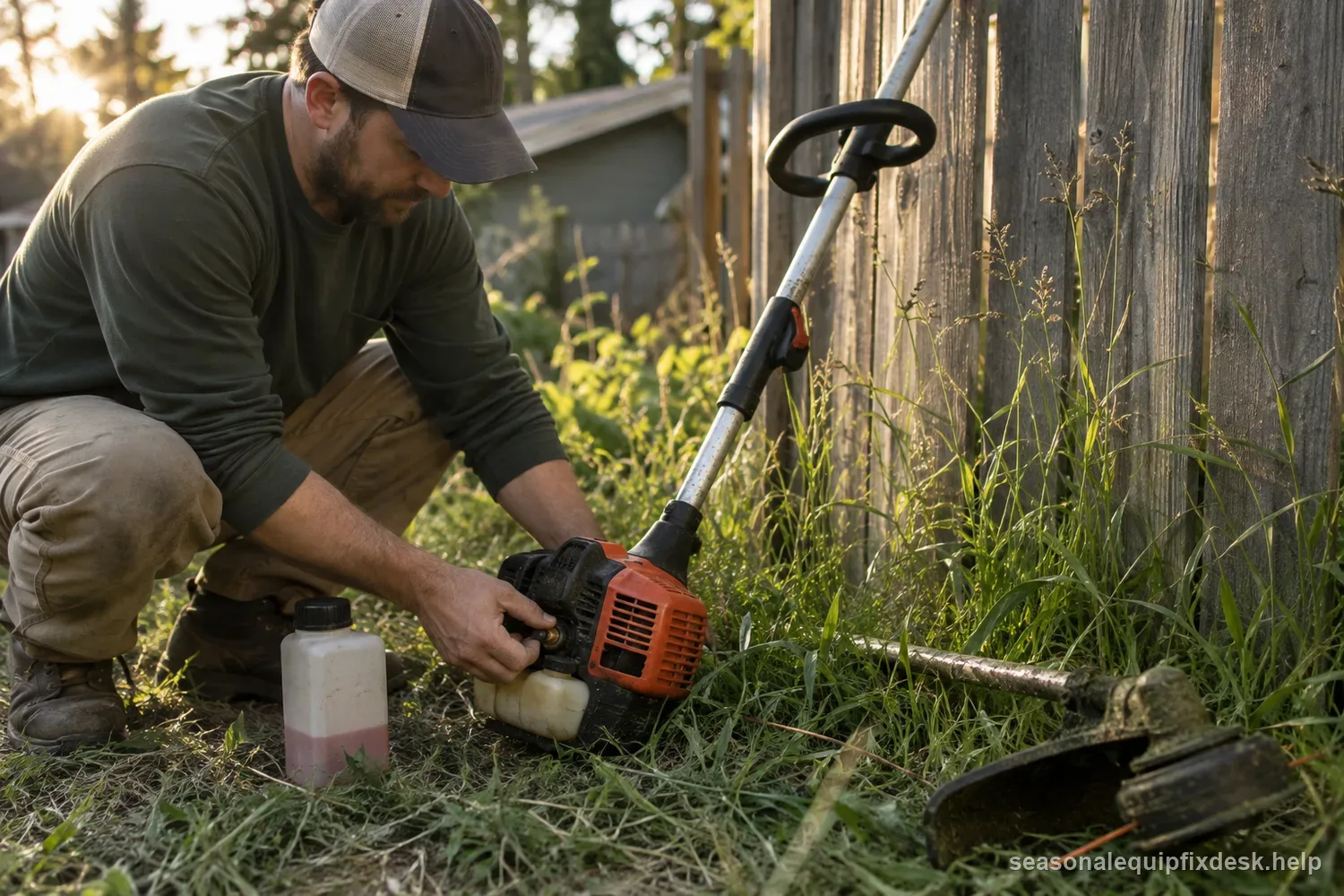
Fuel level and fuel quality are separate facts. Replace unknown seasonal fuel with the correct fresh mixture for the engine. Small two-stroke carburetor passages and diaphragms are sensitive to degraded fuel, and an incorrect oil ratio can affect starting and throttle response.
If the trimmer ran normally before storage and now fires only on choke, fuel metering becomes more likely after fresh fuel and correct start controls are proven. That evidence is stronger than the calendar alone.
Use the purge bulb and spark plug as two different fuel clues
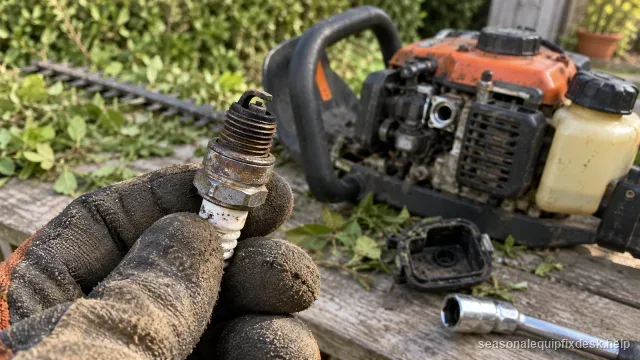
If the primer/air-purge bulb fails to move fuel as the start procedure expects, inspect accessible lines, pickup filter, bulb, and connections for cracks, blockage, or air entry. If the bulb fills but the spark plug remains dry after normal attempts, delivery through the carburetor deserves attention.
If the plug is wet and smells strongly of fuel, stop priming and use the model’s flooded/warm procedure. A wet plug does not prove the ignition coil is bad; it mainly changes the fuel side of the evidence.
Spark comes after you preserve the wet-or-dry clue
Inspect the correct spark plug for fouling, damage, and specification. Use a safe approved spark-test method if needed. Keep ignition tests away from spilled fuel and hot exhaust. Do not hold the plug lead with your hand or improvise a spark gap around the open tank.
If spark disappears only after the engine gets hot, record that heat-soak pattern and let the unit cool before additional service. Repeatedly replacing plugs without testing the hot failure can miss an ignition module or wiring problem.
A jammed head can make an electric trimmer look electrically dead
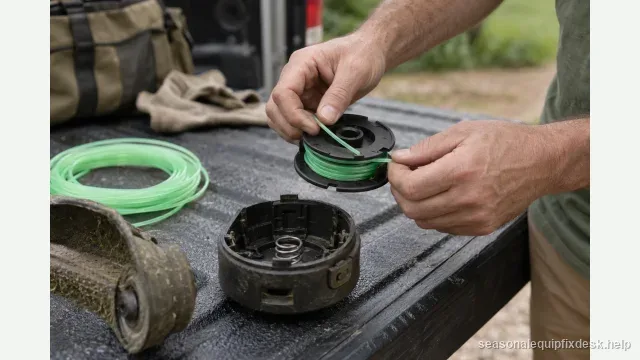
For battery models, remove the battery before inspecting wrapped grass, line, wire, or debris around the head. A motor controller may refuse to run or may shut down if the cutting head cannot rotate. Clear only what the operator manual allows and check that the guard and line cutter remain intact.
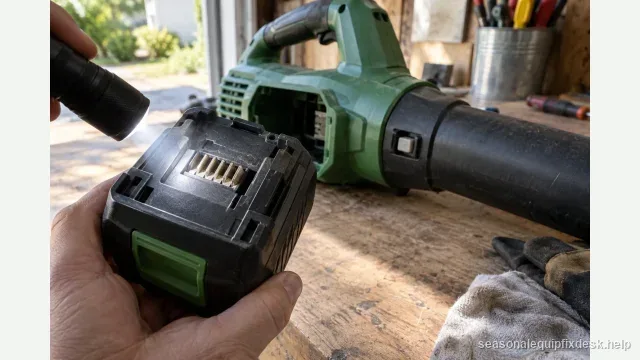
Then check battery seating, charge, temperature, start button, trigger, and lockout sequence. If the tool provides fault LEDs, use the code rather than repeatedly squeezing the trigger. Try a known-good compatible battery only when the manufacturer permits the comparison.
Starter rope behavior creates a separate gas-trimmer branch
If the recoil rope does not engage the engine, remains slack, or becomes abruptly hard to pull, stop treating the problem as fuel-related. Husqvarna notes that a starter pulley/pawl that does not engage can prevent the engine from turning. Mechanical binding in the shaft/head or engine also deserves inspection with the tool disabled.
Do not remove the guard or cutting attachment and run the engine in a configuration the manufacturer does not approve just to reduce drag. Use the correct service method to isolate mechanical resistance.
A start is not a pass until the cutting attachment behaves normally
- Reinstall every cover and safety part and clear the work area.
- Use the correct cold/warm procedure or battery start sequence once.
- Confirm stable idle or normal motor-ready state before loading the head.
- Apply throttle or trigger gradually and verify the head runs without abnormal vibration or binding.
- Check that the stop switch or trigger release shuts the tool down normally.
If a gas trimmer starts but will not reach full speed, the problem has moved to fuel delivery, air filter, exhaust, or attachment load rather than a pure no-start. Husqvarna’s full-throttle troubleshooting similarly begins with fresh fuel, clean airflow, and a free cutting attachment.
- Power type and model
- Cold/hot condition
- Switch, choke, primer or pack/lockout
- Fuel mix or battery status
- Plug wet/dry clue where applicable
- Guard/head condition and service limit
When the no-start should stop being a driveway experiment
Seek service for fuel leakage, persistent no-spark, suspected low compression, damaged stop/lockout controls, a battery/tool fault that follows a known-good pack, or mechanical binding beyond routine head cleaning. Internal carburetor, clutch, shaft, ignition-module, or electronic-controller diagnosis should use model-specific procedures.
Record gas/battery type, cold versus hot behavior, whether the engine ever fired, purge-bulb behavior, plug wet/dry state, fault-light pattern, and whether the head rotates freely when safely disabled. That is a much stronger service handoff than “it needs a carburetor.”