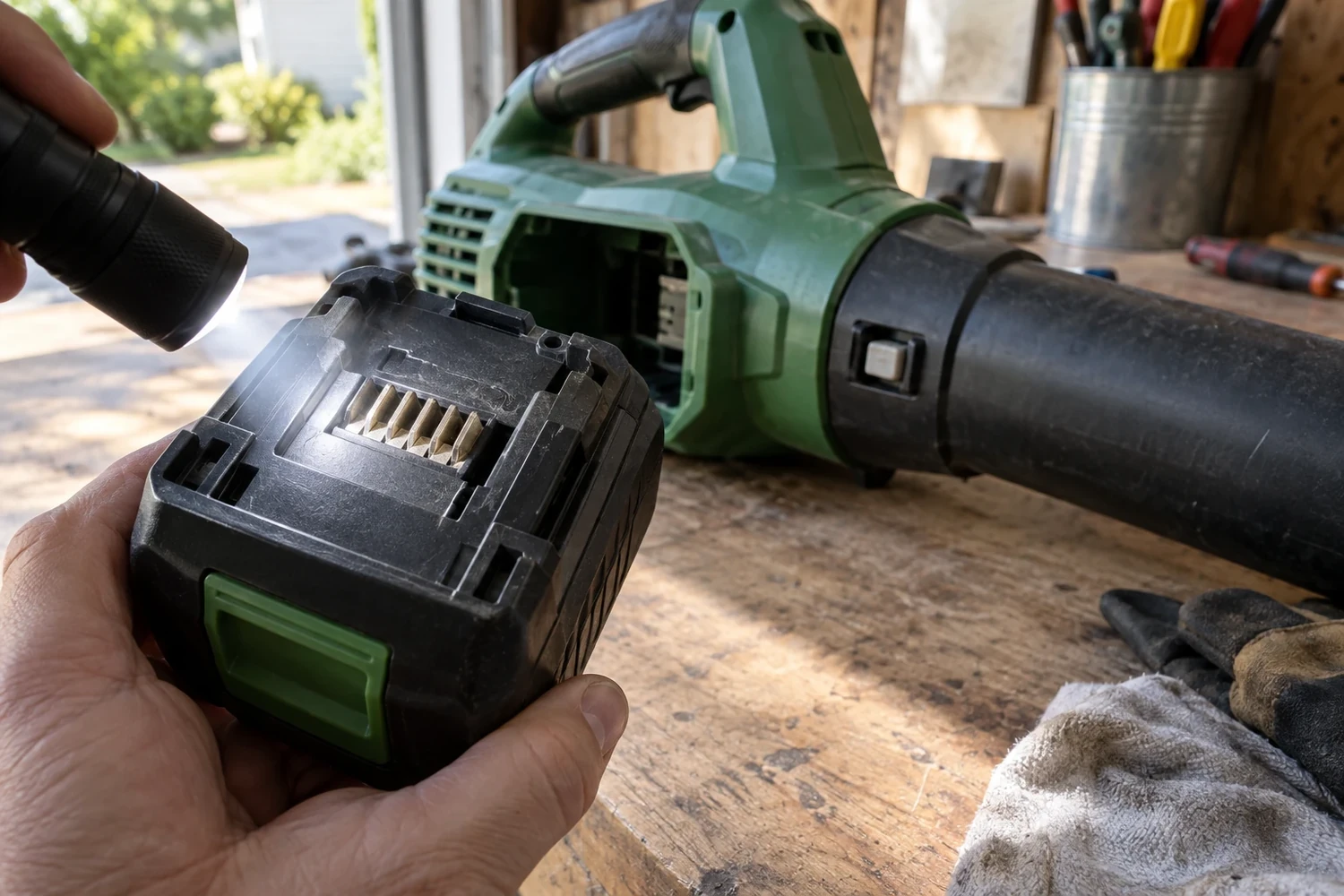
Quick answer: Before assuming a dead motor or trigger, check three things in order: whether the battery itself shows a charge, whether the blower tube is fully locked into its safety interlock, and whether the impeller is jammed with debris. Cordless blowers add failure points that a gas blower does not have, and most "won't turn on" cases trace to one of those three rather than the motor.
Check the battery's own indicator first
Most cordless outdoor-power batteries carry a small fuel-gauge display with several segments or bars. A flashing single bar (rather than a solid one) generally indicates the pack is fully discharged rather than merely low, and the tool will not run at all in that state. Recharge fully or swap in a battery you know is charged before troubleshooting anything else — a dead-feeling blower with a genuinely dead battery is not a tool fault.
Overheat protection can shut the whole tool down
Lithium-ion battery packs include thermal protection that will not allow the tool to operate if the battery is too hot, whether from direct sun, a hot vehicle, or heavy back-to-back use. If the blower was working and then stopped after extended use or after sitting in a hot trunk, let the battery rest in a cool location before testing again rather than assuming a permanent failure. This protection exists specifically to protect the cell and extend the pack's service life, so a hot-triggered shutdown is the system working correctly, not malfunctioning.
The tube assembly has its own safety switch
Many cordless blowers will not start at all unless the air tube is fully assembled and locked, because that interlock exists to keep the impeller inlet covered during operation. Official guidance for one major brand's cordless blowers is specific on this point: check that the tube locking screw has been wound completely in until you hear a slight click indicating proper engagement. A blower with a fully charged battery that still does nothing is worth checking here before any deeper troubleshooting — a half-turned locking collar is an easy thing to miss, especially after storing the blower with the tube detached.
A jammed impeller can mimic a dead tool
With the battery removed for safety, look into the tube and impeller housing for twigs, mulch, or other debris wedged against the fan blades. A jam severe enough to stall the impeller can trip the tool's own overload protection the instant the trigger is pulled, which can look identical to a dead battery or dead switch from the outside. Clear any debris by hand with the battery out, then reinsert the battery and retest.
Check battery and tool contacts for corrosion
Outdoor equipment that spends the season near cut grass, dust, and moisture can develop light corrosion or a film of debris on the battery's metal contacts, or on the matching contacts inside the tool's battery bay. A battery that shows a full charge on its own gauge but still won't power the tool is worth pulling out and visually checking at the contact points — a quick wipe with a dry cloth is often enough to restore a solid connection, and it costs nothing to rule out before assuming a deeper fault.
Trigger and switch problems come last, not first
Once the battery is confirmed charged and not overheated, the contacts are clean, the tube is fully locked, and the impeller turns freely by hand with the battery removed, a genuinely faulty trigger switch becomes the more likely remaining explanation. That is a repair-shop or warranty question rather than a home fix on most sealed cordless tool housings, and it's a smaller share of real-world "won't turn on" cases than the checks above.
What to record before calling support
- Whether the battery's own fuel gauge shows a solid or flashing bar.
- Whether the battery feels unusually warm to the touch.
- Whether the tube locking collar was fully wound in, with an audible click.
- Whether the impeller turns freely by hand with the battery removed.
- Whether the battery and tool contacts show any visible corrosion or debris.
Those five answers let a support line or repair shop skip straight to the actual fault instead of re-walking the same battery and interlock checks you have already ruled out.
Storing the battery correctly prevents most of these calls
Manufacturer guidance for lithium-ion outdoor-tool batteries generally recommends storing packs in a cool, dry location away from direct sunlight, rather than a hot garage, shed, or vehicle where seasonal temperature swings are largest. Storing a battery at a fully drained state for extended periods can also stress the cell chemistry in ways that shorten how well it holds charge later, so a battery being put away for the off-season is generally better stored at a partial rather than empty or completely full charge, per most manufacturers' long-term storage guidance. A blower that's hard to start at the beginning of each new season is frequently explained by a battery that was stored incorrectly the previous fall, not by anything wrong with the tool itself.
If more than one cordless tool from the same battery platform starts showing the same slow-to-charge or won't-hold-charge pattern at the same time, that points toward the charger or a shared storage condition rather than one individual pack failing on its own — worth checking before replacing multiple batteries when the charger itself might be the actual cause.
Checking the charger itself, not just the battery
A battery charger has its own small set of failure points worth ruling out before condemning a battery outright: a charging base with a light that never changes from a blinking or amber state to solid green, a charger left plugged into an outlet that turns out to be dead, or charging contacts on the base that have accumulated the same kind of dust and corrosion that can affect the tool's own battery bay. Swapping a suspect battery onto a known-good charger, or a known-good battery onto the suspect charger, is a quick way to isolate which half of the charging system is actually at fault rather than assuming it's always the battery.
A seasonal pre-check saves a trip mid-yard-work
Before the first real yard-cleanup day of the season, it's worth doing a short dry run: charge the battery fully, insert it, fully lock the tube assembly, and confirm the blower runs for a full minute or two without tripping any protection. That short test surfaces a weak battery, a loose tube interlock, or a developing switch problem while you're standing in the garage rather than halfway through a yard with a dead tool and no easy way to diagnose which of the several possible causes above is the actual one. Keep a spare charged battery on hand if the platform supports it — for anyone who relies on a cordless blower regularly, a second battery removes most of the practical downside of battery-based tools compared to a gas equivalent that never needs a charging wait at all.
Cross-brand battery adapters are worth mentioning specifically here: an adapter that lets one manufacturer's battery power a different manufacturer's tool introduces a connection point that isn't part of either company's original design or testing, and a blower that won't turn on when run through an adapter should have that adapter itself checked, or bypassed entirely with the original matching battery, before any of the diagnostic steps above are treated as conclusive.