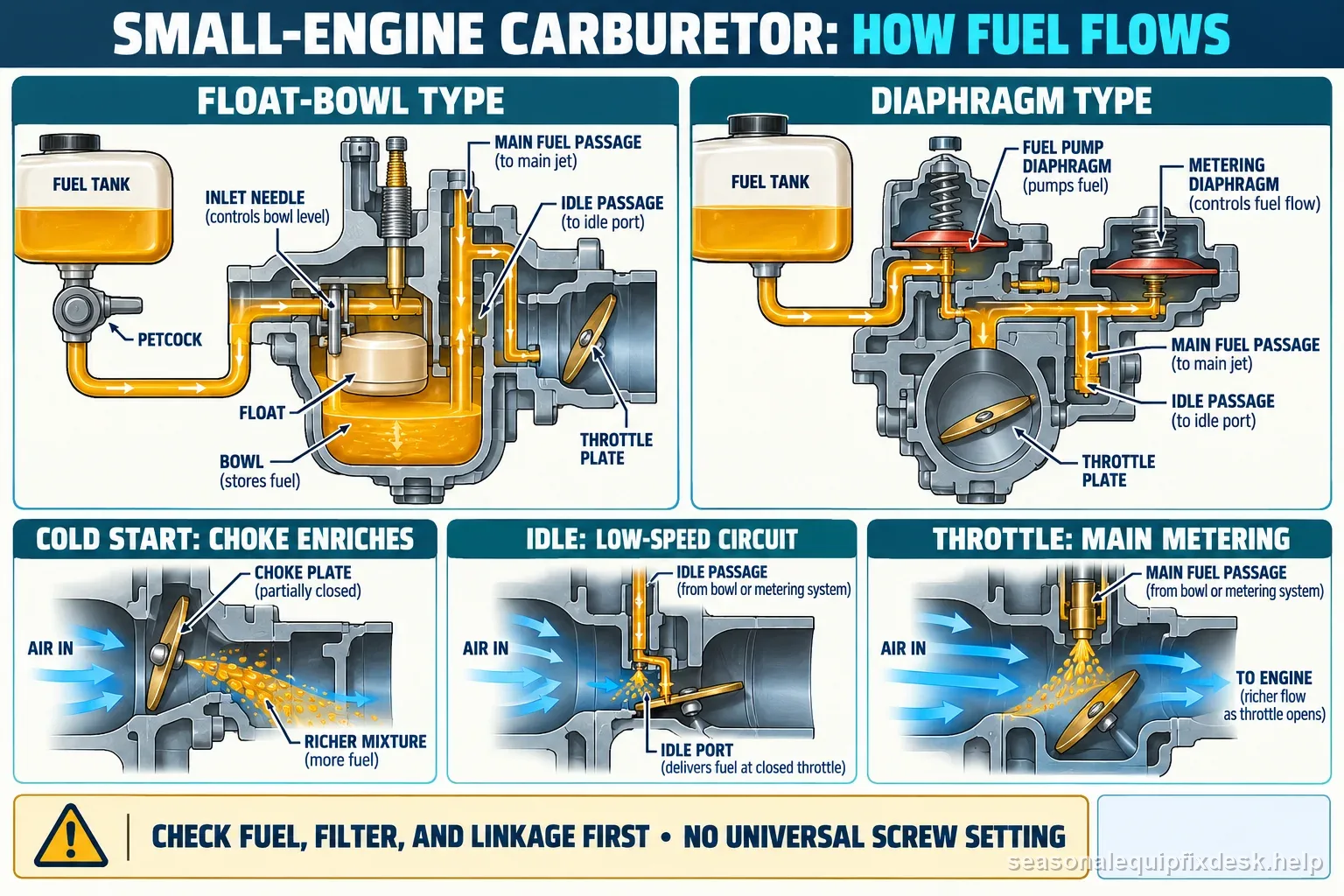
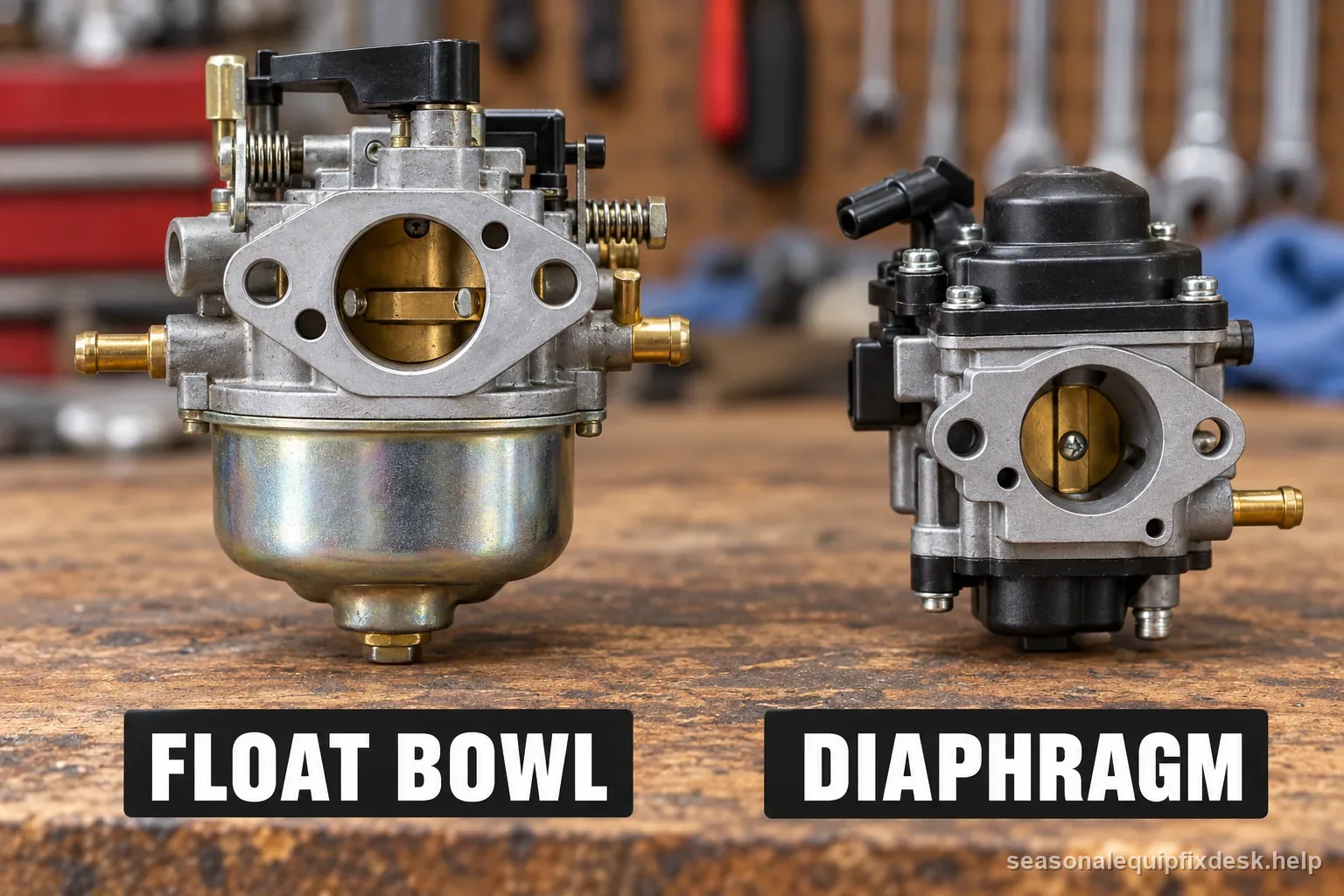
Quick answer: A small-engine carburetor is not one jet with one adjustment. It meters fuel across different starting and running conditions. A float-bowl design uses a float and inlet needle to maintain fuel level; diaphragm designs use flexible diaphragms and check-valve passages to move and meter fuel in equipment that may operate at changing angles. Understanding which circuit is active when the symptom appears prevents unnecessary disassembly.
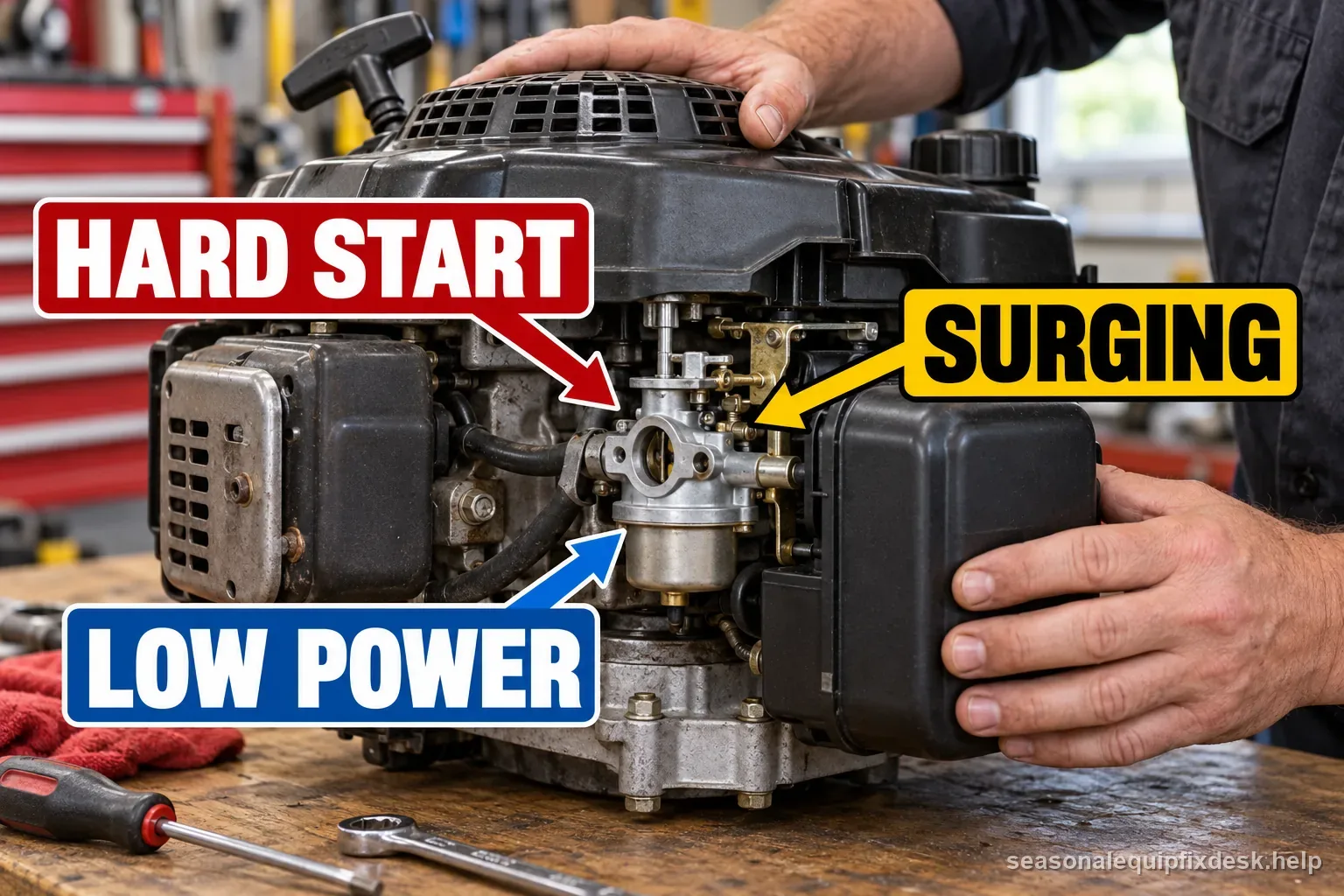
| Symptom pattern | Possible carburetor path | Other checks first |
|---|---|---|
| Hard cold start | Choke, fuel level, starting circuit | Cold-start steps, fresh fuel, spark |
| Runs only on choke | Lean mix, restricted passage, air leak | Fuel flow, intake seal, filter, linkage |
| Dies at throttle | Main metering or fuel delivery | Tank vent, filter, load, ignition |
| Fuel leak | Inlet needle, float, gasket, line | Shut down; remove ignition sources |
| Observation | Possible meaning | Next step |
|---|---|---|
| Float bowl | Maintains a small fuel reservoir | Demand stall may point to refill flow |
| Diaphragm pump | Moves fuel without fixed bowl level | Orientation and diaphragm condition matter |
| Idle passage | Meters fuel at low throttle | Idle trouble can coexist with a clear main jet |
| Choke | Enriches mixture for starting | Choke-only running is a clue, not proof |
Start with the four things the engine needs
Briggs and Stratton summarizes basic four-stroke operation around air, fuel, compression, and spark. The carburetor controls only the air-fuel mixture. If the engine has no compression or no ignition, cleaning a perfect carburetor will not create combustion.
Use the symptom to decide whether mixture is plausible. A dry plug after normal cranking, an engine that runs only on choke, or a machine that dies when throttle opens gives the carburetor more diagnostic weight than a starter that cannot turn the engine.
- ObserveRecord the first observed symptom and what changed beforehand.
- InspectCheck the external controls, supply, and visible obstruction first.
- IsolateFollow the component path that matches the symptom.
- Retest or stopRetest under controlled conditions, then stop if the fault remains.
Float-bowl carburetors maintain a small reservoir
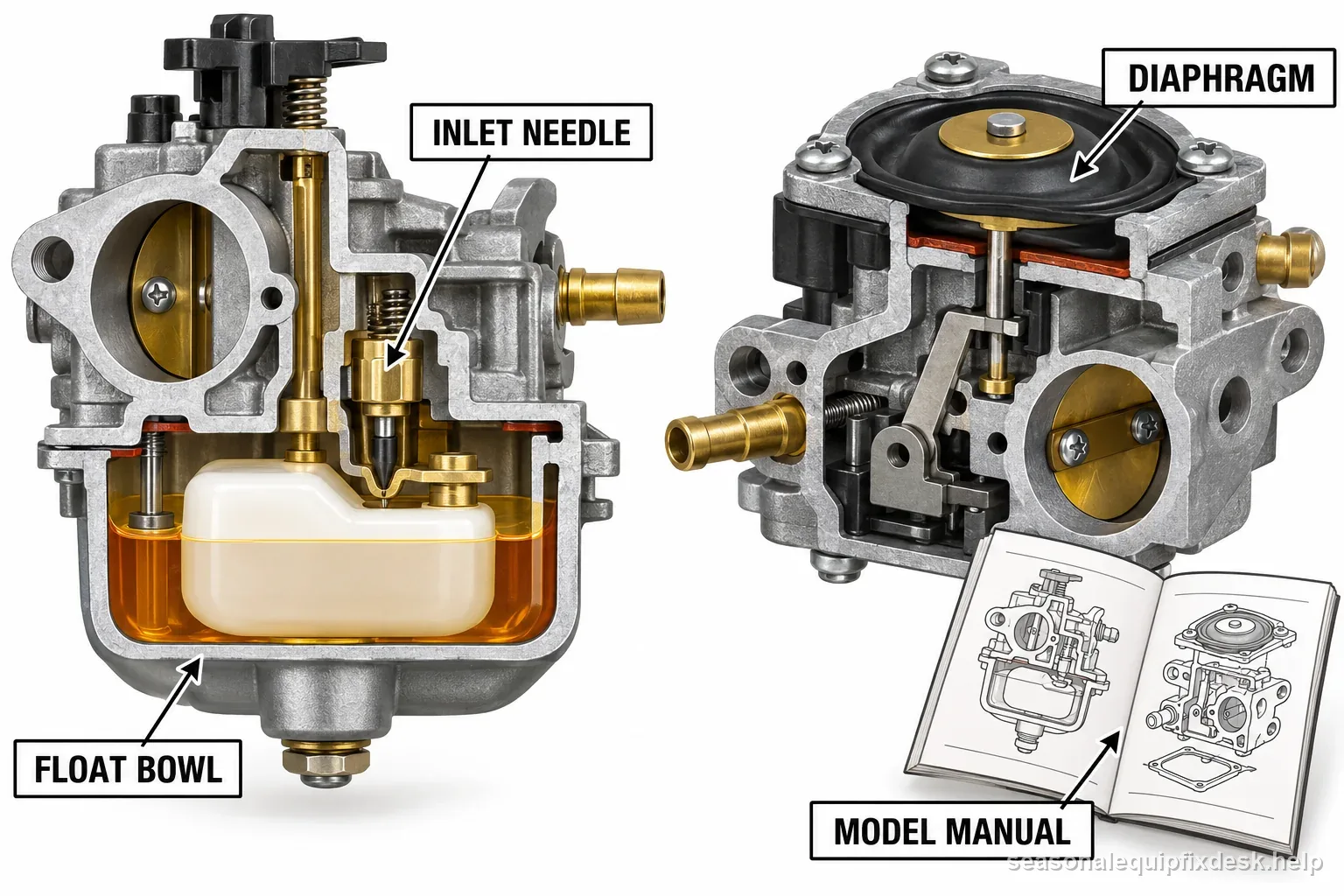
Fuel enters the bowl through an inlet needle controlled by the float. As fuel level falls, the float allows more fuel in; as it rises, the needle closes. A stuck closed needle can starve the engine. A leaking or contaminated needle and seat can overfill the bowl and cause flooding or leakage.
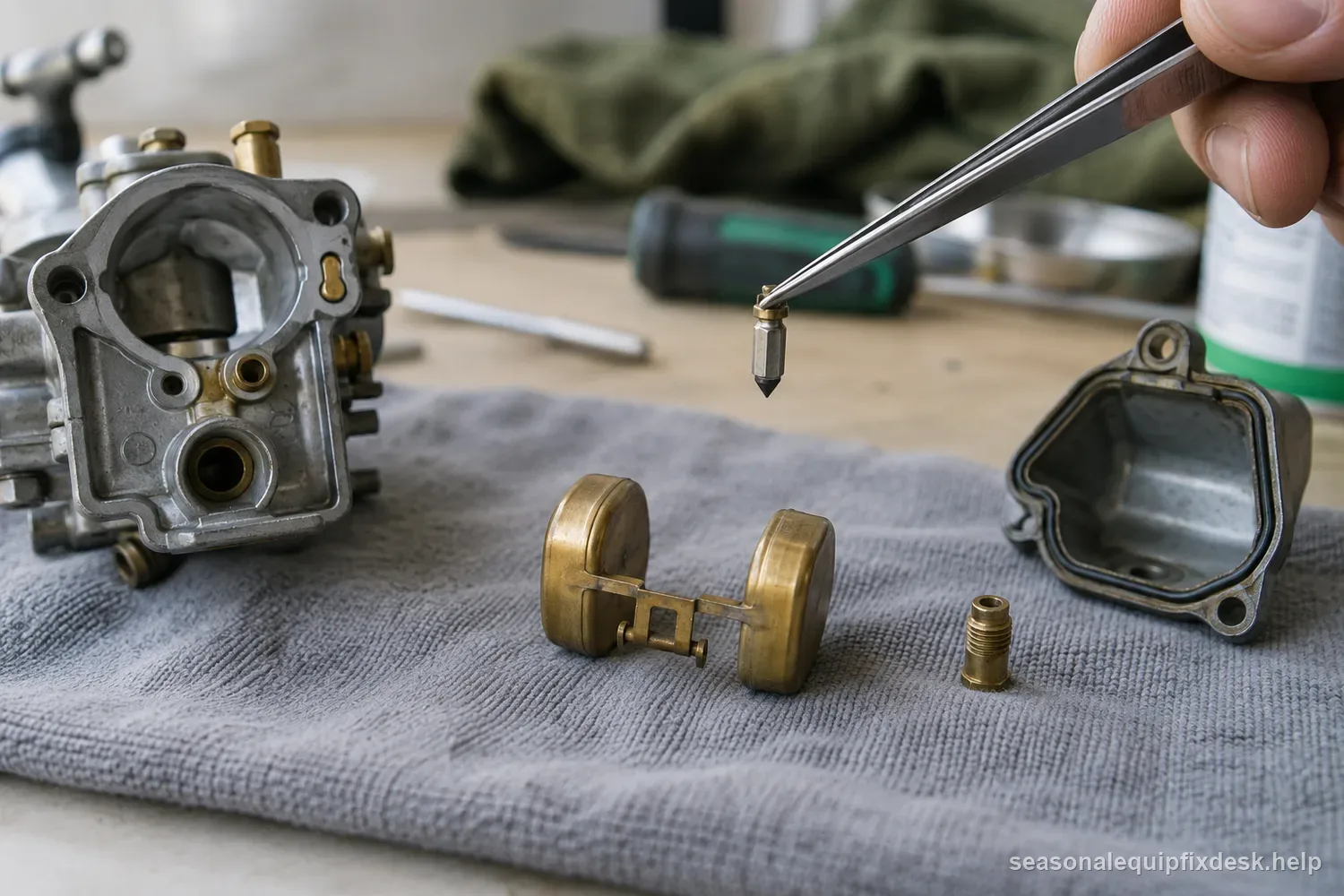
The bowl nut may also contain a metering passage on some designs. Treat it as a calibrated component, not just a fastener.
Main metering matters when the engine needs power
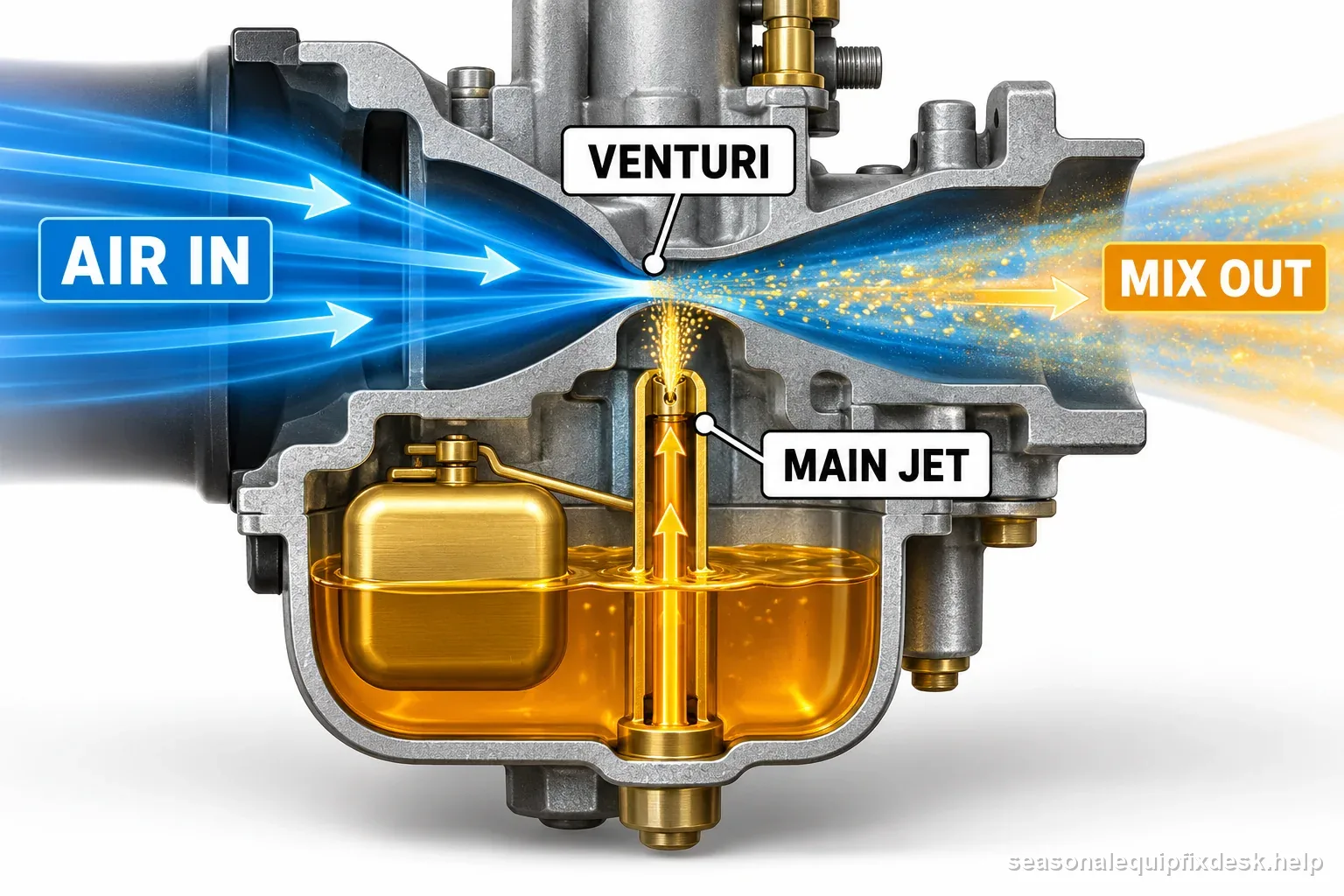
As airflow increases through the venturi, pressure differences draw fuel through the main metering system. Deposits in a small main jet or emulsion passage can let an engine start but cause it to sag or die when the throttle opens. That is why "starts but will not take throttle" is more informative than the vague statement "carburetor bad."
Do not enlarge a jet with drill bits or torch-cleaning wires. Removing metal changes fuel calibration permanently.
Idle and transition passages can fail while the main jet is fine
At closed or small throttle openings, engines often rely on separate idle and progression passages. A machine that runs at higher speed but will not idle can have a different restriction from one that idles but dies under load. Some modern carburetors have fixed circuits with little or no user mixture adjustment.
The choke enriches starting mixture; it is also a diagnostic clue
A cold engine may need choke because reduced air flow creates a richer mixture for starting. Once warm, continued full choke should not be necessary. If a warm engine runs much better with extra choke, normal metering may be too lean because of restricted fuel flow or an intake leak.
If extra choke makes a fuel-wet engine worse, do not conclude the choke itself is broken. The engine may already be flooded.
| Design clue | Float-bowl style | Diaphragm style |
|---|---|---|
| Fuel-metering clue | Bowl, float, inlet needle | Flexible diaphragm and metering lever |
| Common owner observation | Fuel leak or flooding near bowl | Poor run after storage or stiff diaphragm |
| Before opening | Match gasket and bowl layout to model | Use exact kit and service sequence |
Diaphragm carburetors solve an orientation problem
Handheld chainsaws and trimmers cannot rely on a float bowl staying level while the tool is tilted. Diaphragm carburetors use pressure pulses, flexible diaphragms, metering levers, and check valves to move and regulate fuel. Hardened diaphragms or debris can therefore create fuel-delivery problems that look different from a stuck float.
Rebuild kits are model-specific. Spring, lever, gasket, and diaphragm order matters; a generic "same size" membrane is not a reliable substitute.
Before cleaning, check the easy air and linkage faults
Briggs and Stratton's current carburetor-cleaning guidance starts with the air filter and linkage. A filter soaked with oil or packed with debris can cause rich running. Dirty or binding throttle and choke linkages can create a control problem that mimics poor fuel metering.
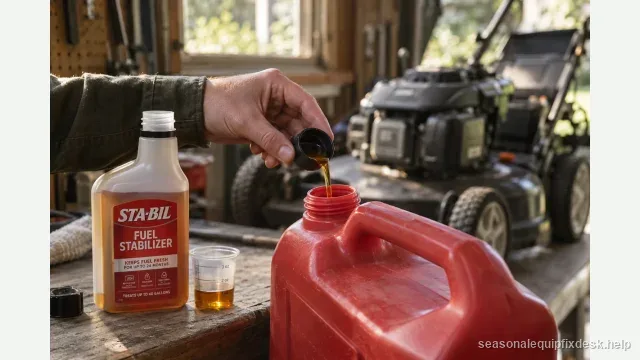
Confirm fuel is fresh and permitted for the engine before opening the carburetor. Cleaning a bowl while feeding it the same stale contaminated gasoline is not a complete repair.
Cleaning should preserve calibration
Disconnect the spark-plug lead, shut off or safely control fuel flow, and follow the service sequence. Use approved carburetor cleaner and compressed air only where the manual permits. Protect eyes and skin. Keep jets, emulsion tubes, needles, gaskets, and springs organized by position.
Briggs' rebuild guidance specifically shows how float, inlet needle, choke shaft, throttle plate, and seals have defined orientations. Photograph linkages before removal if the manual does not already make their routing obvious.
Adjustment is not the same as cleaning
If mixture screws are provided, return them only to a documented baseline and adjust by the specified procedure. Do not defeat limiter caps or emissions settings. Governor springs are also not mixture controls; changing them to mask a fueling problem can overspeed the engine.
Change one diagnostic condition at a time and preserve the original symptom. Repeated attempts can erase useful evidence or cross a stop condition.
A successful carburetor repair has a symptom-specific proof
After reassembly, check for leaks before starting. Then test the condition that failed: cold start, idle, transition to load, or sustained high-speed operation. A carburetor is not proven repaired merely because the engine fires once.
If correct fuel, clean passages, intact gaskets, and documented adjustment still do not resolve the symptom, return to spark, compression, valve condition, and mechanical load rather than cleaning the carburetor a third time.
Briggs and Stratton advises checking the air filter and throttle or choke linkage before cleaning, because those faults can mimic carburetor trouble. Stale fuel, a fouled plug, and deteriorated oil can also affect performance; do not assume every rough-running symptom belongs to a jet.
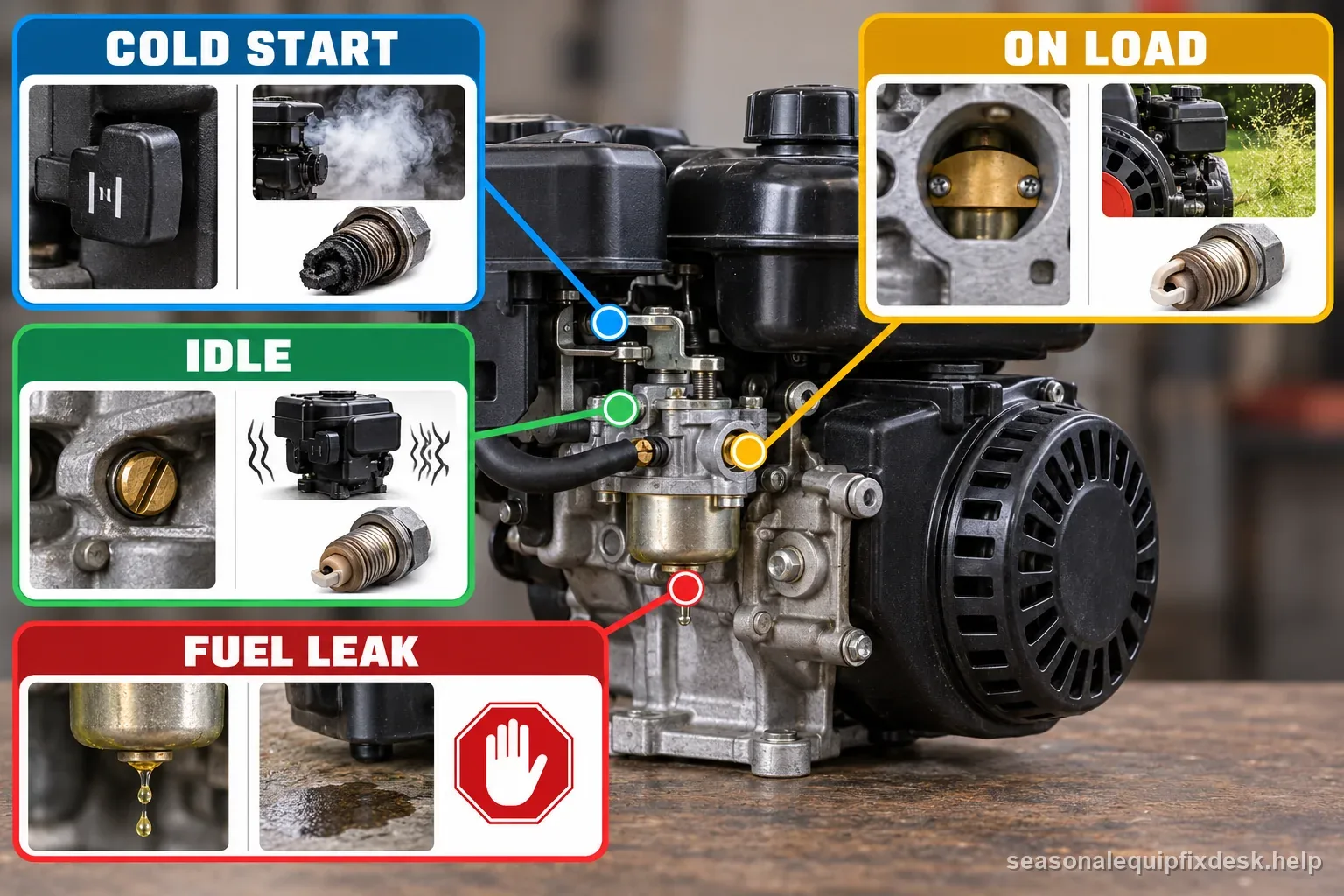
Two illustrative diagnosis notes
These sample observations show how to separate symptoms; their values are not service specifications.
Example 1: starts, then dies as choke opens
A mower starts on choke, runs for 40 seconds, then stalls when moved to run. The owner notes fresh fuel and a clean filter, then checks the model manual and fuel flow before considering a restricted passage. The pattern alone does not prove a clogged jet.
Example 2: fuel appears below the bowl
A generator leaves a small fuel spot after sitting. The owner shuts off its fuel valve, avoids sparks, and records the leak location. They do not run it to test the float; a technician checks the inlet needle, float, seal, and fuel line against the exact model parts diagram.
Illustrative diagnostic path; follow the equipment manual.
Fuel leaks are a different class of carburetor symptom
Gasoline dripping from the bowl, air-cleaner area, or overflow path should not be treated as a tuning problem. Shut the fuel off if the machine provides a valve, move away from ignition sources, and identify whether the leak comes from a gasket, inlet needle, fuel line, primer system, or damaged casting. Do not continue running an engine that is actively leaking fuel.
On a float carburetor, contamination at the needle and seat can prevent fuel shutoff, but a saturated float, damaged gasket, or excessive fuel pressure can create similar symptoms. Repair the leak before any mixture test because a leaking carburetor makes normal fuel-level assumptions invalid.
Verify the repair with one controlled retest
Keep the retest tied to the original symptom
After the exact cleaning or repair described by the equipment maker, reinstall the air cleaner and reconnect fuel lines before starting. Move the machine outdoors and use its normal starting procedure. Record whether it starts cold, idles with the choke in its run position, and accepts a brief change in load without surging. Change only one condition between tests so the result stays useful. Stop immediately for a visible fuel leak, unstable high-speed running, or a stall that persists after the manual’s normal sequence. If the engine runs only with the choke partly closed, record that clue for the repair shop instead of adjusting an unknown mixture screw.