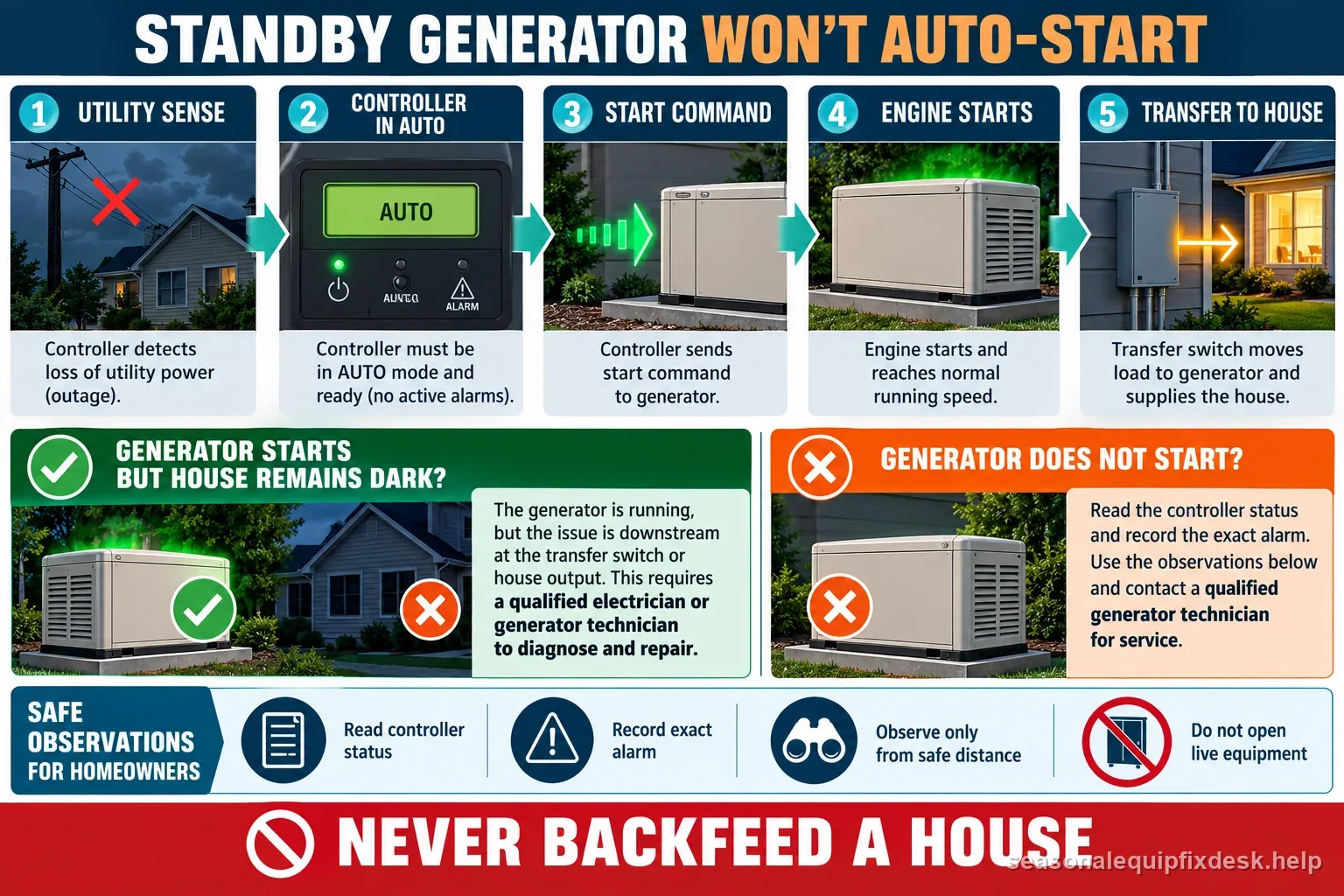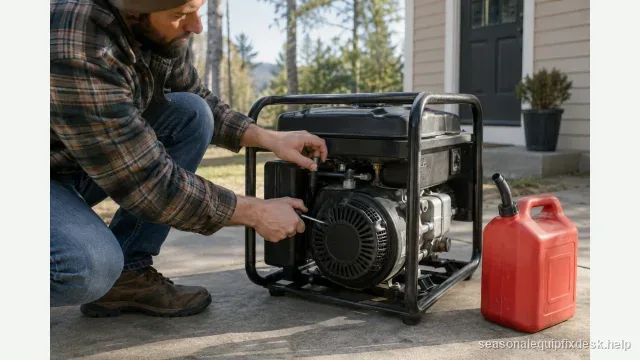
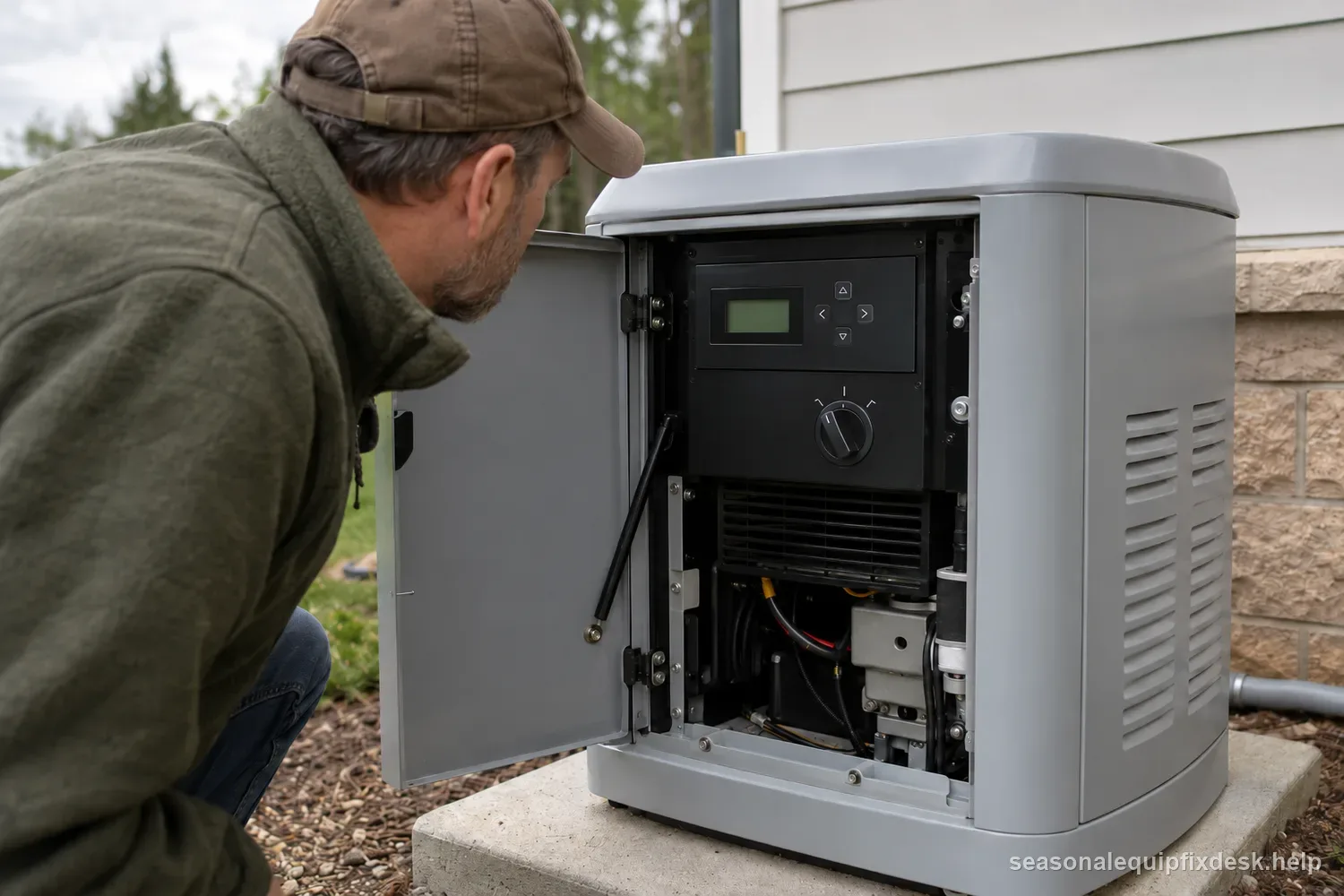
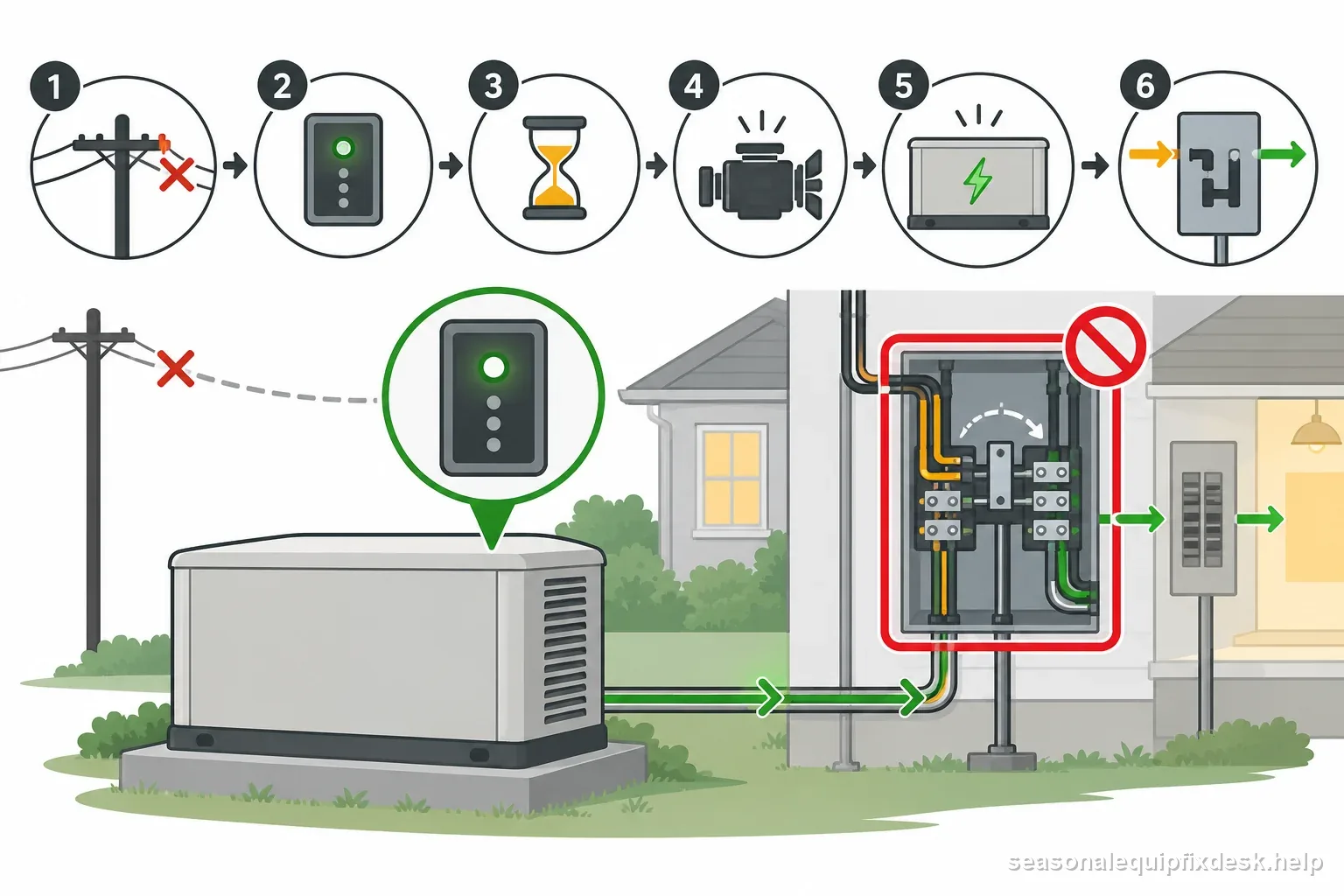
Quick answer: Do not treat “the house stayed dark” as one generator fault. A standby system has to pass several separate events: the controller must be armed in AUTO, it must recognize utility loss, any programmed start delay must expire, the engine must crank and run, and the transfer equipment must move the load to generator power. Find the first event that failed. That one observation can prevent a battery replacement when the real problem is mode, sensing, an alarm, or transfer.
During a real outage, keep the diagnosis at the control panel and other owner-accessible points. Transfer switches contain utility and generator conductors and can remain hazardous even when one power source is absent. Do not remove covers or probe live terminals to “see whether voltage is there.”
| Event in sequence | Owner-accessible clue | Service boundary |
|---|---|---|
| System armed | Exterior controller mode/status and alarm | Do not open electrical compartments |
| Utility loss recognized | Whether a sustained outage occurred and display changed | Do not simulate outages at service disconnects |
| Configured delay expires | Countdown or start-delay message | Preserve alarm history; do not repeatedly reset |
| Engine starts and transfer occurs | Whether engine cranked/ran and house circuits changed | ATS covers, live conductors, and transfer tests require qualified service |
A normal weekly exercise does not prove the entire outage-sensing and transfer path. Keep observations to the exterior panel and exact owner-manual checks.
Start with the controller state, not the starter battery
Look at the display and status LEDs before clearing anything. Generac states that AUTO mode enables automatic response to an outage; its troubleshooting information also lists conditions such as NOT ACTIVATED and AUXILIARY SHUTDOWN that prevent an automatic start. If the panel says OFF, MANUAL, SERVICE, or shows a red alarm, record that exact state first.
A generator can be healthy and still fail the outage if someone left it out of AUTO after maintenance. Return it to automatic operation only after the maintenance procedure is complete and the manual says it is safe to do so. Do not clear a shutdown merely to get the green light back without understanding why it occurred.
- Confirm outage and exterior controller status.
- Record AUTO/OFF/service mode and exact alarm.
- Note whether the configured start delay appeared.
- Record whether the engine cranked and ran.
- Note whether protected circuits transferred; stop at the ATS boundary.
A countdown means the controller has seen something important
Many standby systems intentionally wait before cranking after utility voltage falls. Generac documents a start-delay countdown and model-dependent programmable delays. If the display is counting down, the controller may already have recognized the outage. Let the configured delay expire instead of assuming the starter failed after the first few seconds of darkness.
If the utility returns during the delay, the set may correctly remain stopped. That is why a brief neighborhood flicker is a weak test of automatic-start reliability. Record whether the outage was sustained and whether the panel ever entered a start sequence.
No crank and crank-no-start are different service paths
If the countdown finishes and the engine never turns, battery condition, charger status, cable connections, starter circuit, controller output, and active shutdown inputs become relevant. A LOW BATTERY or CHARGER WARNING is valuable evidence; do not replace the battery solely because the engine did not start.
If the starter turns the engine but the engine never runs, the problem moves away from simple AUTO-mode diagnosis. Fuel supply, fuel pressure on gaseous systems, ignition, air, temperature, overcrank limits, and engine condition may be involved. Preserve any OVERCRANK, RPM SENSE LOSS, or related alarm before resetting it.
| Event or indicator | What it suggests | Owner-safe next step |
|---|---|---|
| Utility failed but controller is not in AUTO | The start sequence may not be armed | Read controller status; do not open equipment |
| A countdown or alarm appears | The controller logged a condition | Record the exact code and time |
| Engine starts but the house stays dark | Transfer or house output is downstream | Contact a qualified electrician or generator technician |
| Live switchgear or wiring needs inspection | This is beyond homeowner observation | Do not open live equipment |
The weekly exercise is a clue, but it is not a complete outage test
A normal exercise proves that the controller can schedule a run and the engine can start under exercise conditions. It does not necessarily prove that the utility-loss sensing path or transfer switch will behave correctly in an outage. Conversely, a missed exercise may point to mode, schedule, battery, controller, or engine-start issues even before storm season arrives.
Use the exercise history to build a timeline. “Exercised normally three days ago but did nothing during a sustained outage” pushes the diagnosis toward utility sensing, start logic, or a newly introduced alarm. “Has not completed an exercise for six weeks” makes the failure less outage-specific.
Engine running but house dark means the diagnosis has moved downstream
If the generator is audibly running at normal speed but the protected circuits remain off, do not keep cycling the engine. Check only the owner-accessible generator disconnect or main line circuit breaker positions described in the manual and note controller messages. Generac troubleshooting explicitly separates a unit that runs in AUTO but supplies no house power from a unit that never starts.
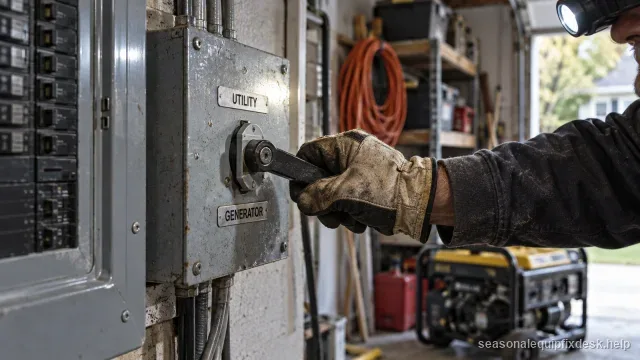
From that point, transfer-switch position, control wiring, breaker state, and utility/generator sensing may require qualified electrical service. Removing the transfer-switch cover during an outage is not an acceptable homeowner shortcut because utility power can return without warning.
Battery and charger warnings deserve seasonal attention
A standby battery can still light the controller while being too weak to crank reliably. If the unit reports a battery or charger warning, follow the controller’s battery test and maintenance guidance. Check terminals for obvious corrosion or looseness only with the unit disabled according to the manual. Battery replacement intervals and specifications are model-specific.
If a battery was replaced recently, confirm that the system was fully returned to service: charger power restored, terminals secured, covers installed, alarms cleared appropriately, and AUTO reselected. A maintenance action that leaves one enable step incomplete can surface only when the next outage occurs.
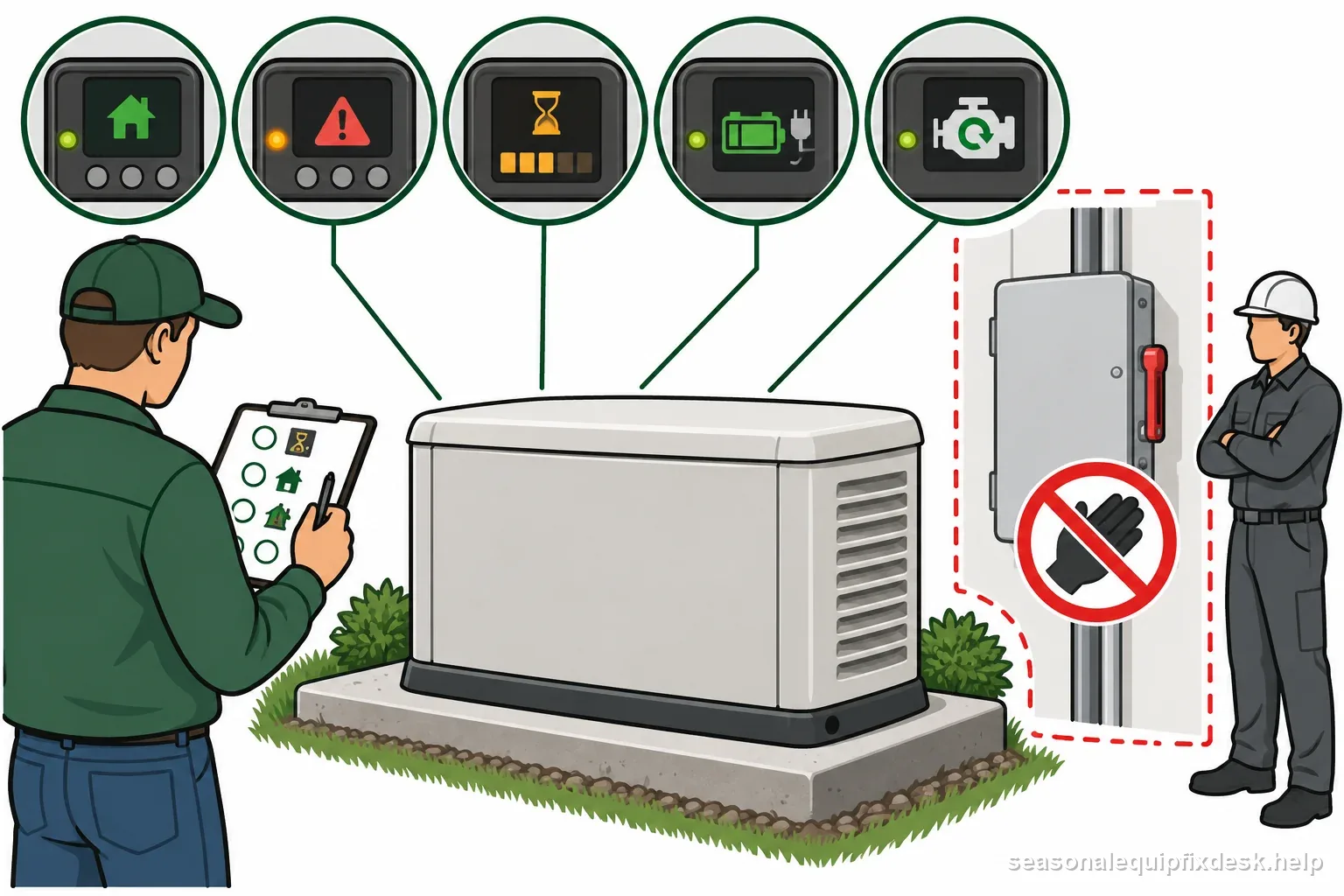
- Controller mode before outage
- Exact alarm text and countdown
- No crank, crank-no-start, or engine running
- House power/transfer observation
- Recent exercise and battery/charger warnings
- Do not open transfer switch
Use a safe event log instead of repeated outage simulations
- Controller mode before the outage: AUTO, OFF, MANUAL, or service.
- Exact alarm or warning text and whether a start-delay countdown appeared.
- Whether the engine never cranked, cranked without starting, or started normally.
- Whether the generator ran but protected house circuits remained de-energized.
- Recent exercise result, battery/charger warnings, maintenance, or fuel-service changes.
That sequence is more useful than repeatedly opening the utility disconnect to force starts. Any functional test involving service disconnects, transfer equipment, or energized conductors should follow the manufacturer procedure and applicable electrical requirements.
Escalate at the boundary between observation and live power work
Call for service when the controller reports a persistent fault, the engine repeatedly overcranks, the battery/charger system does not pass its built-in checks, the unit runs but will not transfer, or diagnosis would require opening the transfer switch. For gaseous-fuel systems, odor of gas or suspected fuel-supply problems also end the homeowner test.
The handoff should state the first missing event in the sequence. “AUTO, sustained outage, countdown completed, no crank, LOW BATTERY warning” is far more actionable than “generator did not work.” It also avoids replacing parts in a system whose controller was already telling you where the failure occurred.