Quick answer: A zero-turn that starts normally but will not move in either direction usually deserves a common-control diagnosis before anyone assumes both hydrostatic drives failed at the same time. Verify that both steering levers are in the operating position, the parking brake is actually released, and any tow/freewheel or hydro bypass controls are returned to drive. Only then move downstream to the shared drive belt and hydro inputs.
That order matters because zero-turns are deliberately built so control position and parking-brake logic can stop motion. Husqvarna’s current support specifically points to steering-control position and bringing both controls inward from the neutral/parking-brake position. A machine that was recently pushed, transported, or serviced may also simply have a bypass left in the release position.
Both sides dead is a pattern, not just a bigger failure
A shared command or input is usually a stronger first lead than two separate hydro failures appearing together. When left and right traction disappear together, check the common operator-control position, parking-brake state, paired bypass controls, and engine-to-hydro belt path before considering either transaxle.
Use the movement pattern to choose the next safe check. These clues do not identify a failed part by themselves; they help prevent a one-side fault or tracking complaint from being treated like a total drive failure.
| Observed pattern | What it points toward | Next check |
|---|---|---|
| Both sides dead forward and reverse | Shared controls, brake, paired bypass, or drive belt | Verify each position with the model manual; inspect the guarded belt path with engine off. |
| Only one side moves | One side’s bypass, brake, linkage, or hydro | Stop the paired-failure branch and compare the affected side with the working side. |
| Mower moves but drifts straight | Tracking or setup issue | Use the model-specific tracking procedure only after both sides drive. |
| Engine bogs or a wheel binds | Mechanical resistance or brake drag | Stop the test; do not add throttle or repeat powered checks. |
First question: was the mower recently moved by hand?
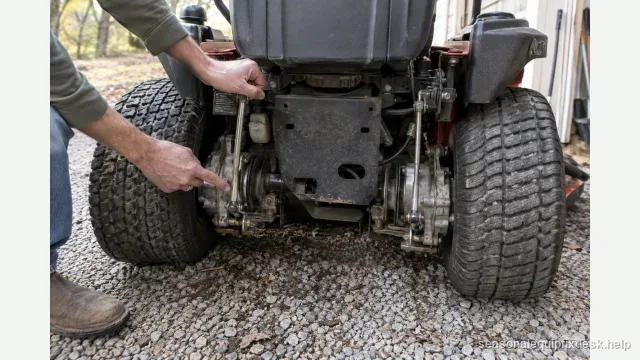
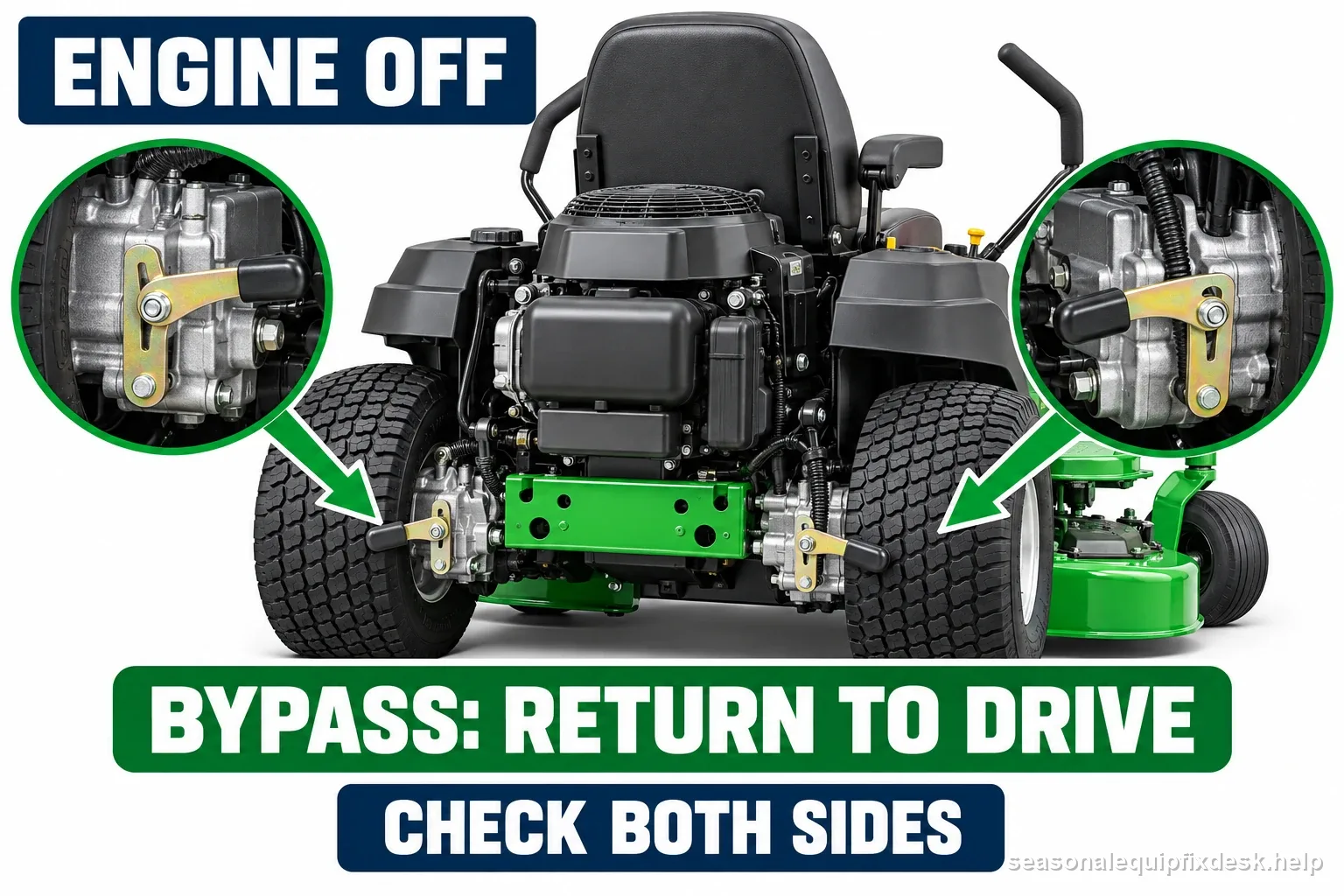
Zero-turns commonly have bypass or release controls that allow the machine to be rolled with the engine off. The exact lever, rod, or linkage location varies, so use the operator manual. If one or both releases remain in tow/freewheel, the engine can run and the steering levers can move while the drive units are intentionally disconnected from normal propulsion.
Do not “see what happens” by forcing the controls with a bypass half-engaged. Return each side fully to the documented drive position with the engine off, then retest. A bypass that will not seat or whose linkage is bent deserves repair rather than extra lever force.
Parking-brake and steering-lever geometry comes next
On many zero-turn designs the control levers themselves interact with the neutral/parking-brake position. If the levers are still out in the locked position, the mower is not being commanded to drive normally. Husqvarna also warns that failing to bring both controls inward together can invoke the safety system on applicable machines.
Watch for an obvious mechanical mismatch: one lever blocked by the seat, an adjustment that prevents a lever reaching its slot, or a brake linkage that remains applied after the controls are brought inward. Do not bypass an interlock switch to make the mower move. If the safety system is preventing operation, diagnose why the correct operator position is not being recognized.
Prove whether the hydro pumps are being driven
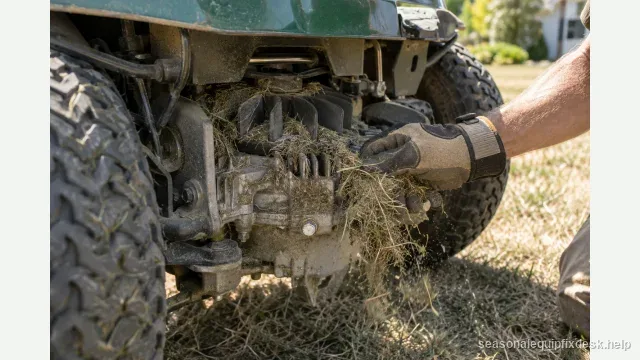
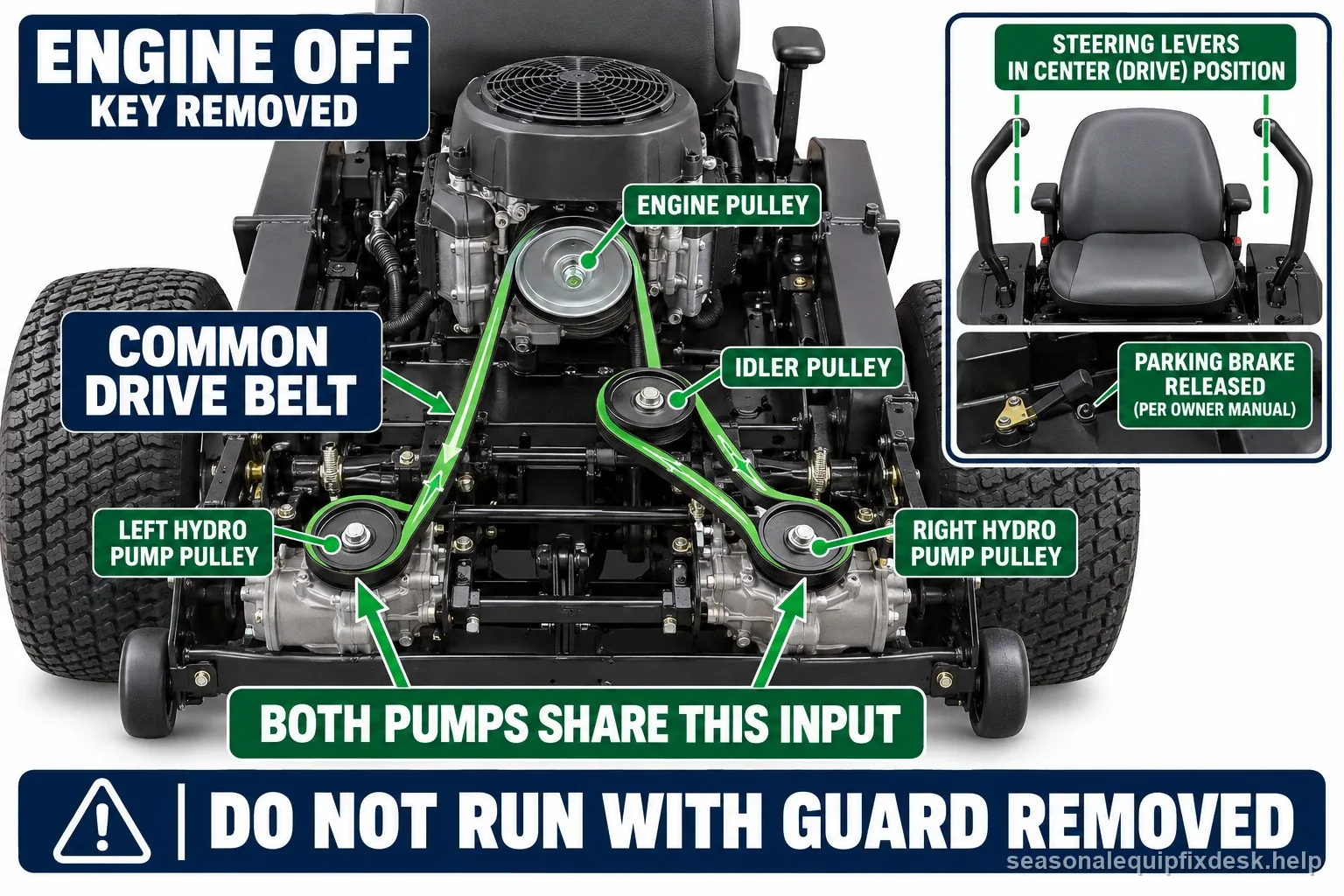
With the key removed, parking brake set, and the machine secured, inspect the engine-to-transaxle drive belt path that the owner manual exposes. A common belt can come off an idler or pulley, break, glaze, or lose tension. Grass and debris can also interfere with pulleys or linkage. If the belt is missing from a pulley, that single fault can explain why neither side responds.
Do not crawl under an unsupported zero-turn or work around a belt with the engine running. If observing belt motion requires defeating a guard or exposing rotating components, that is a service procedure, not a homeowner diagnostic shortcut.
Keep the complaint separated from a tracking issue. A mower that rolls but drifts usually needs a different adjustment than one that will not move in either direction. Also note whether the engine bogs when a lever moves: that can indicate resistance or a bound wheel, so stop rather than adding throttle to overcome it.
A control test should be symmetrical
- On a clear, level outdoor area, start the mower using the normal operator procedure.
- With blades disengaged, bring both steering controls into the operating position exactly as the manual describes.
- Command a small amount of forward travel with both levers equally. Note whether either tire twitches or tries to load the engine.
- Return to neutral, then command a small amount of reverse. A machine dead in both directions on both sides keeps the common-path diagnosis strong.
- If one side begins working during this test, stop treating the complaint as “both sides dead” and switch to a one-side comparison.
Hydro fluid is not a universal homeowner adjustment
Do not assume every zero-turn has a fill cap that should be topped off. Husqvarna states that consumer zero-turn and tractor transmissions are commonly maintenance-free unless the owner manual specifies regular fluid service. Commercial and older serviceable units can use different oils and capacities. Adding a generic “hydro fluid” to the wrong system can create an expensive second problem.
If your exact model has a serviceable reservoir, inspect level, leakage, hose condition, and any required purge procedure exactly as documented. If it is sealed or the manual sends loss-of-drive complaints to a dealer, respect that boundary.
- Whether both sides or one side failed, and forward/reverse behavior
- Whether mower was pushed, towed, transported, or recently serviced
- Position of paired bypasses, controls, brake, and shared belt path with engine off
- Any binding, creep, damaged belt, leak, or abnormal sound
- Model number and the manual procedure already followed
When two bad hydros finally becomes believable
Internal hydro failure moves higher only after the common controls are proven: bypasses are fully engaged for drive, parking brake releases, steering controls reach their range, and the shared belt actually turns the pump inputs. Even then, simultaneous internal failure of both sides is unusual; contamination, common overheating history, or previous service may provide the missing explanation.
A technician can work faster if you report the state of both inputs rather than just “won’t move.” Note whether the drive belt turns, whether either hydro makes a different sound, whether the mower was recently towed, and whether the failure was sudden or gradually weakened over several mowings.
Do not turn a no-drive problem into a safety-system problem
Avoid bypassing the seat switch, neutral logic, or parking-brake interlock. The correct repair restores both motion and normal safety behavior. After any linkage or belt work, confirm the mower stays still in neutral, releases the brake when commanded, responds evenly to small forward and reverse inputs, and stops when the controls return to neutral.
If the machine creeps, surges, or reacts unexpectedly after an adjustment, shut it down and revisit the control setup before mowing near slopes, fences, vehicles, or people. Do not repeat a powered test to collect more evidence when a wheel binds, a belt is visibly damaged, a leak appears, or the neutral/park behavior is unreliable.
For the matching drive or fuel symptom, see a zero-turn with one drive side that will not move.
| Observed pattern | More likely shared cause | First safe check |
|---|---|---|
| No movement in either direction | Controls, brake, paired bypasses, common belt input | Confirm controls and both bypass positions per manual |
| Only one drive wheel moves | Side-specific brake, linkage, or hydro fault | Compare sides; use the dedicated one-side diagnostic |
| Engine bogs or a wheel binds | Mechanical resistance or brake not releasing | Stop; do not add throttle or keep testing |
| Mower moved by hand before failure | Tow/freewheel bypass left released | Set both releases to documented drive position |
| Moves but drifts on a straight line | Tracking/alignment issue | Use model-specific tracking procedure after both sides drive |
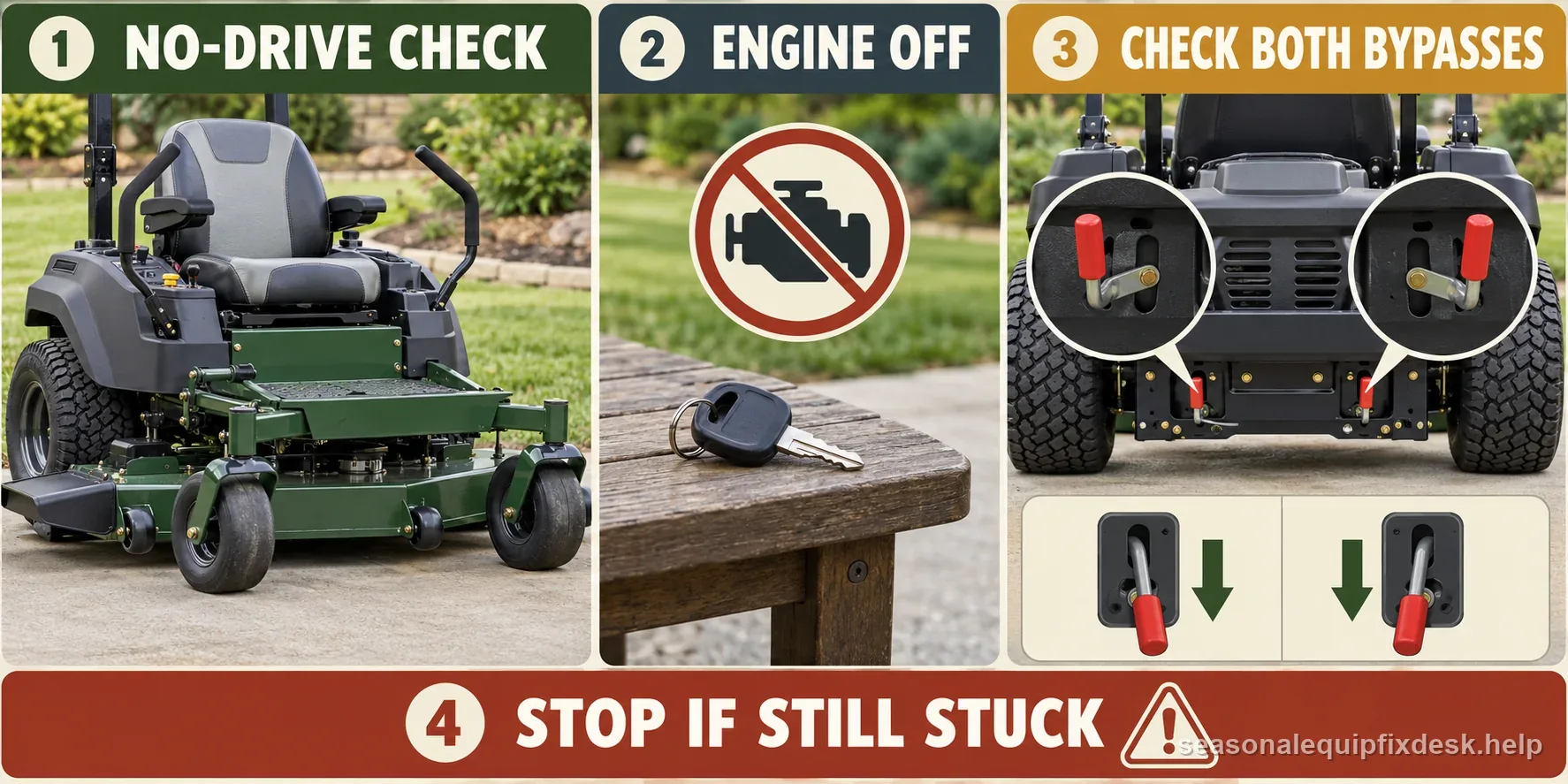
Use this as a visual summary; follow the exact equipment owner manual for any operation or maintenance.