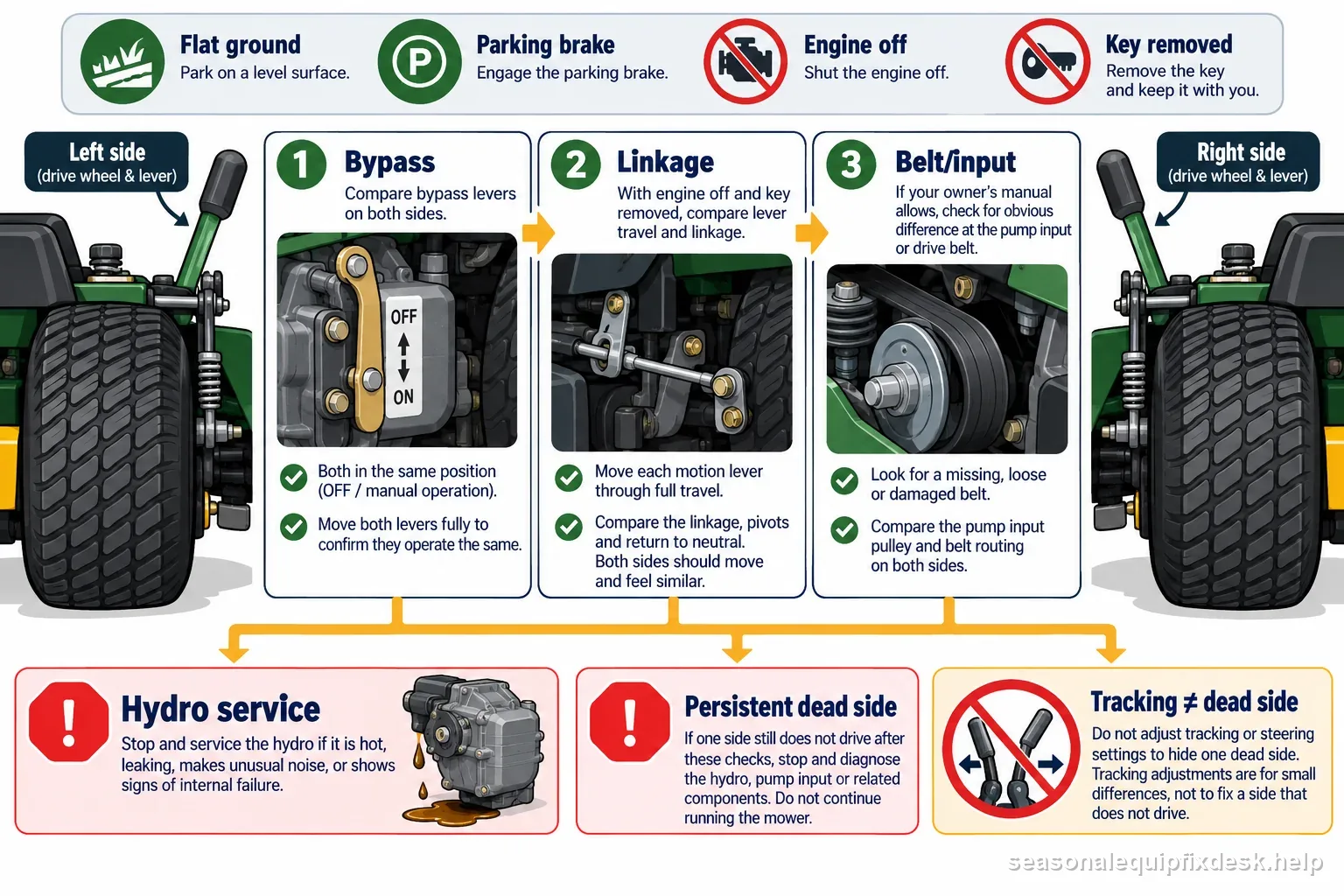
Quick answer: If the right side drives and the left side does not—or vice versa—use the working side as your built-in reference. Compare bypass position, steering-linkage travel, brake release, pump pulley/input motion, and wheel response side by side. A one-side failure is fundamentally different from a zero-turn that will not move at all because the engine and much of the common drive path are already proven by the side that still works.
If both drive sides stop, begin with the shared control and bypass positions before tracing the one-sided steering or hydro pattern. See the zero-turn mower that will not move forward or reverse guide for the matching checks.
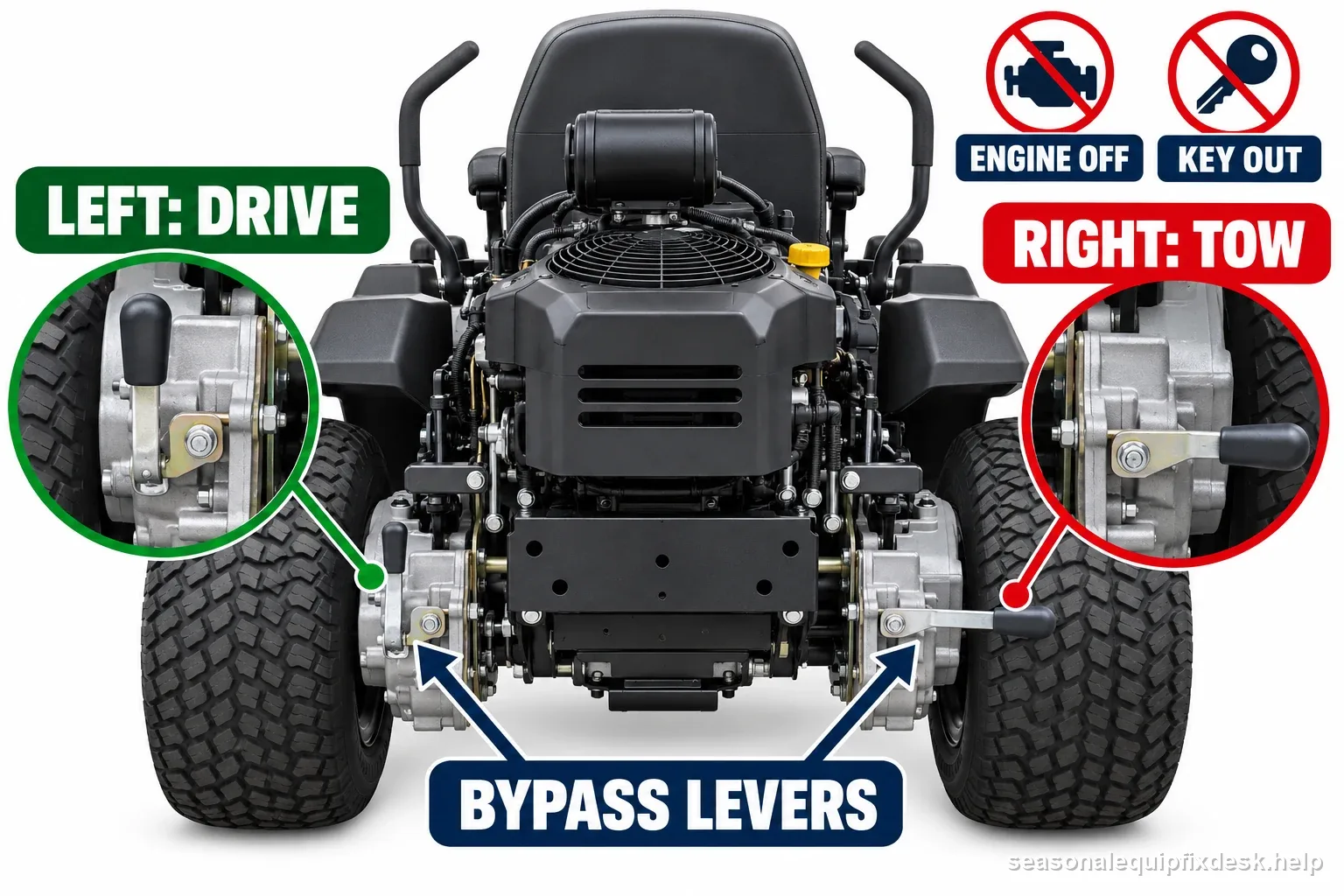
Before any inspection, park on a hard, level surface, disengage the blades, set the parking brake, stop the engine, remove the key, and wait for moving parts to stop. Follow the model’s manual for battery isolation and safe access. Never crawl under a mower supported only by a jack, reach toward a belt with the engine running, or bypass a seat, brake, or neutral safety switch.
Write down exactly what the weak side does
- No tire movement in forward or reverse: look for a disconnected command, bypass still released, brake drag, missing input, or failed hydro unit.
- Moves in one direction but not the other: linkage travel and hydro control geometry deserve more attention than a simple shared drive-belt theory.
- Moves, but much slower than the other side: distinguish tracking/adjustment from a developing traction fault.
- Jerks, chatters, or changes after warming: stop treating it as a simple lever-alignment problem and preserve the temperature/load clue.
The distinction matters because some zero-turns allow tracking adjustment while others do not. Husqvarna notes that larger units may have a tracking adjustment in the operator manual, whereas some smaller consumer models do not. An adjustment intended to make two healthy sides track evenly cannot repair a side that produces no drive. Hydro-Gear’s ZT-2100/2200 service troubleshooting treats one-direction-only operation as its own branch and lists linkage, belt or pulley, oil, bypass, and trapped-air checks. Those details apply to those transaxles only; use the exact model manual before fluid service or a purge.
Compare the two bypass controls before touching linkage
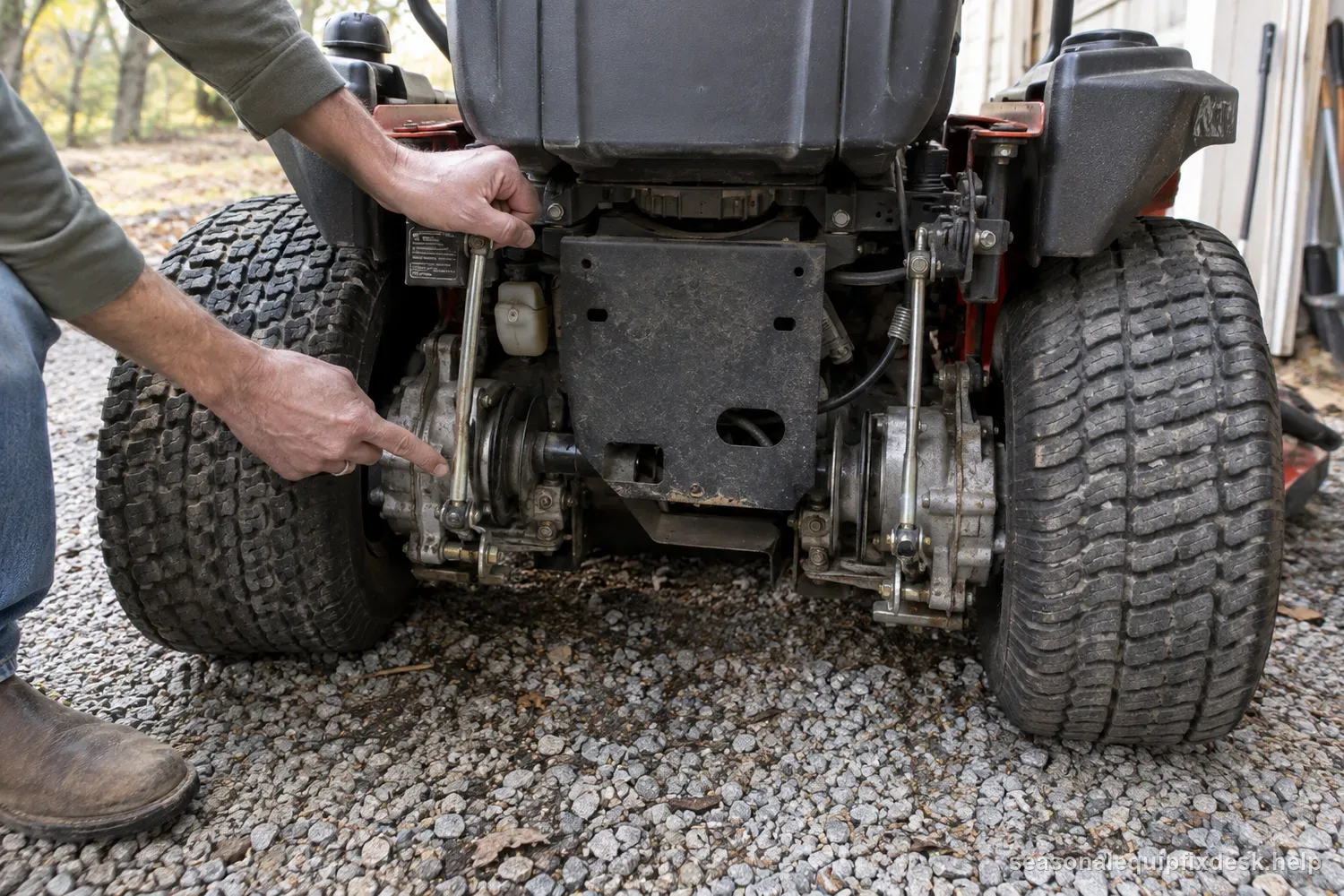
A mower that has been rolled, trailered, or serviced may have only one bypass control returned to the drive position. With the engine off and key removed, find the left and right release locations specified for the model. Compare the physical position and seating of each side. A visible position difference between the two sides can be more useful than an internal hydro theory.
If a bypass is bent, sticky, or will not latch in the documented drive position, repair the linkage rather than tying it in place. The release must still work correctly when the machine needs to be moved without engine power.
Steering lever travel should look like a mirror image
Sit in the operator position with the machine shut down and compare how far each control lever travels forward, backward, and into neutral. Look at the linkage beneath or behind the controls only where the manual permits. A loose fastener, slipped adjustment, bent rod, or disconnected joint can leave one hydro control arm near neutral even though the hand lever appears to move.
Husqvarna publishes a control-lever alignment procedure for certain zero-turns. That procedure is about lever alignment, not permission to force the hydro control arm beyond its designed range. If lever geometry is visibly different, restore it to model specification and retest before moving deeper. For the Husqvarna models covered by its current support procedure, bring both steering/park-brake controls inward together; a safety shutdown after moving them separately can look like a drive fault. Apply that sequence only to a model the support page covers.
Brake drag can imitate a weak hydro
Some systems combine parking-brake logic with steering-control position. If one side’s brake linkage does not release fully, the hydro may be trying to drive against a brake. The useful clue is resistance: with the transmission released for transport according to the manual, compare how freely each drive wheel turns or how the machine rolls. Do not defeat a brake interlock or disconnect braking hardware for a powered test.
| Observed response | Problem class | Direction |
|---|---|---|
| Both wheels drive; mower slowly veers | Tracking / tire / input comparison | Use the model-specific tracking procedure |
| One wheel does not propel | Bypass, brake, linkage, belt, or hydro side | Park and inspect only permitted external items |
| One side fades only when hot | Heat-related belt, brake, or drive fault | Record time/load and arrange service |
| Leak, binding, noise, erratic control | Stop-use condition | Do not keep operating to test |
A tracking adjustment is for a mower that drives on both sides; follow the exact manual for any powered test.
Does the affected pump input actually turn?
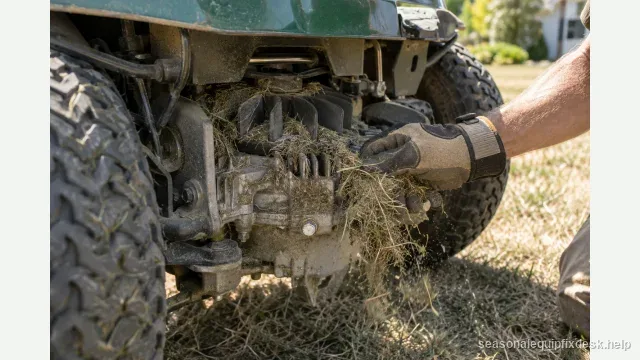
The working side proves the engine is running and the main drive system has some function, but a one-side pulley, belt segment, coupling, fan, or input component can still fail. With the machine secured and shut down, compare the left and right hydro pulley area for a thrown belt, damaged fan, debris, missing hardware, or an obvious pulley problem.
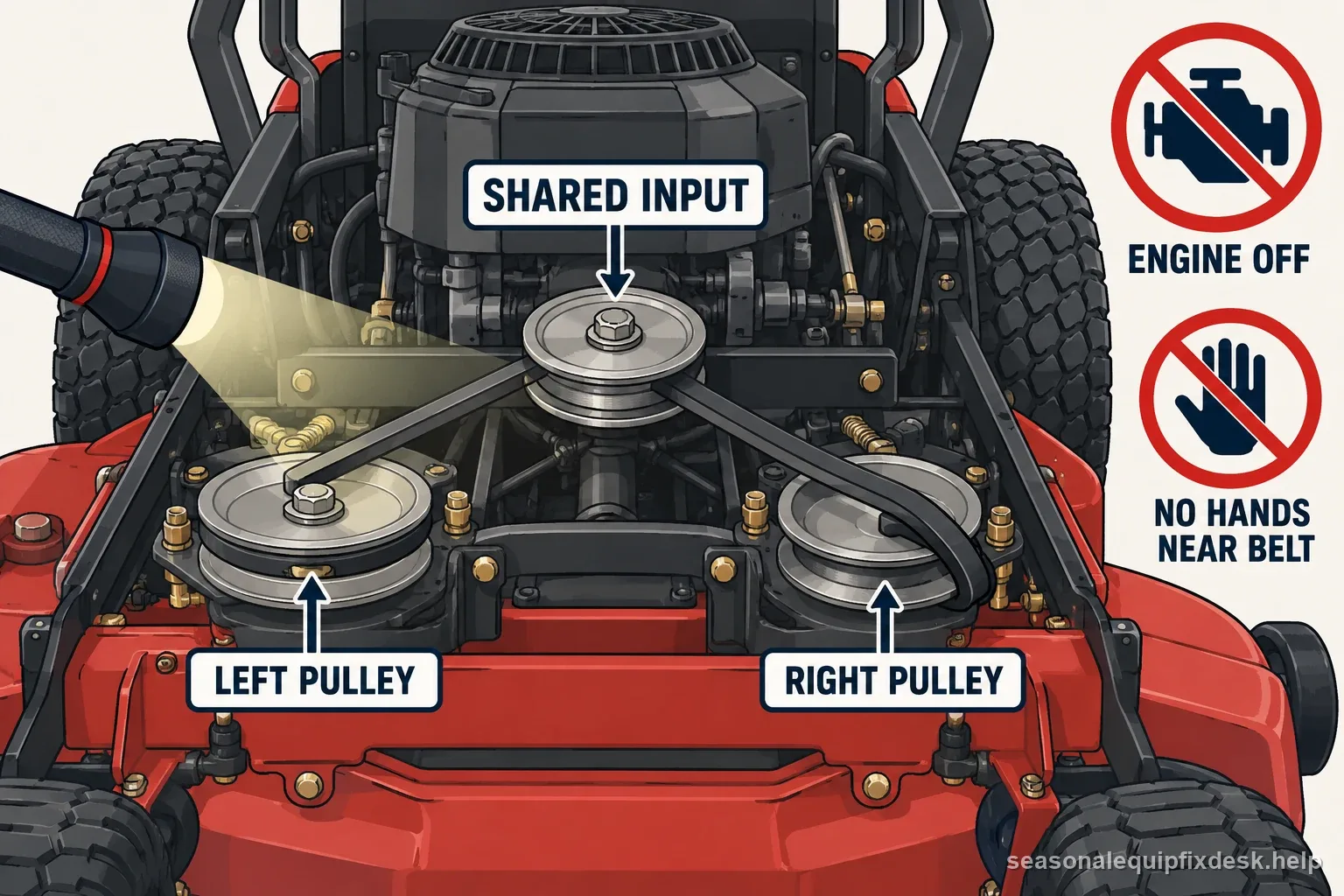
A common belt may power both transaxles, while some designs use separate components. That is why a one-side complaint does not prove the belt is good or bad by itself. Use the parts diagram and manual for the exact routing, and stop if checking the belt requires lifting the mower or removing a guard beyond routine owner maintenance.
If the design uses one common belt around both hydro pulleys, inspect how that belt sits on the affected pulley. A belt can remain on the system yet ride incorrectly on one pulley or lose wrap because an idler or bracket has shifted.
Do not use tracking adjustment to hide a dead side
Tracking is for a mower that drives but does not travel straight when the controls are held equally. If one tire does not rotate under a small command, turning a tracking screw until the other side is slower only masks the fault. First restore equal mechanical capability; then perform any tracking procedure the operator manual allows.
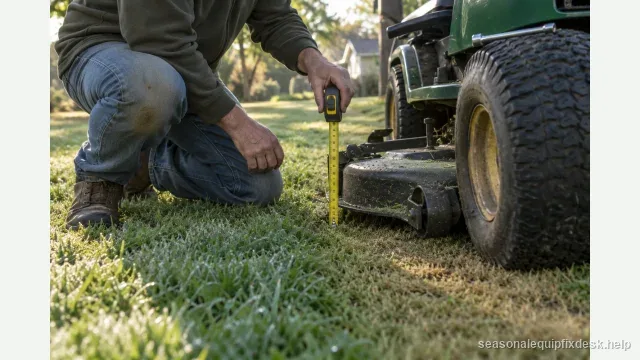
Tire pressure can affect straight-line tracking, but it does not explain a drive wheel that is completely stationary. Hydro-Gear lists improperly inflated tires under a separate “does not drive/track straight” branch, so keep a dead-side fault on the bypass, brake, linkage, belt, and hydro path.
Classify the symptom before making adjustments: note whether the weak wheel is completely stationary, moves only forward or reverse, slips under load, or fails only after warming up. A mower that drives on both sides but gradually pulls across a flat surface has a tracking complaint; a side that does not propel at all needs a different diagnosis. Toro’s manuals separate these conditions, so do not use a small tracking correction to conceal a failed drive side.
Keep engine-off comparisons truly external. With the machine parked level, brake set, blades disengaged, engine stopped, and key removed, compare both bypass controls, lever travel, and visible belt routing only where the owner manual permits access. Do not raise the mower and run the wheels in the air unless the exact service procedure specifies secure stands and trained handling. Stop for a leak, binding wheel, unusual hydro noise, or unpredictable movement.
Do not improvise a raised-wheel purge or inspect a moving belt with the engine running. Use only the procedure and setup in the exact service manual; stop for binding, screeching, leakage, or unexpected movement.
When the hydro unit becomes the leading suspect
Internal trouble is plausible after the external comparison is clean: bypass positions match, both brake sides release, lever/linkage travel reaches the hydro controls, the common belt is correctly driving both inputs, and there is no wheel-end mechanical disconnect. If the affected hydro input turns but its wheel output remains absent or weak, dealer diagnosis is reasonable.
On serviceable systems, model-specific fluid level, leakage, and purge procedures may add information. On sealed consumer units, do not invent a fluid service. A one-side leak, failed cooling fan, or hot-only fade should be documented for the technician rather than “fixed” with unspecified oil.
Stop the test if the mower screeches, a wheel binds, fluid leaks, or the machine moves unpredictably. Do not “purge” the hydro by improvising a raised-wheel procedure: Hydro-Gear service instructions describe model-specific conditions, including wheels off the ground and engine operation, so use that only when the exact manufacturer procedure applies and the setup can be secured safely.
A side-by-side retest catches false repairs
- Restore every guard and verify both bypass controls are in normal drive position.
- Only if the owner manual permits an operator retest, use a level, open area with blades off, bystanders clear, and the operator seated correctly. Make a small forward input and observe whether both sides begin moving together; stop at noise, binding, or unpredictable travel.
- Return to neutral and repeat in reverse. A repair that fixes forward but leaves reverse dead is incomplete.
- Drive a straight low-speed line. Only after both sides clearly propel should you evaluate tracking.
- After several minutes, repeat the straight-line check if the original problem appeared warm.
Record the left and right lever travel, bypass position, visible belt/input condition, brake release, and wheel response separately. The comparison table below keeps those observations together for a service call.
| Observation | What it points toward | Safe next step |
|---|---|---|
| One bypass control sits differently | Bypass/freewheel state | Set both sides exactly as the owner manual describes, with engine off |
| Lever travel differs or linkage is loose | Control rod, adjustment, or joint | Inspect only accessible linkage; use model-specific adjustment specs |
| Squeal, binding, or brake drag on dead side | Belt/input, brake release, or mechanical fault | Stop operating; do not compensate by slowing the working side |
| Inputs appear equal but one wheel remains weak | Side-specific hydro/transaxle or internal drive fault | Record conditions and request qualified model-specific service |
| Both sides become weak | Shared belt, engine power, or common drive condition | Broaden diagnosis beyond the single-side branch |