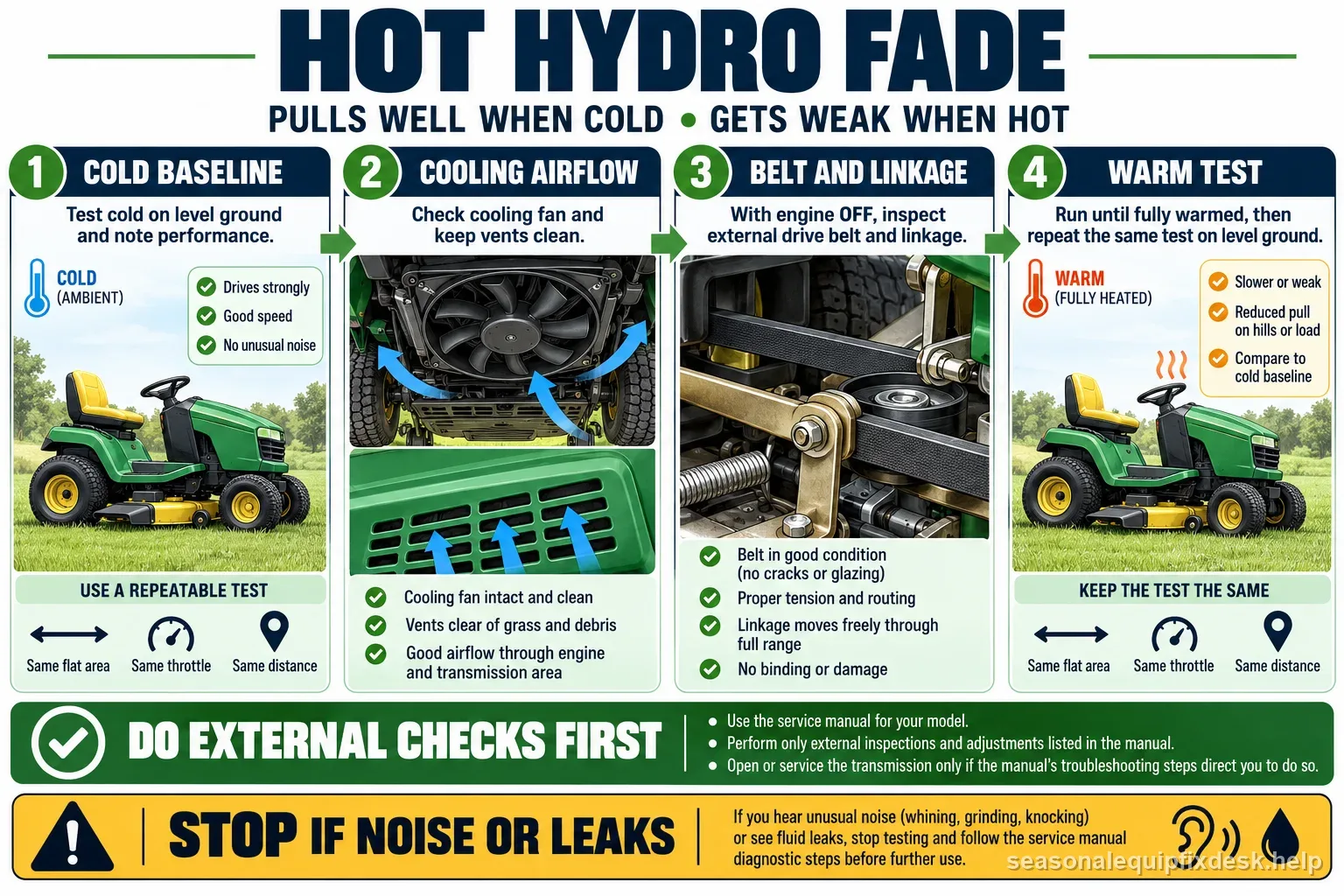
Quick answer: “Pulls normally cold, then slows or stops after the transaxle gets hot” is not the same complaint as a mower that never moves. Preserve the warm-up timeline. Clear cooling airflow, confirm the freewheel control is fully engaged, inspect the motion-drive belt and external linkage, and then stop short of generic fluid experiments. Husqvarna explicitly identifies cold-normal/hot-weak behavior as a common symptom of a faulty transaxle that should be handled by an authorized technician.
A machine with no motion in either direction needs the operating controls, brake, bypass state, and shared drive path checked before an internal hydro diagnosis. See the zero-turn mower with no forward or reverse drive guide for the matching checks.
That manufacturer boundary is important. Many consumer tractor and zero-turn hydrostatic transmissions are described as maintenance-free unless the owner manual specifically lists fluid service. There is no universal “top off the hydro” repair.
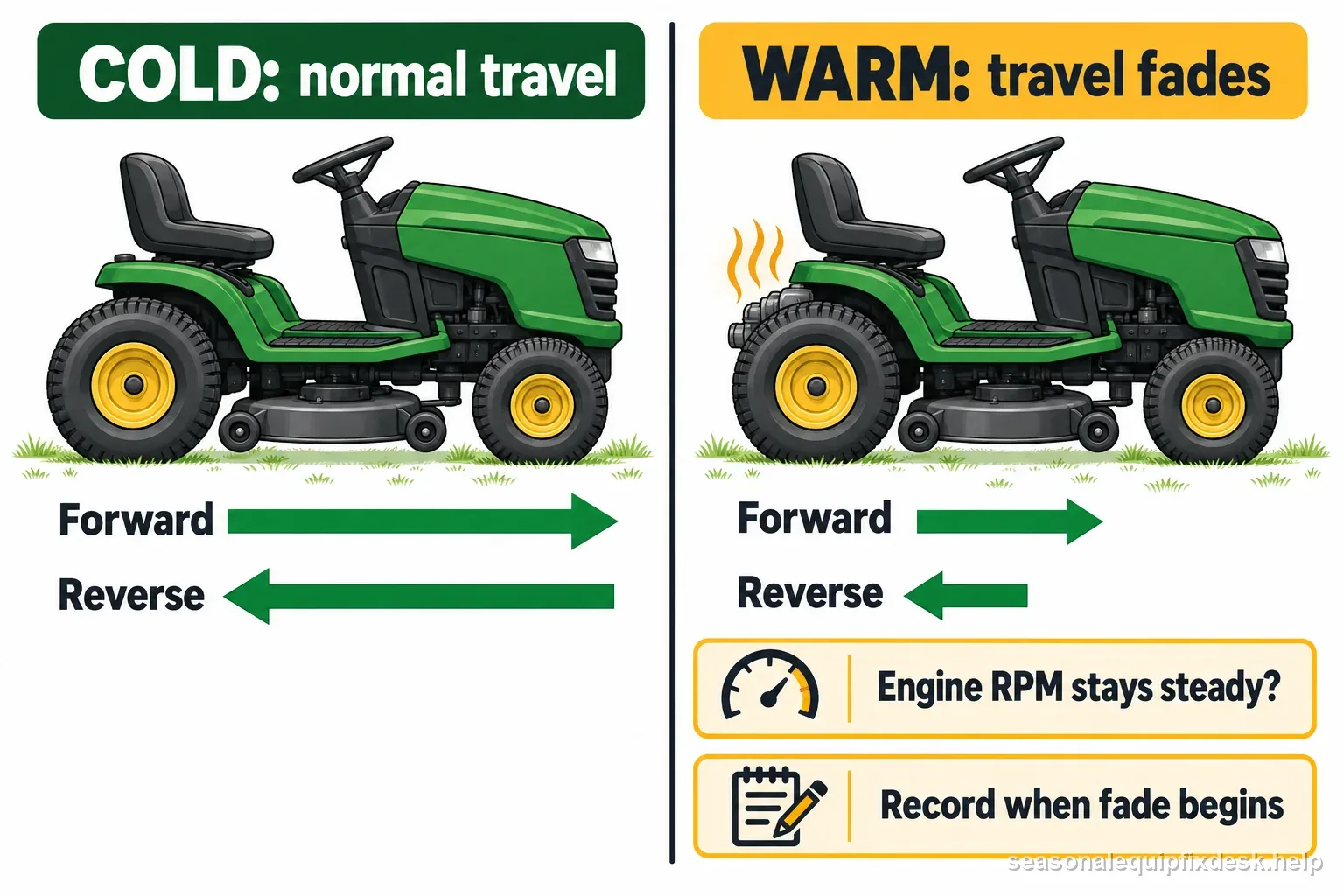
Measure the fade instead of calling it “weak”
Before changing anything, record how the machine behaves from a cold start on the same route. Note approximately when ground speed begins to fall, whether reverse weakens at the same time as forward, whether the engine maintains normal speed, and whether the symptom appears sooner on hills or while towing. A consistent 20-minute heat fade carries different information than an intermittent linkage problem that occurs from the first minute.
If engine RPM also drops, separate engine power loss from hydro traction loss. A transmission diagnosis assumes the engine remains capable of producing its normal speed while ground travel fades.
Cooling is the first external check
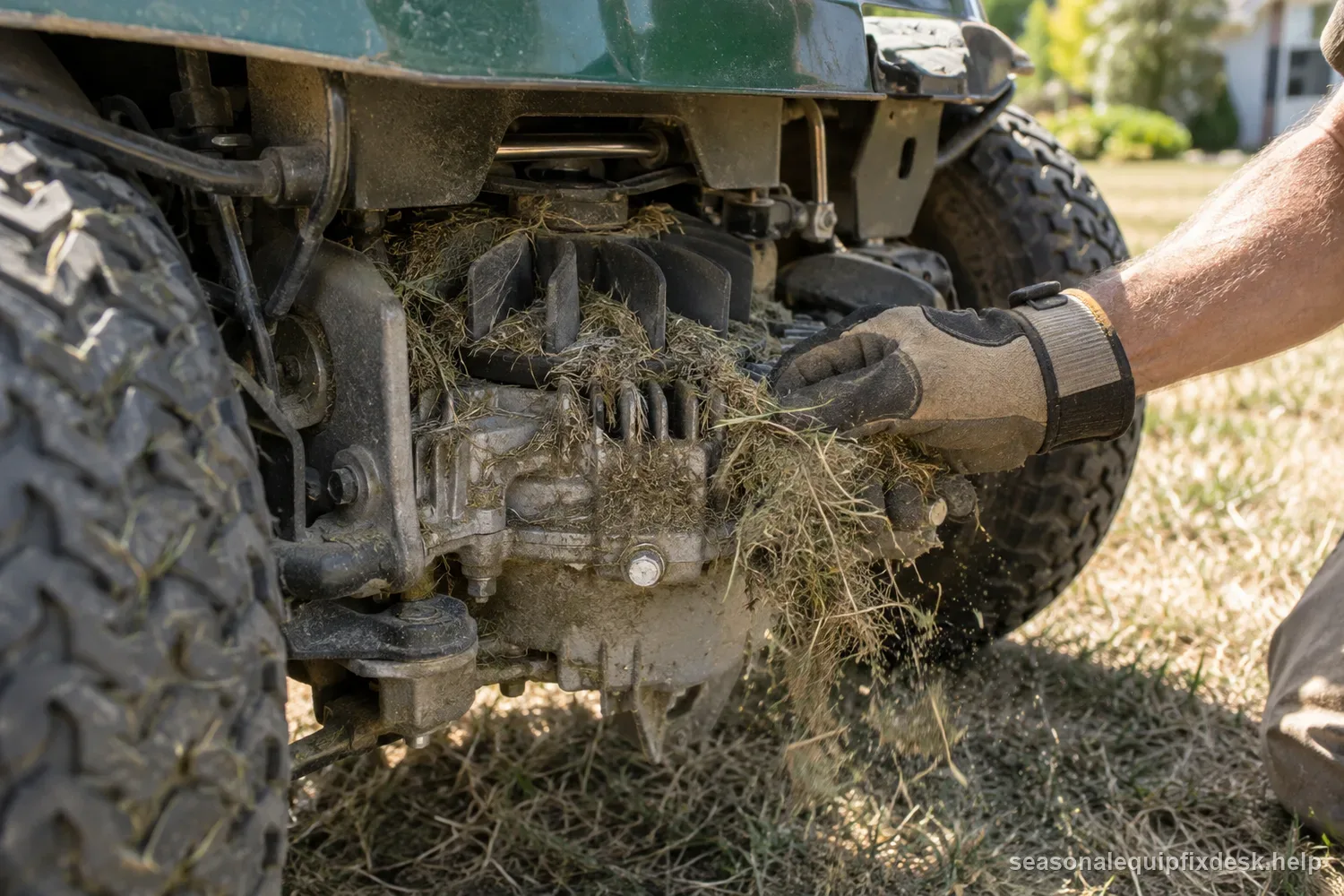
Hydro units shed heat through their case, cooling fan, and surrounding airflow. With the key removed, engine off, and transmission completely cool, inspect the fan blades, cooling fins, and area around the transaxle for grass or debris. Husqvarna says to keep the fan and fins clean, but warns against cleaning while hot or running, compressed air on the fins, and high-pressure water or steam on the transmission. Use the method allowed by your exact manual; a broken fan blade or packed debris can restrict cooling.
If buildup is present, remove it only after the transmission is cool and with the cleaning method allowed by the owner manual. Do not direct a pressure washer or steam at the transaxle or force water into seals.
A slipping motion belt can imitate hot hydro fade
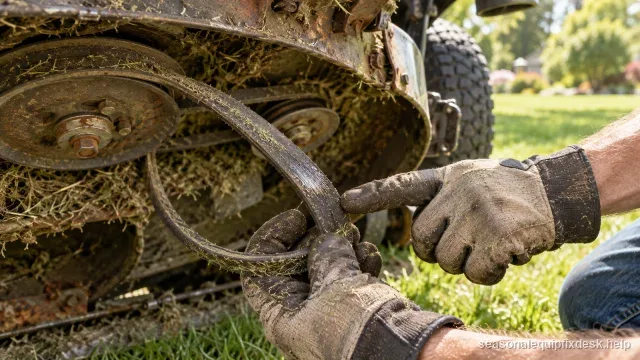
Rubber belts change behavior with temperature and load. Inspect the motion-drive belt for glazing, narrowing, cracking, oil contamination, or rubber dust. Check the tensioning and idler path the manual exposes. If the engine maintains speed but belt slip increases as the tractor warms, input torque to the transaxle can fall even though the hydro itself is not yet proven faulty.
Look for corroborating evidence: hot rubber smell, black dust near a pulley, a tensioner that does not travel freely, or a belt that was recently replaced with a non-matching size. Do not spray belt dressing as a diagnostic shortcut.
| Engine-off observation | Likely external branch | Next safe check |
|---|---|---|
| Cooling fan or vents packed with grass | Restricted airflow | Clean only as the manual permits, with the engine stopped and cool |
| Belt shows cracks, glazing, or slack | Motion-drive belt | Use the model routing and service procedure |
| Freewheel control not fully seated | Transport bypass | Return it to the documented drive position with the machine off |
| External path looks sound but fade repeats warm | Possible internal hydro issue | Record warm-up time and load for a technician |
Freewheel control must be fully in drive
Riding tractors use a freewheel or bypass control so the machine can be pushed with the engine off. Husqvarna’s loss-of-drive guidance instructs owners to place that control in the engaged position. A linkage that is not fully seated can reduce drive or create a confusing partial-motion complaint.
Compare the control position cold and after the mower has weakened. If vibration or linkage wear lets the control creep, the external problem may be visible. Repair the linkage; do not wire or tie the bypass permanently in one position.
Fluid advice has to be model-specific
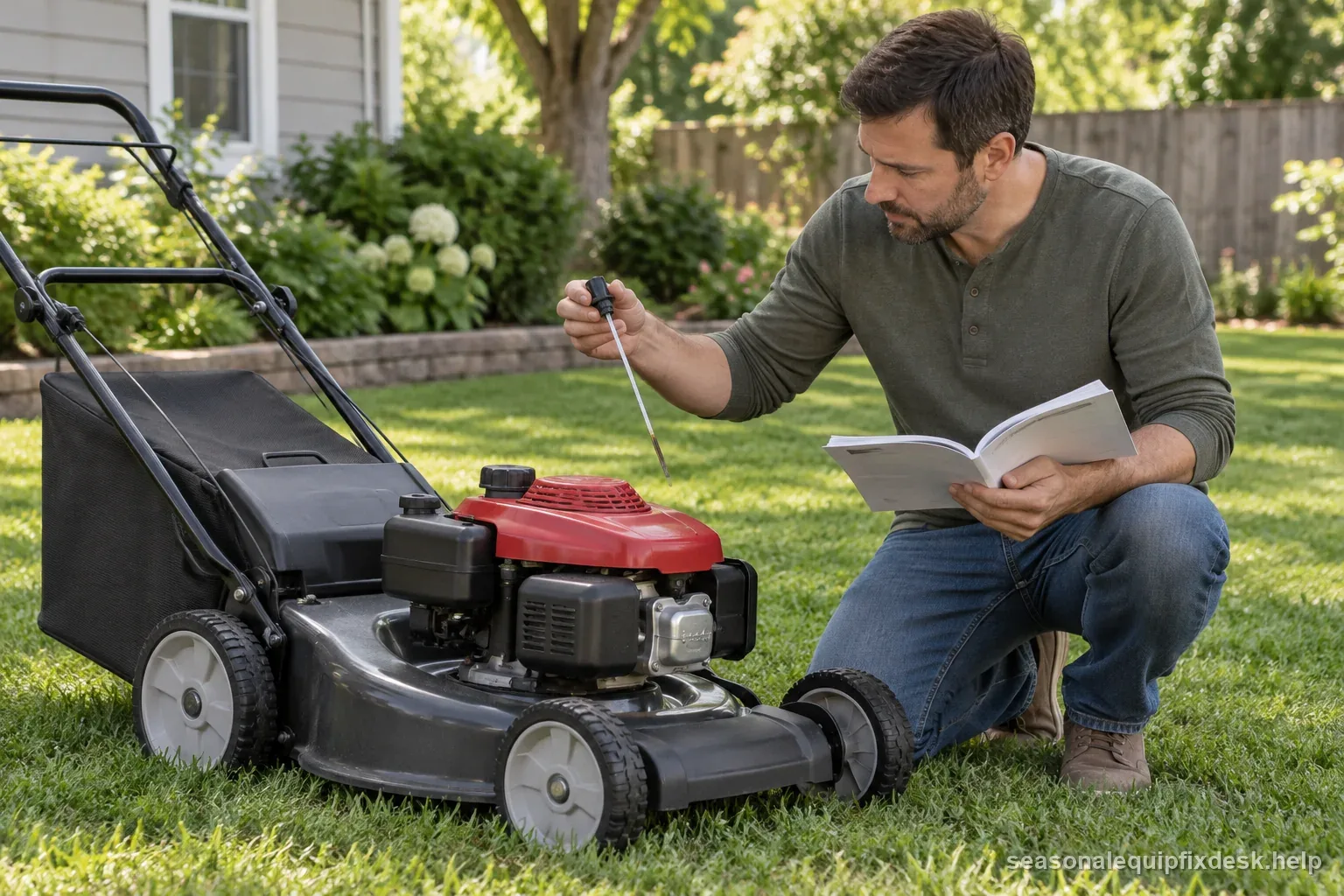
Do not remove a plug merely because it looks like a fill point. Husqvarna states that consumer zero-turn and tractor transmissions generally do not require routine fluid changes unless the owner manual says otherwise, while some older or commercial systems do list specific oil grades. The wrong fluid, level, or opening procedure can introduce air or contamination.
If your model is explicitly serviceable and the manual provides a reservoir level or purge procedure, follow that document exactly. Husqvarna’s published purge procedure is intended for specified situations such as initial setup or after transmission removal; it is not a blanket cure for internal wear.
Why hot-only weakness points inward after external checks
Hydrostatic drives rely on close internal clearances. As oil temperature rises, viscosity changes, and internal leakage across worn pump or motor surfaces can become more pronounced. That mechanism is why a worn transaxle can feel acceptable cold and lose pulling force hot. It also explains why adding thicker unspecified oil is not a legitimate diagnosis: it can mask a symptom while violating the system’s lubrication requirements.
The correct escalation point is reached when cooling is clear, the motion belt is sound and remains engaged, the freewheel control is fully seated, engine speed is normal, and the same heat-fade repeats. At that point, the manufacturer’s dealer recommendation is more appropriate than opening the transaxle on speculation.
| Observed pattern | What it may indicate | Next safe check |
|---|---|---|
| Normal cold; forward and reverse fade warm while engine speed stays steady | Heat-sensitive transaxle symptom | Confirm cooling is clear; arrange authorized service if the repeatable fade remains |
| Weak only under hill or tow load | Load-sensitive belt or hydro issue; symptom alone does not prove internal failure | Avoid slopes and tow loads; inspect the motion belt and compare only on level ground |
| Engine speed drops as travel slows | Engine power loss may be part of the complaint | Diagnose the engine symptom separately before concluding the hydro is weak |
| Drive returns after a full cool-down | A repeatable heat-related fault remains possible | Record the time to fade and recovery; do not treat cooldown as a repair |
A controlled warm test gives the shop useful data
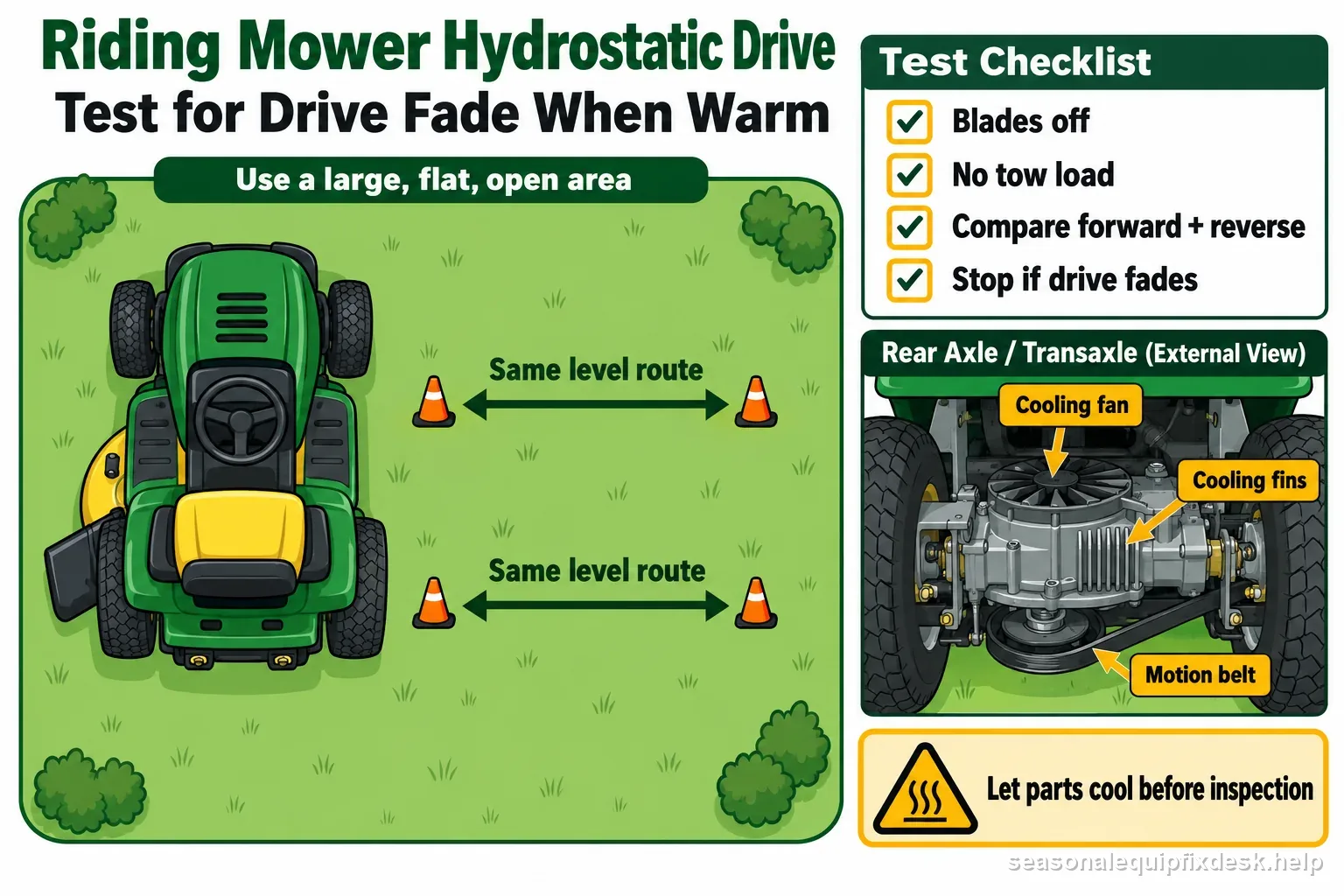
- Begin with the mower cold on level ground, blades off, and no tow load.
- Run a fixed short route and note ground response in forward and reverse.
- Continue only if operation is safe, then repeat the same route at the time the original fade usually appears.
- If travel slows while engine speed stays normal, stop before the unit completely loses motion on a slope.
- After shutdown, note unusual heat, belt odor, leakage, or fan damage without touching hot transmission surfaces.
- Start cold on level open ground with blades off and no tow load.
- Use the same short route and note forward, reverse, and engine-speed behavior.
- Repeat only while travel remains controlled; record when the fade starts.
- Stop before a slope or complete loss of motion; never touch hot transaxle parts.
- After the machine is fully cool, inspect only external fan, fins, belt, and linkage as the manual allows.
Do not “test” a weak hydro on a hill
A mower that may lose propulsion as it warms should be diagnosed on level open ground. Losing drive downhill, on a trailer ramp, or near a ditch can turn a mechanical fault into a rollover or collision. Avoid towing loads during diagnosis because it both increases heat and obscures the baseline.
For service, bring the model number plus the warm-up timeline: cold speed normal, fade begins after a repeatable interval, engine speed stays normal, forward/reverse behavior, and whether the drive recovers after cooling. That is the evidence that distinguishes heat-sensitive hydro performance from a general “mower feels slow” complaint.
For the matching drive or fuel symptom, see a zero-turn side that loses drive when hot.