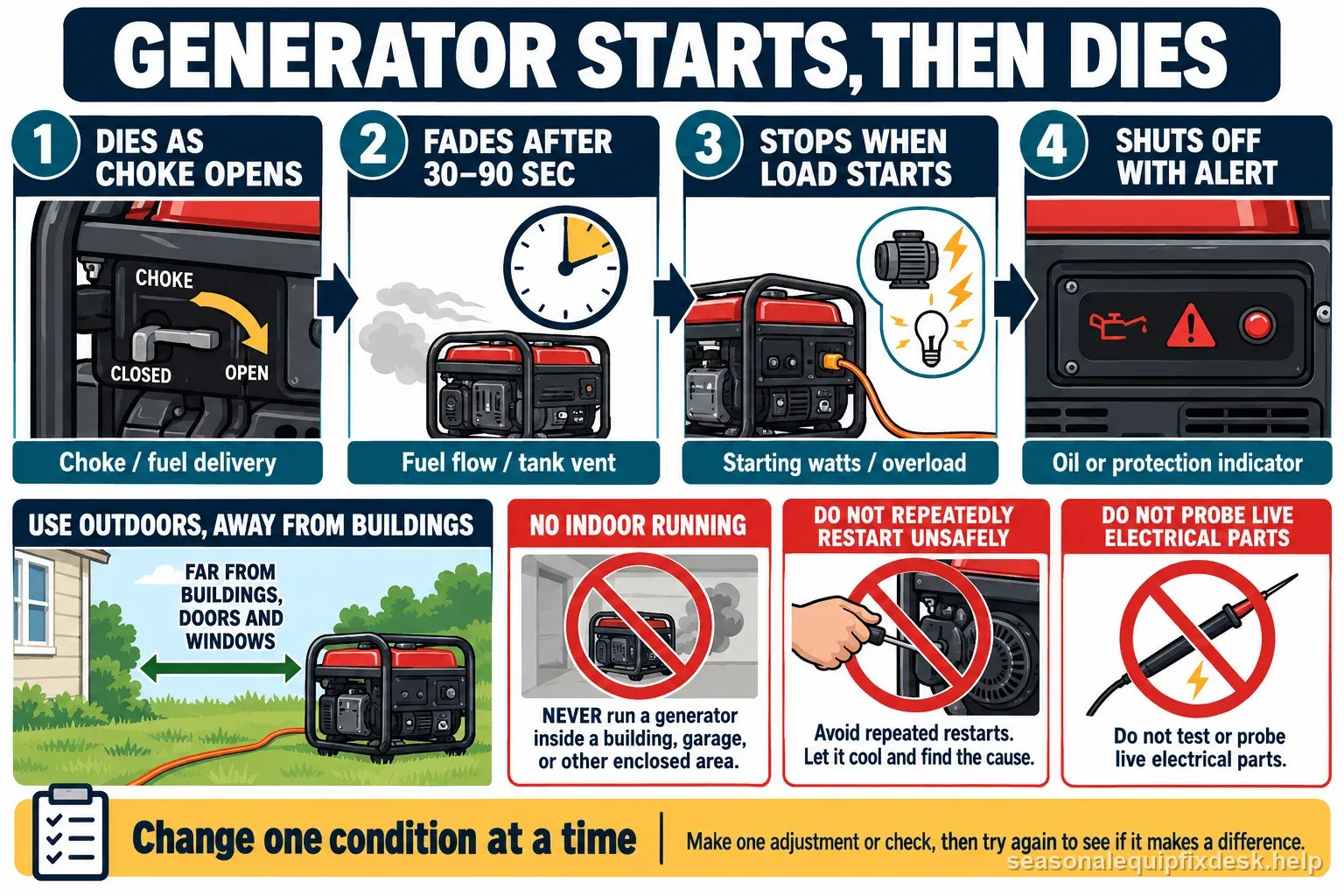
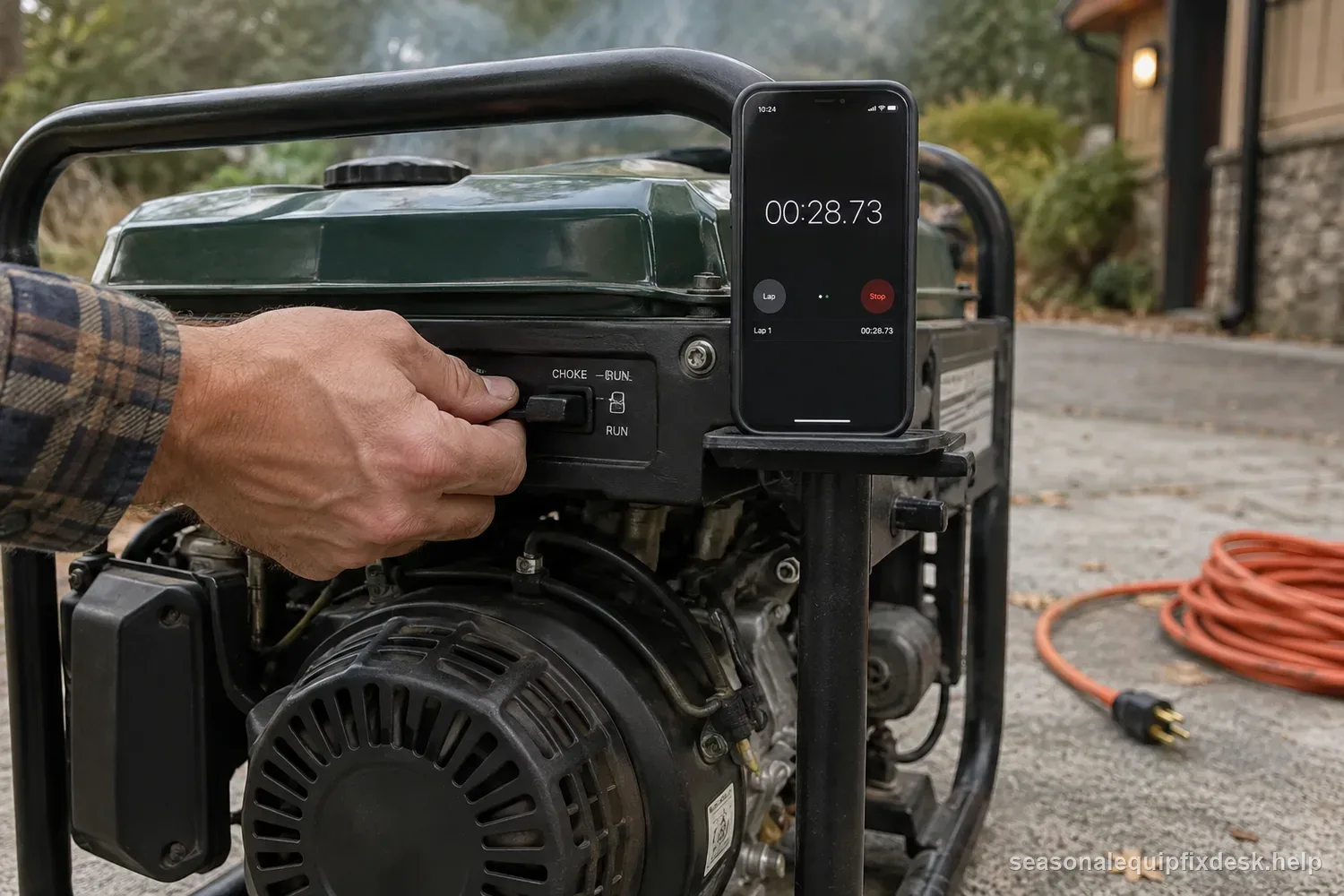
Quick answer: Time the shutdown. A generator that dies the instant the choke moves to RUN is telling a different story from one that runs for 30–90 seconds until the carburetor bowl empties, or one that runs indefinitely with nothing plugged in but stalls when a refrigerator starts. The clock is the fastest way to stop treating every “starts then dies” complaint as the same carburetor problem.
A generator that starts and then stops is not the same as one that runs without transferring load. See the transfer-switch checks for the latter symptom.
All running tests belong outdoors more than 20 feet from doors, windows, and vents. Keep loads disconnected until the engine proves it can run steadily by itself.
| Observation | Possible meaning | Next step |
|---|---|---|
| Dies as choke opens | Mixture or fuel metering | Record choke position and start steps |
| Fades after brief run | Fuel refill, vent, or contamination | Record elapsed time and fuel source |
| Stops with indicator | Oil, CO, or protection system | Read warning before restarting |
| Dies when load begins | Load or engine response | Disconnect load; never bypass protection |
| Observation | Possible meaning | Next step |
|---|---|---|
| Dies when load begins | Load or engine response | Disconnect load; never bypass protection |
| Stops with indicator | Oil, CO, or protection system | Read warning before restarting |
| Fades after brief run | Fuel refill, vent, or contamination | Record elapsed time and fuel source |
| Dies as choke opens | Mixture or fuel metering | Record choke position and start steps |
Dies as the choke opens: follow the mixture clue
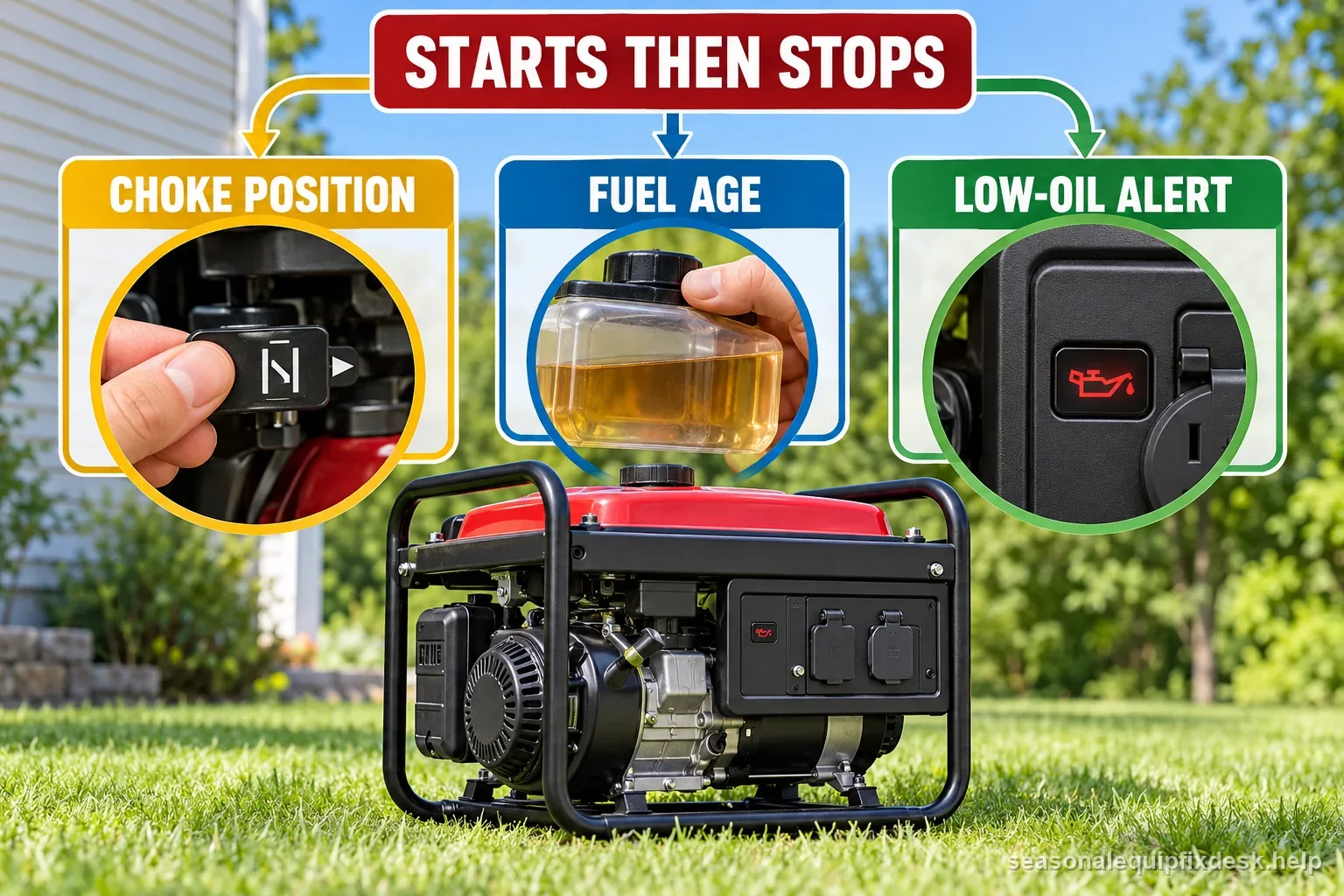
Generac’s current choke guidance covers the exact behavior where an engine starts with choke but shuts down when moved toward RUN. Full choke enriches the mixture. If the engine needs that enrichment after the normal warm-up period, fuel metering may be too lean because of stale fuel deposits, restricted carburetor passages, or a choke control that is not moving as expected.
Do not keep the choke fully closed simply to keep the generator alive under load. That can cause poor combustion and fouling while hiding the original fuel problem. Verify fresh correct fuel and the documented choke transition first.
Runs briefly, then fades: think about bowl refill and tank breathing
A gasoline engine can start on the fuel already in the carburetor bowl, then die if the bowl is not replenished. Watch the shutdown character. A gradual sag or hunting before it quits can fit starvation better than a crisp electronic shutdown.
Check the fuel valve position, line routing that is externally visible, and tank-cap/vent instructions for the model. Do not drill or permanently modify a cap. If loosening a cap is an authorized diagnostic step for that design, perform it only outdoors away from ignition sources and replace a defective cap rather than operating with a makeshift vent.
A dirty carburetor is plausible only when the timeline fits
Generac notes that old fuel can gum a portable generator carburetor and that cleaning may address “starts and then powers off” behavior. That does not mean every shutdown needs carburetor removal. First establish that correct fuel is reaching the carburetor, the choke is transitioning properly, and the shutdown is not being commanded by a protective system.
If cleaning is owner-permitted, preserve jet sizes, gaskets, float orientation, and mixture settings exactly. Avoid enlarging jets with wire or turning capped/fixed mixture adjustments by guess.
| When it stops | First branch | Record before retest |
|---|---|---|
| As choke moves to run | Choke transition or fuel mixture | Exact choke position and engine response |
| After a short steady run | Fuel refill or tank breathing | Elapsed time and whether fuel flow is restricted per manual |
| Only when an appliance starts | Starting-watt overload | Appliance nameplate starting and running watts |
| With an indicator or code | Engine protection | Exact warning and manual-listed meaning |
Instant clean shutdown: read the protection indicators
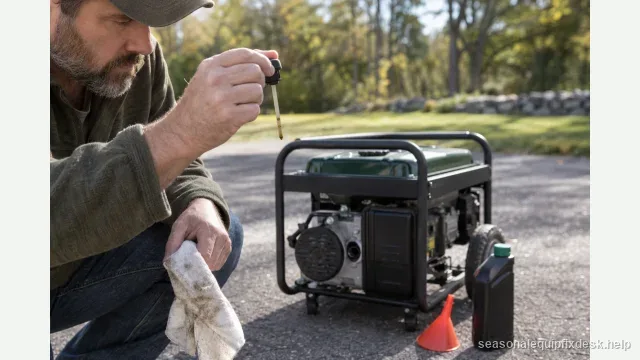
Low-oil protection and carbon-monoxide shutdown systems can stop an engine abruptly. Put the generator level and check oil with the manual’s dipstick method. Then read the panel indicator or fault code before cycling the switch. A real low-oil event should be corrected; a persistent low-oil indication at the correct level requires sensor diagnosis, not bypass. Generac’s portable-generator troubleshooting likewise directs owners to remove loads, verify fuel supply controls, and check oil by the applicable manual before service.
On generators with CO shutoff, move the machine only as the manufacturer directs and investigate the placement/indicator. Never defeat CO protection because the generator “runs fine” when the sensor is disconnected.
Runs unloaded but dies when something starts
This is no longer primarily a fuel-start problem. Motor loads such as refrigerators, pumps, compressors, and power tools can demand a brief starting surge well above their running watts. If the generator idles or runs steadily with zero load, then stumbles exactly when a certain appliance starts, compare that appliance’s starting demand with the generator/circuit rating and test a simpler known-good load.
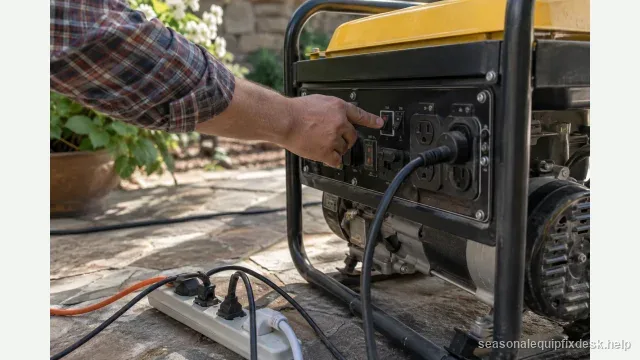
Also inspect extension cords and plugs for damage or undersizing. A faulty appliance or cord can create a short or overload event that trips protection or drags the generator down. Do not repeatedly reconnect a load that causes an immediate electrical fault.
Propane and dual-fuel machines add another clock
A dual-fuel generator that runs well on gasoline but dies on propane has already provided a useful A/B test. Check cylinder supply, valve opening sequence, regulator connection, hose condition, and fuel-selector position using the manual. Cold weather and high demand can affect propane vaporization, but do not heat a cylinder or regulator with an open flame or improvised heater.
Illustrative owner-safe path; operate outdoors and follow the exact generator manual.
Use a shutdown timeline instead of six random parts
- Dies at choke transition: mixture/choke/fuel metering.
- Dies after a repeatable short run with no load: fuel refill/venting or protective shutdown deserves attention.
- Dies instantly with a warning light/code: follow that safety system.
- Runs indefinitely unloaded, dies on one appliance: load, starting surge, cord, or appliance fault.
- Gasoline mode stable, propane mode fails: isolate the alternate-fuel supply path.
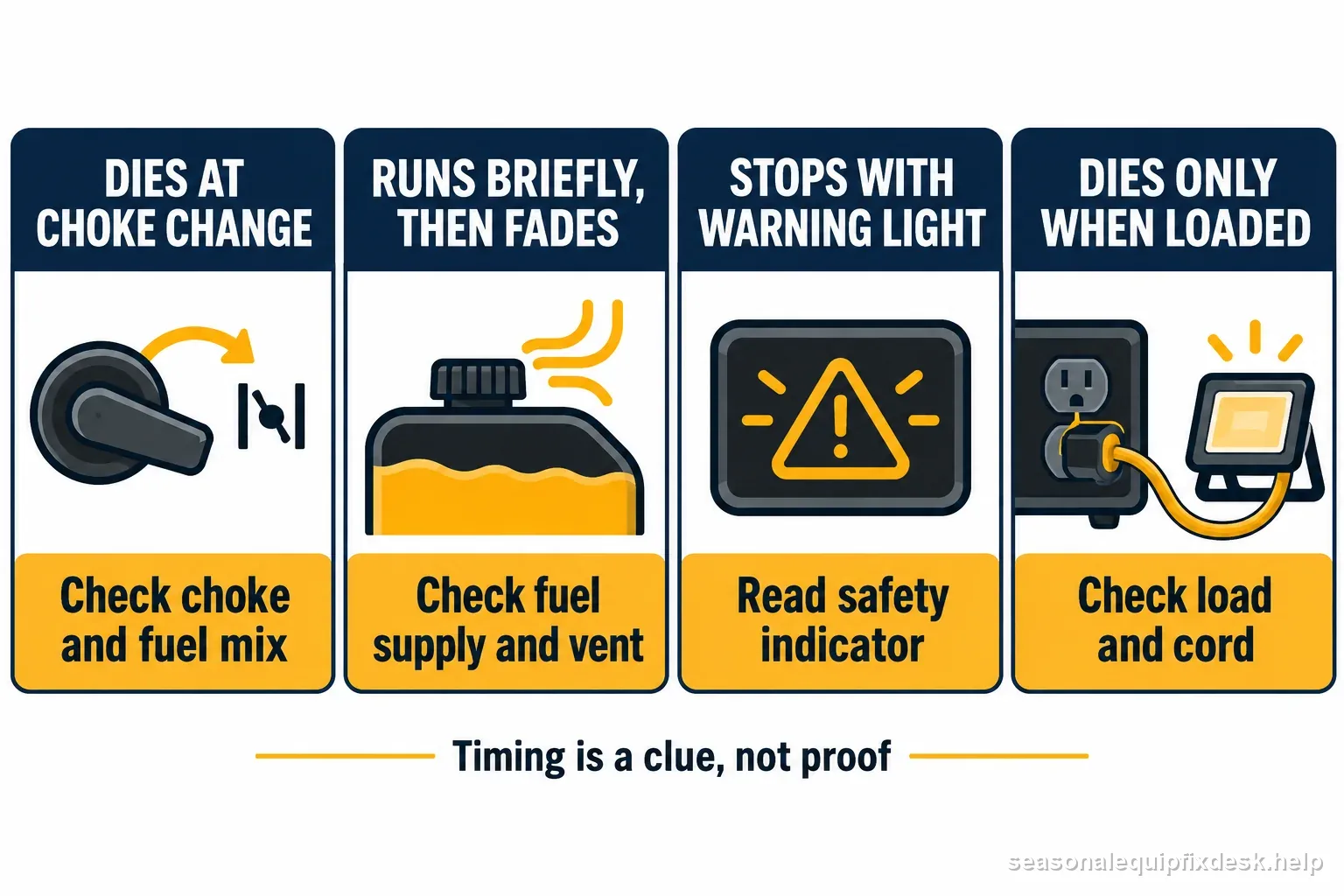
| When it stops | What it points toward | First useful check |
|---|---|---|
| At choke transition | Choke movement or lean fuel metering | Verify the manual’s cold/warm choke sequence |
| After a short unloaded run | Fuel refill, tank vent, or protective shutdown | Note whether it fades gradually or stops abruptly |
| With warning light or code | A commanded safety shutdown | Read the indicator before cycling power; never bypass it |
| Only when a load starts | Starting surge, load, cord, or appliance fault | Retest unloaded, then use one modest known-good load |
| Gasoline stable; propane stalls | Alternate-fuel supply branch | Check selector, cylinder valve, regulator, and hose by the manual |
Retest without changing the failure condition
- Place the generator outdoors at safe distance and disconnect all loads.
- Start using the exact cold/warm procedure and time how long it runs.
- Record choke position and any panel light at the moment of shutdown.
- If it runs steadily unloaded, add one modest known-good resistive load before any motor load.
- If the original failure returns, stop and preserve that timing rather than changing two systems at once.
If the generator repeatedly shuts down with correct fuel, correct oil, proper choke use, no load, and no obvious vent problem, service is appropriate. Internal ignition modules, inverter controls, or engine faults are beyond what a shutdown-timing test can safely resolve.
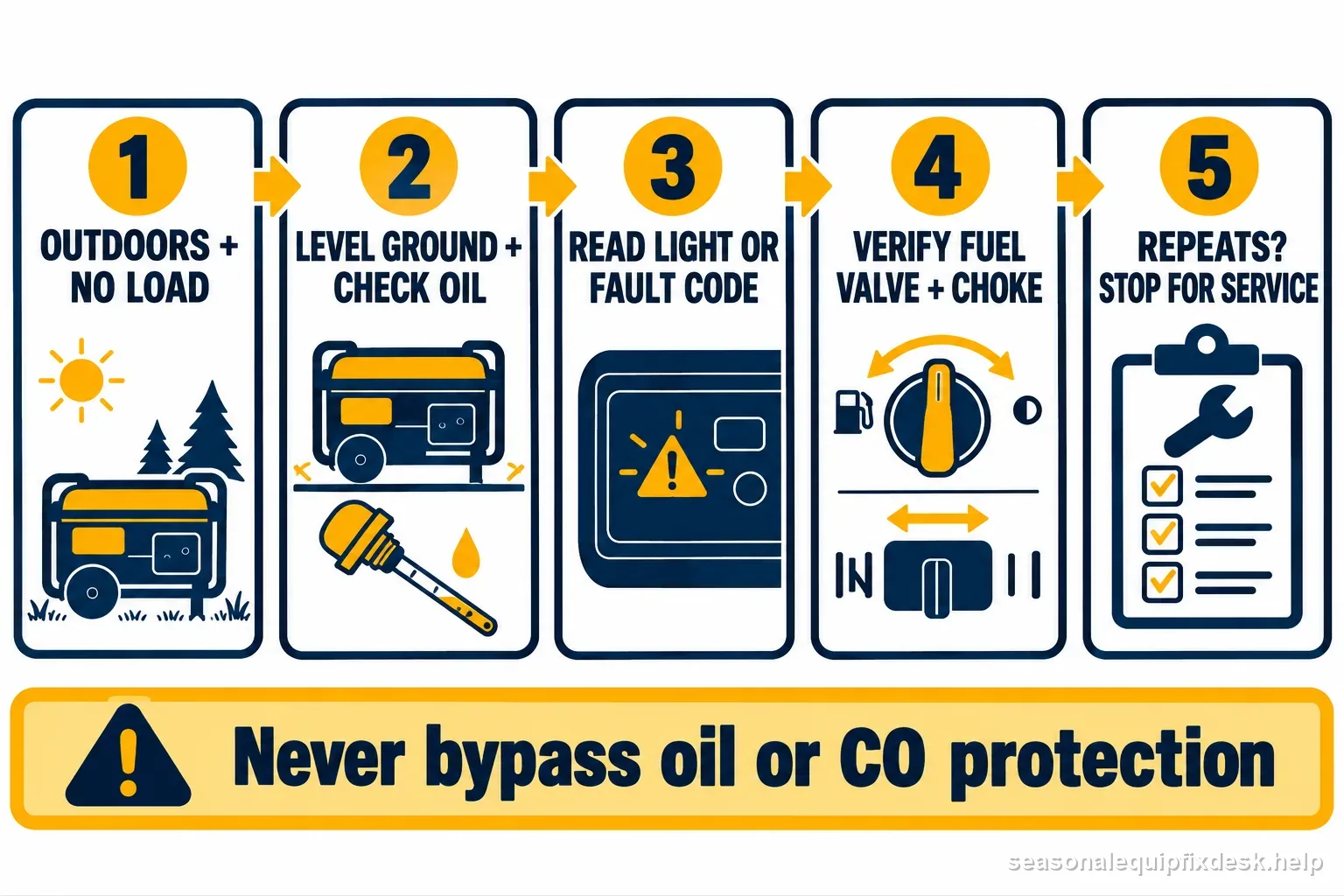
- Move outdoors to a dry, level, well-ventilated location and disconnect loads.
- Check oil on level ground using the exact dipstick method in the manual.
- Read and record any warning light or fault code before cycling the switch.
- Verify fuel valve and choke positions using the exact model’s starting sequence.
- If it runs unloaded, add one modest known-good resistive load before motor loads.
- If the shutdown repeats or a safety warning remains, stop and arrange service.
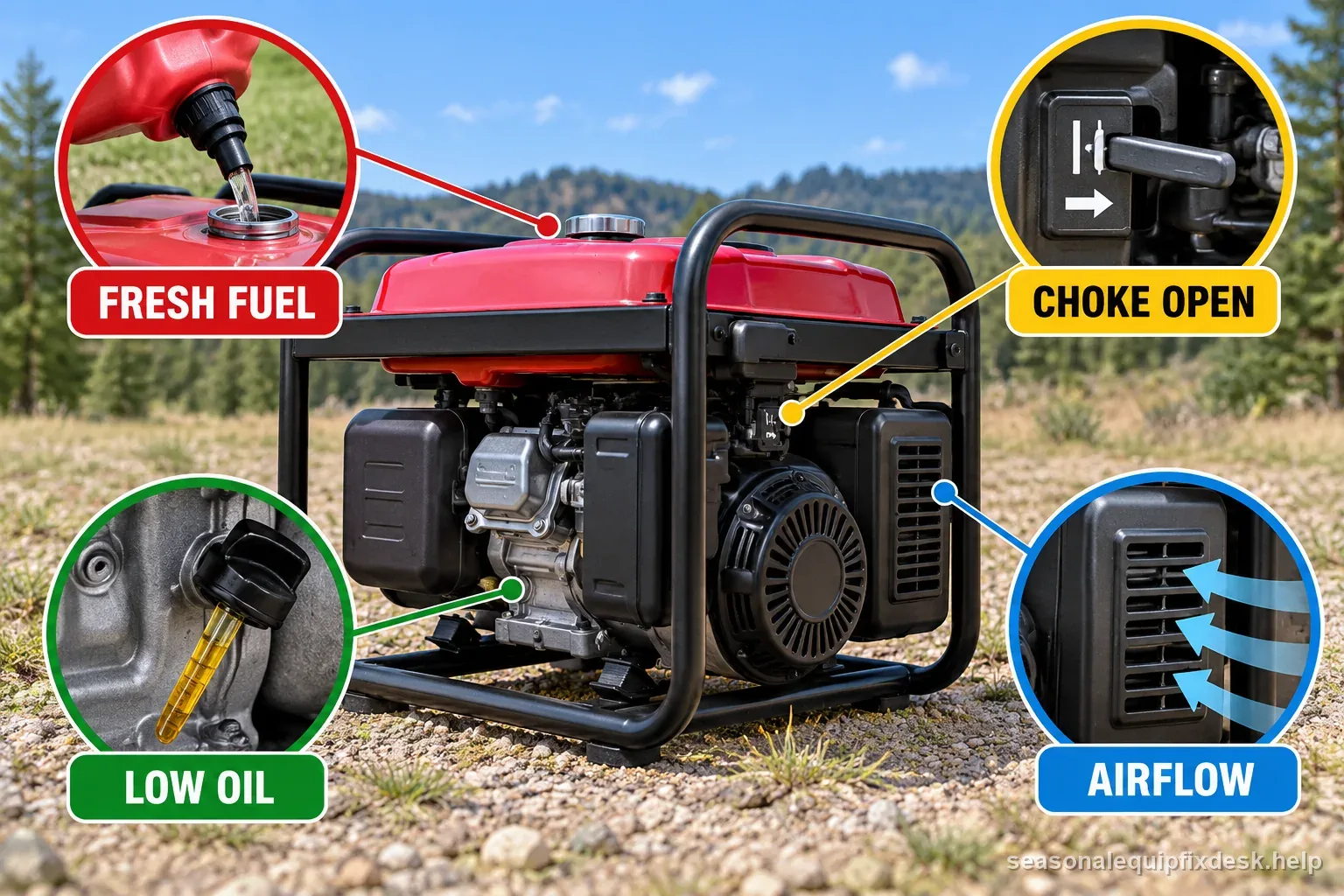
Hot restart behavior can separate fuel and ignition clues
After a normal cool-down, note whether the generator restarts immediately, restarts only with extra choke, or refuses to fire until it is fully cold. A unit that repeatedly dies hot and recovers only after cooling may have a heat-sensitive ignition or control fault rather than a simple tank-vent restriction. Conversely, a machine that restarts as soon as the fuel cap or supply problem is corrected keeps the fuel branch stronger.
Do not create this test by running a suspect generator unattended until it fails. Stay present outdoors, keep the load modest, and stop for fuel leakage, abnormal heat, electrical odor, or any protective warning.
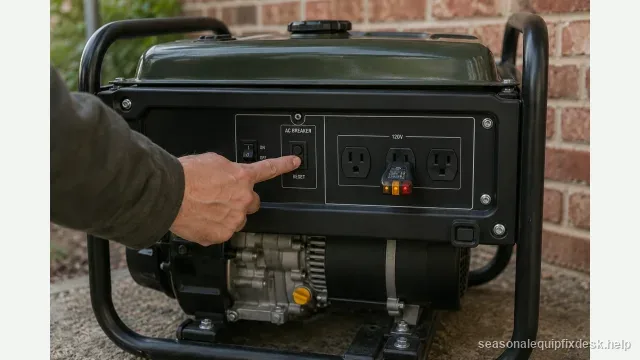
If the engine runs steadily but a receptacle is dead, use the safe no-output checks for a running generator to separate the outlet/GFCI branch from a load or cord problem.
Two illustrative shutdown logs
These sample times help organize observations; they are not diagnostic thresholds.
Example 1: stalls while moving the choke
After sitting overnight, a generator starts on its model-directed cold setting and runs for about 20 seconds. It falters as the control moves toward RUN. The owner records the sequence, checks the exact choke instructions, and follows the manufacturer’s fuel-service boundary rather than assuming a clogged jet.
Example 2: stops only after a load starts
A generator runs unloaded, then stops when a 600-watt test load is connected. The owner disconnects the load after shutdown, records the nameplate running-watt rating and appliance label, then checks overload indicators and the manual before one controlled retest. The sample wattage does not establish a safe capacity for another unit.
Record when the engine quits
The timing helps separate a setup issue from a fault that appears as the engine warms. Note whether the generator stops while the choke is still engaged, just after the choke moves to run, after a few minutes, or only when a load is connected. Keep the generator outdoors, well away from doors, windows, and vents, and never test it in a garage or other enclosed space. Check the fuel age and the oil warning only with the machine shut down and cool enough for the owner’s manual procedure. Do not remove the outlet panel or probe electrical connections. If it stalls only under load, disconnect appliances and record the load rather than repeatedly restarting it. A fuel smell, visible leak, unusual heat, or persistent alarm ends owner checks. Share the model number, control positions, and exact stall timing with qualified service.