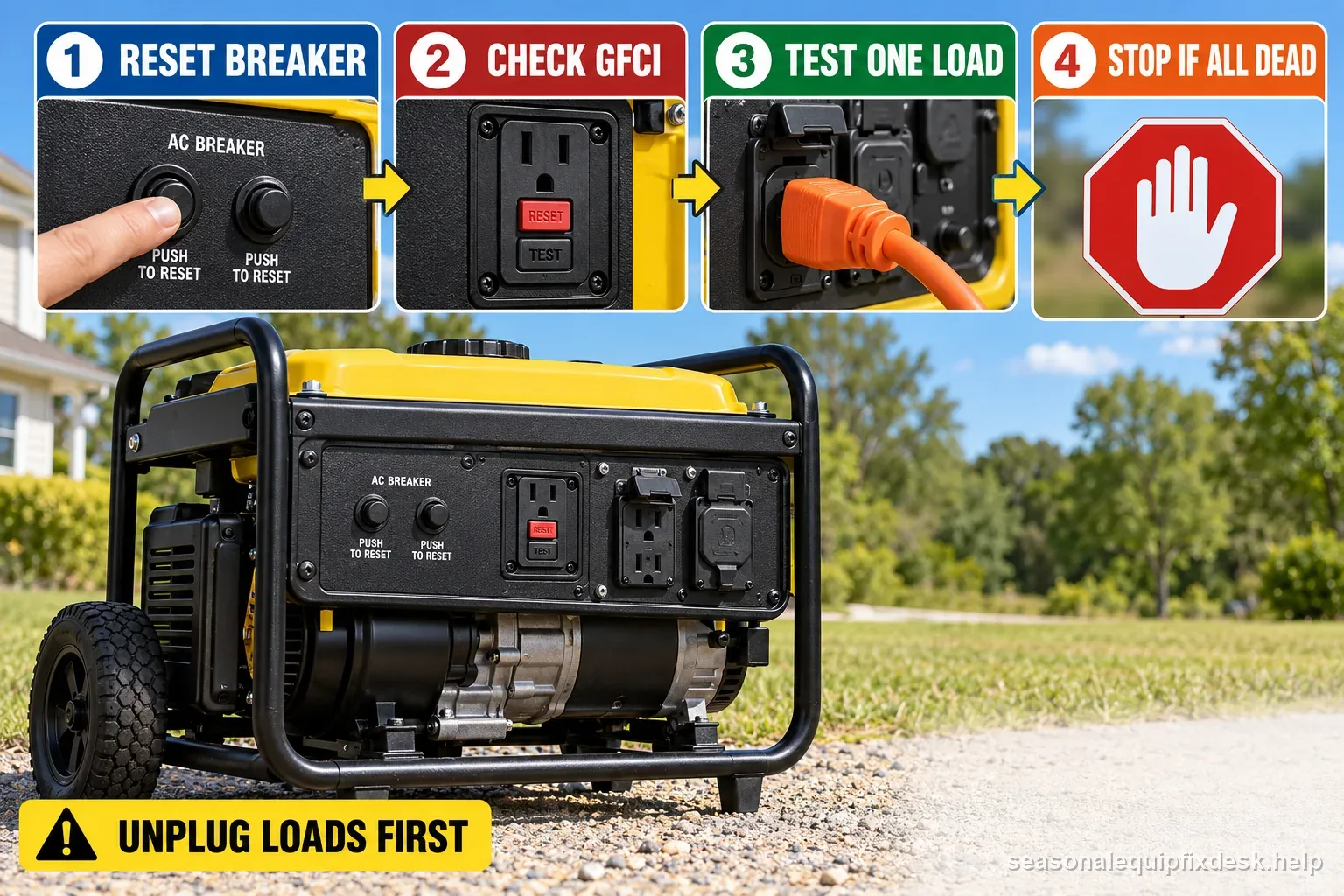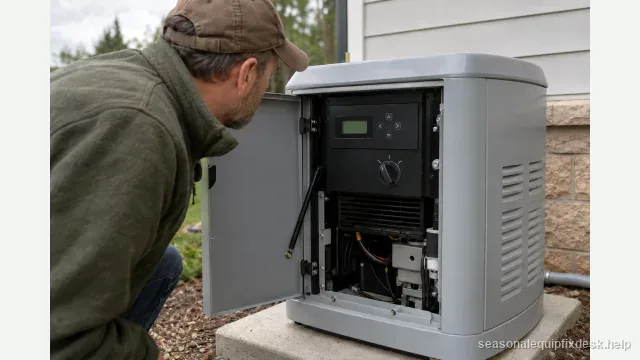
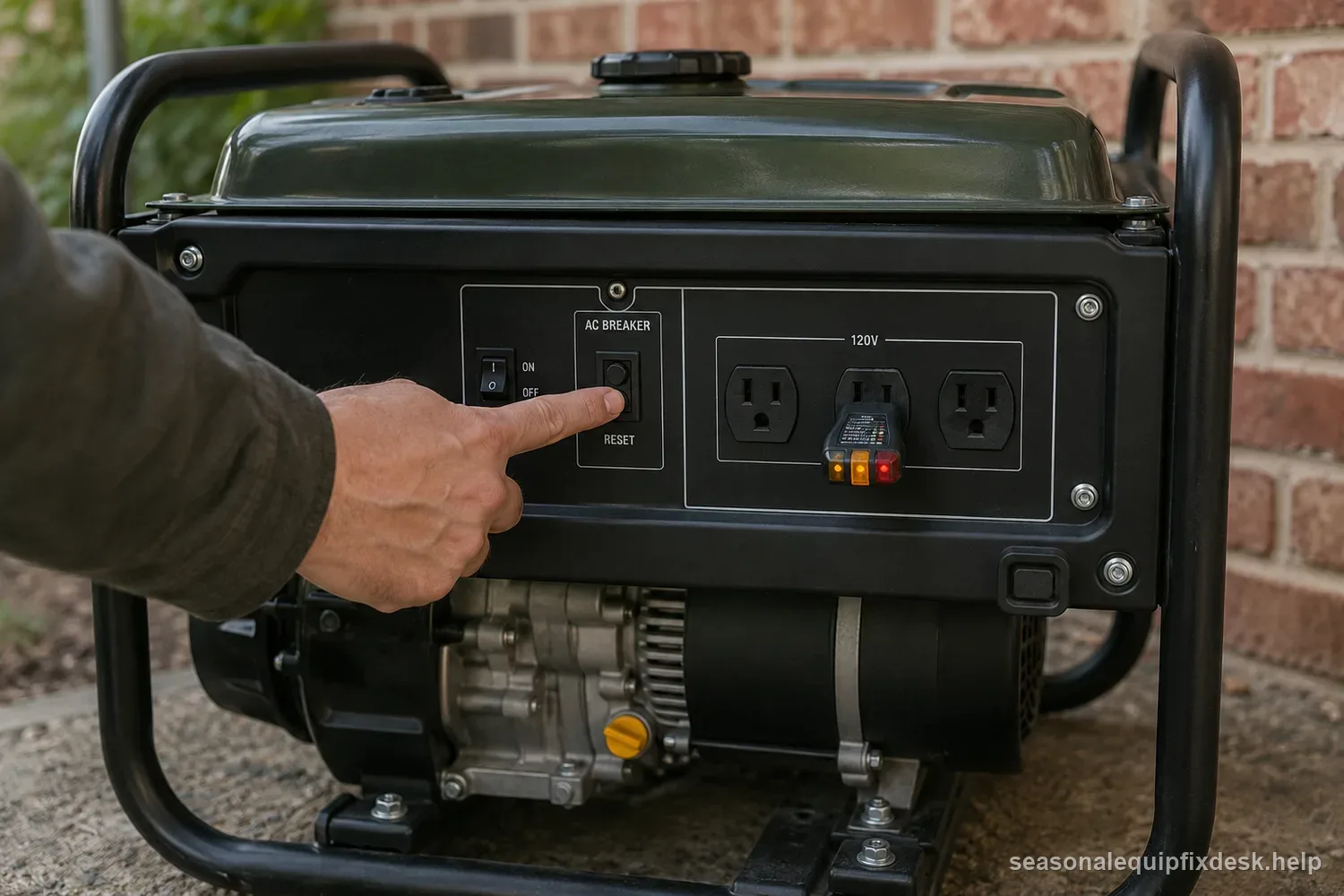
Quick answer: A smooth-running engine does not prove the generator is producing usable electricity. Start with every appliance unplugged. Check the main AC breaker and any receptacle circuit protectors/GFCIs, then test one known-good outlet with one known-good simple load. If the outlet remains dead after documented resets, stop before opening energized panels or “flashing” the field with improvised methods.
For a generator that runs normally but cannot keep running under load, use the starts-then-dies sequence before diagnosing output.
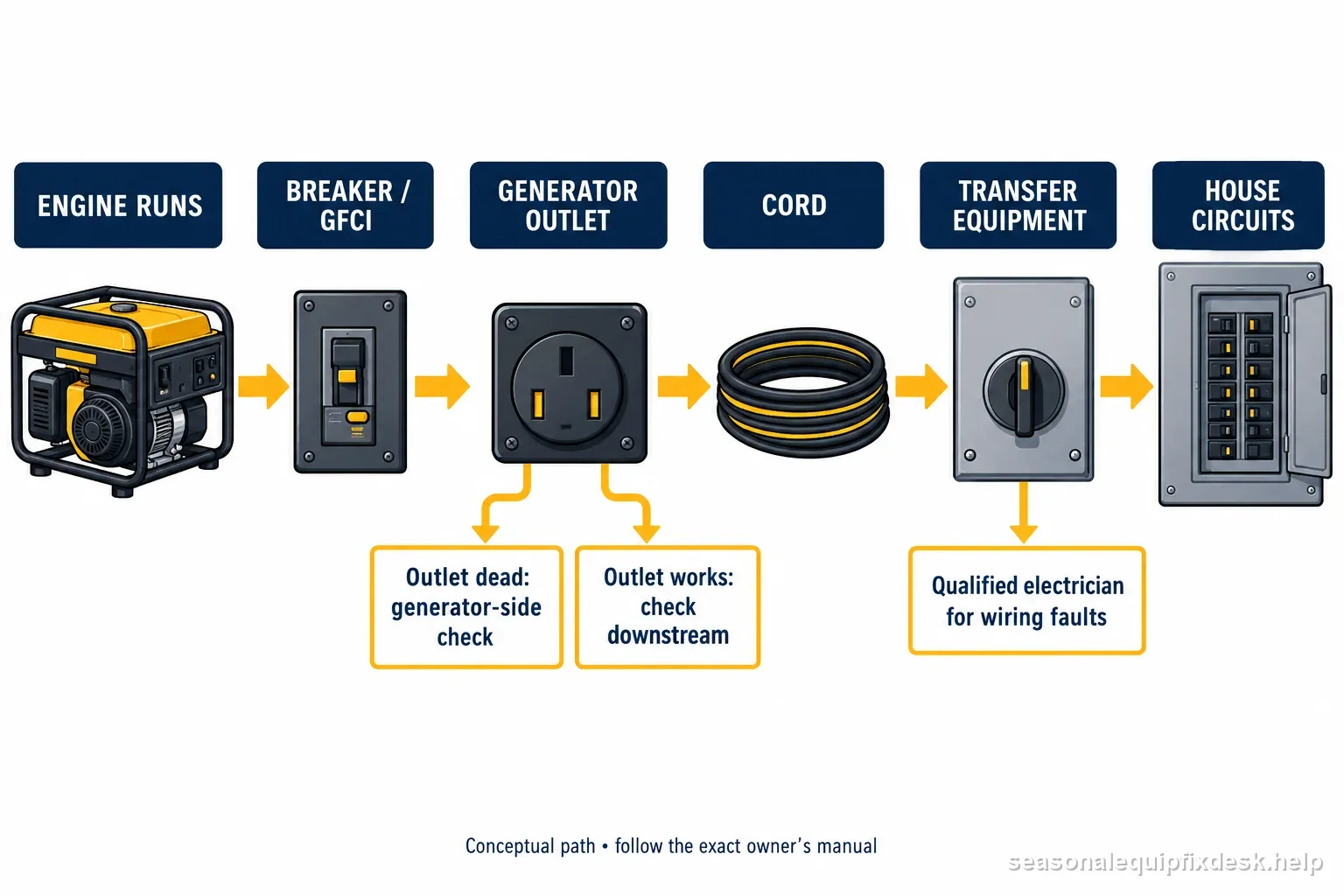
If the generator runs but household circuits remain off, identify the transfer-switch type before diagnosing the output. The transfer-switch troubleshooting guide keeps external checks separate from live electrical work.
Generac’s July 2026 portable-generator guidance follows this same practical order: no load while starting, engine stabilized with choke in RUN, breaker positions checked, GFCI status checked, then a known-working appliance. That owner-level sequence separates a tripped protection device from deeper alternator or inverter trouble.
| Observation | Possible meaning | Next step |
|---|---|---|
| One receptacle is dead | Local breaker, GFCI, or receptacle | Follow one manual-directed reset |
| Every outlet is dead | Main breaker or output-system fault | Remove loads; stop if it trips again |
| One appliance fails | Load, cord, or appliance | Try a known small load and sound cord |
| Engine speed hunts | Engine or load response | Disconnect loads; use engine manual |
First prove the engine is actually in normal run mode
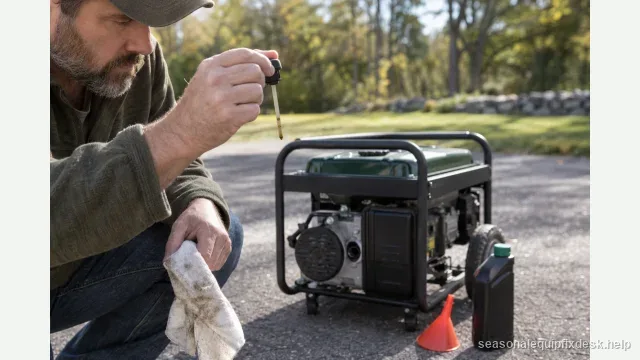
Let the generator stabilize outdoors with all loads disconnected. Make sure the choke is fully in RUN/OPEN as required and that eco/throttle modes are set according to the manual for testing. An engine that is surging, stuck on choke, or repeatedly near shutdown can produce misleading electrical symptoms.
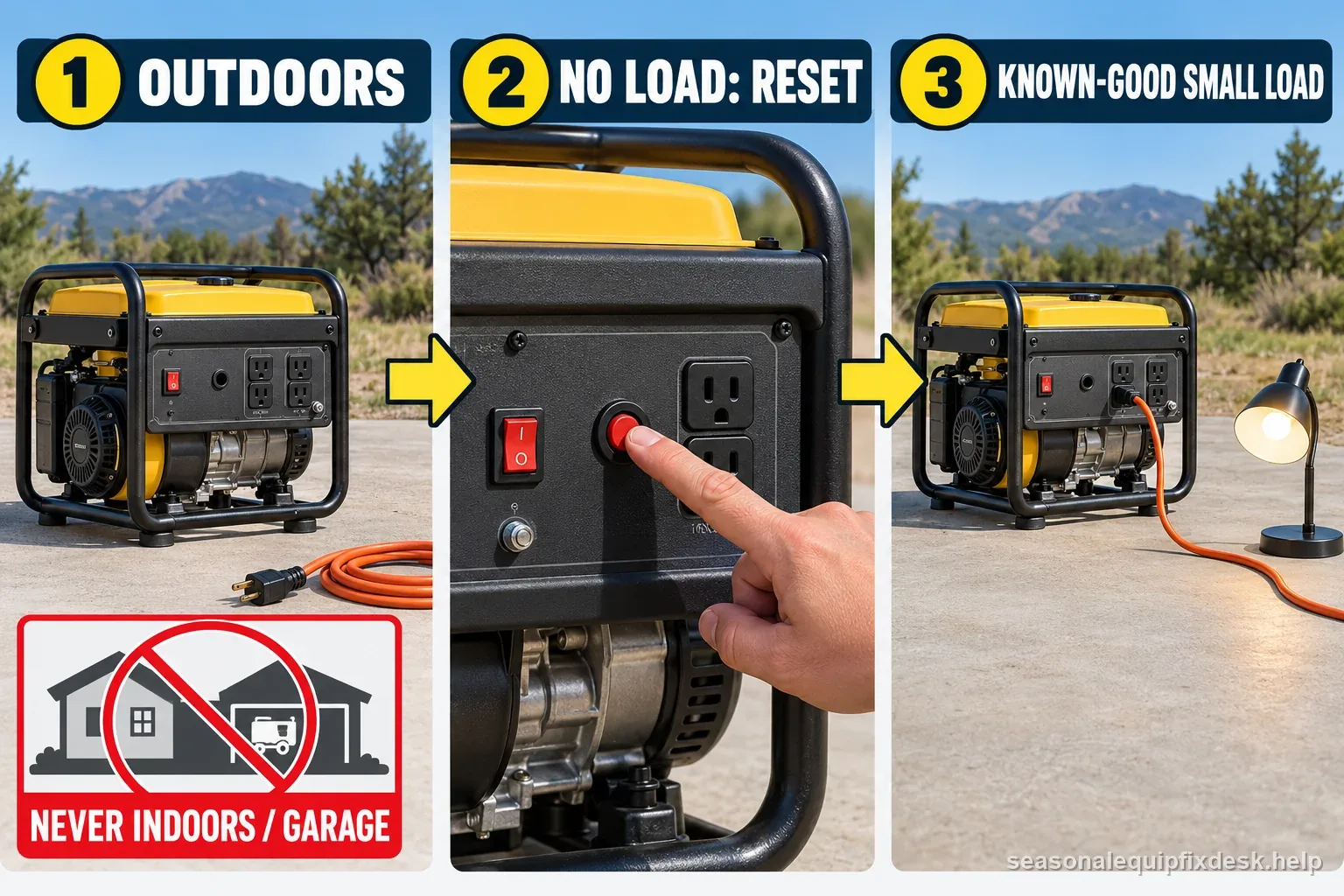
Do not test generator output inside a garage or near a doorway. CDC says portable generators should be more than 20 feet from doors, windows, and vents, with CO detection in the home.
Before judging output, read any 120/240-volt selector and overload, low-oil, or inverter status light. Some outlets may be inactive by selector design, and some inverter units disable output while the engine keeps running; use only the model’s documented reset.
Main breaker versus receptacle protector versus GFCI
Portable generators may have more than one layer of protection. A main breaker can be ON while a small push-button circuit protector for one receptacle is tripped. A GFCI receptacle may also need its own reset. Use the control-panel labels and owner manual; do not assume every button is a breaker or every “reset” applies to all outlets.
| Observation | Next owner-safe step |
|---|---|
| One receptacle trips | Unplug loads; reset only as the manual directs. |
| All outlets remain dead | Stop after external checks; arrange model-specific service. |
| Reset trips again | Do not bypass protection or install a larger breaker. |
Honda manuals explain that AC breakers/protectors automatically switch off for a short circuit or significant overload and should only be reset after checking the connected appliance and rated load. That warning matters even when the current complaint is “no power”: the protection may have tripped for a real reason during the previous use.
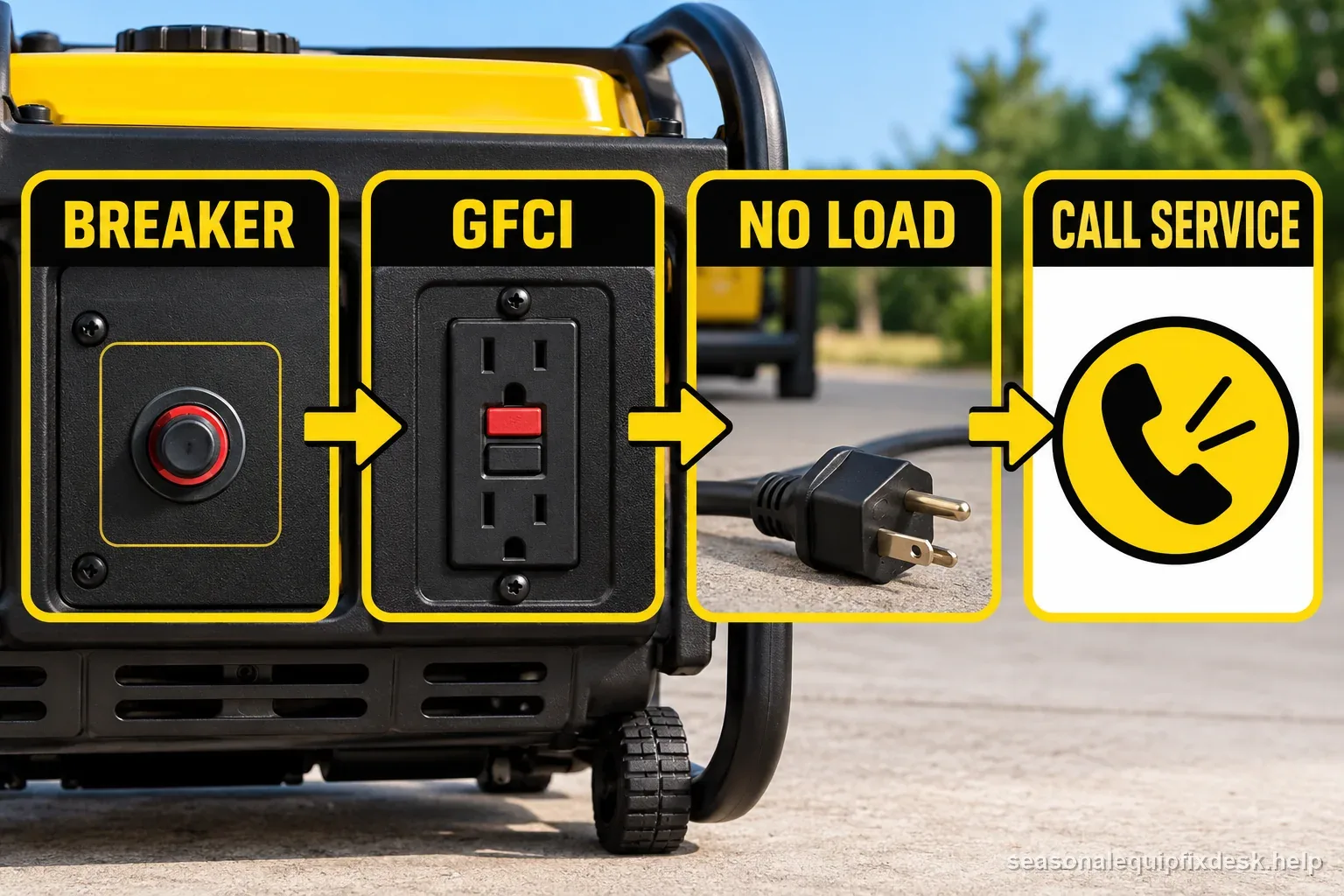
One known-good load is better than a house full of guesses
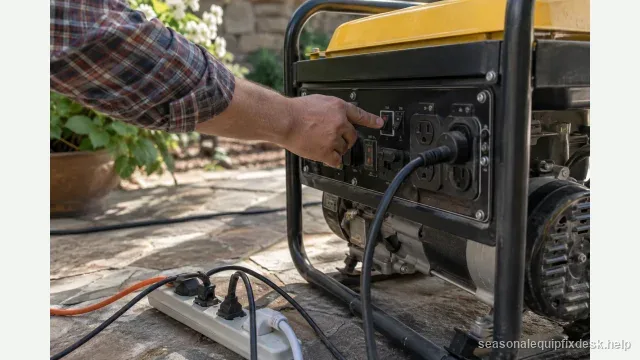
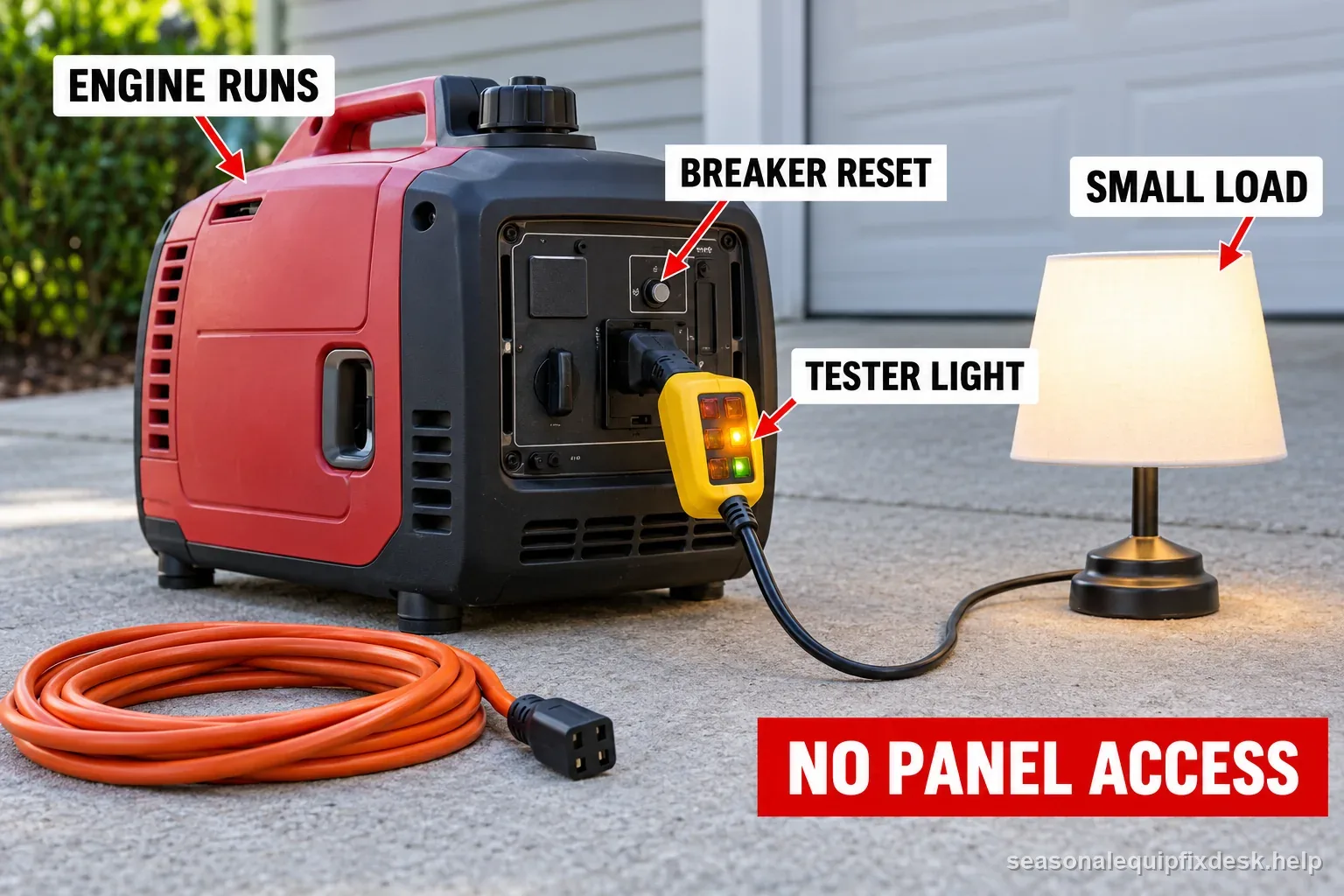
After a documented breaker/GFCI reset, connect a small known-working resistive appliance that is comfortably within the outlet rating. If it works, the generator is producing some output and the original cord, appliance, adapter, or load combination becomes the next suspect. If the known-good load does not work on one receptacle, test another outlet only if the manual permits and the protection state is known.
Do not use a refrigerator, well pump, or large compressor as the first proof load because motor starting surge can complicate the result.
Two worked load examples
These are sample label readings, not universal generator ratings or test thresholds. Keep the generator outdoors and follow the exact manual.
Example 1: one outlet works, another does not
With all loads disconnected, a known-good 60 W lamp lights in one receptacle but not a second. The generator is producing power at the first outlet. Check the second outlet's breaker or GFCI and its model-specific reset steps; do not diagnose a total alternator failure from one dead receptacle.
Example 2: connected load exceeds the nameplate
A generator label lists 3,500 W running output. Two connected appliances list 1,900 W and 1,800 W, or 3,700 W together. That combined demand exceeds the listed running rating and can trigger overload protection. Disconnect loads and reset only as the manual allows; do not keep forcing the breaker.
Check cords and adapters before blaming the alternator
Inspect extension cords end to end for cuts, crushed jackets, burned blades, loose connectors, missing ground pins, and a rating appropriate for the load. CPSC recommends heavy-duty outdoor-rated extension cords with wattage capacity exceeding the connected appliances. A bad cord can make a healthy generator appear dead at the far end.
Never use a male-to-male “suicide cord” or backfeed a wall receptacle. The correct method for supplying home wiring is a properly installed transfer equipment arrangement, not an improvised cord test.
If every outlet is dead after resets, the branch changes
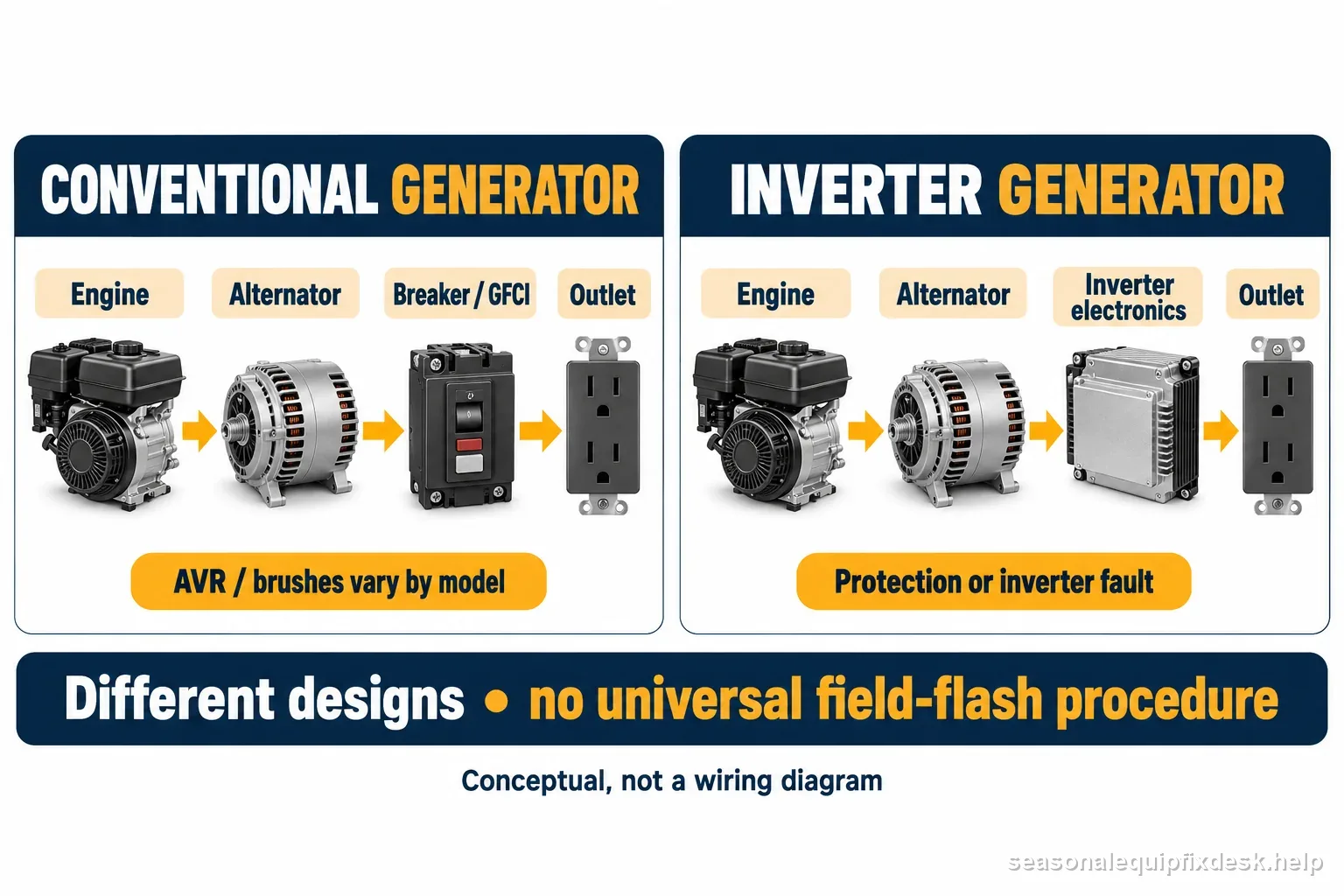
Conventional generators may use brushes, an automatic voltage regulator, rotor/stator windings, and residual magnetism; inverter generators use different power electronics. Those distinctions matter because a generic internet “field flash” procedure can be wrong for the machine and exposes the user to dangerous voltage.
When a portable unit has no output at any outlet, record which indicator, breaker, or GFCI changed and stop if a reset trips again. Generac’s portable-generator troubleshooting begins with the output breaker and receptacle protection, then recommends a known-working load with other loads disconnected. If the whole generator remains dead after those external checks, internal excitation or control faults need model-specific service rather than a live voltage test. Generac’s guide applies to its portable models; other brands’ reset procedures may differ.
Keep the engine outdoors and far from doors, windows, and vents during any run test. Do not connect a generator to home wiring through a wall outlet. The transfer-switch guide covers the separate handoff problem when generator power exists but house circuits do not receive it.
Owner diagnosis should stop at the point where proving the next fault requires opening the generator head, measuring live alternator windings, bypassing an inverter module, or defeating a GFCI. Bring the model and serial number so the technician can use the correct excitation and wiring diagram.
| Observed result | Likely branch | Next owner-safe check |
|---|---|---|
| One outlet dead; another works | Local receptacle, GFCI, protector, or branch | Check panel labels and reset only as the model manual allows |
| All generator outlets dead after reset | Generator-side output or protection fault | Unplug loads; stop before opening the head or testing live internals |
| Generator outlet works; house is dark | Cord, inlet, transfer equipment, or house circuit | Inspect cord externally; use installed transfer equipment as designed |
| Output trips again with no load | A continuing protection fault | Stop repeated resets and arrange service |
| Engine hunts or output flickers | Engine speed/regulation may be affecting output | Restore normal engine operation before judging electrical output |
A dead single outlet and a dead entire panel are not the same
- One receptacle dead, another works: local receptacle, GFCI, protector, or wiring branch.
- All outlets dead, main breaker was tripped: determine why it tripped before resetting repeatedly.
- All outlets dead, breakers/GFCIs reset, engine stable: generator-head/inverter diagnosis becomes more likely.
- Power only disappears with one cord or appliance: move the investigation downstream to that load.
- Voltage flickers with engine hunting: stabilize the engine problem first; electrical output testing is not isolated yet.
- Place the generator outdoors, dry, stable, and unloaded.
- Start and stabilize it; set choke and operating mode by the manual.
- Check breaker, receptacle protector, and GFCI states by their labels.
- Try one known-good modest load directly at a generator outlet.
- If it works, add the original cord and appliance separately to locate the downstream fault.
- If the outlet stays dead or protection trips again, shut down and arrange service.
A safe retest order
- Generator outdoors, dry, stable, and unloaded.
- Start and warm it; place choke in normal RUN position.
- Confirm main breaker, receptacle protectors, and GFCIs according to panel labels.
- Test one known-good, modest load directly at a receptacle.
- If successful, add the original cord and then the original appliance separately so the failed component can be identified.
- If still dead at the generator receptacle, shut down and escalate rather than opening live electrical sections.
Do not confuse generator output with home transfer
If a portable generator produces power at its receptacle but the house circuits remain dead through installed transfer equipment, that is a different system-level problem. The generator may be healthy while an inlet, breaker, transfer switch, or interlock arrangement is misconfigured or faulty. Fixed wiring should be evaluated by qualified electrical service personnel.
The strongest handoff note is “engine stable, no load, main breaker ON, GFCI reset, known-good lamp dead at two receptacles.” That evidence justifies internal electrical diagnosis without inviting unsafe live probing at home.
Frequency and engine speed are part of the output story
On conventional generators, electrical frequency is tied closely to engine speed. If the engine is audibly hunting, bogging, or stuck at an abnormal speed, the output problem may begin with engine regulation rather than the receptacle panel. Do not adjust governor hardware by ear to chase a voltage complaint. Restore normal engine operation using the model procedure before judging alternator performance.
For inverter generators, the electronics decouple output frequency from raw engine speed, so a quiet or variable engine speed can be normal. That is another reason not to import a conventional-generator field-flash or governor fix into an inverter model.