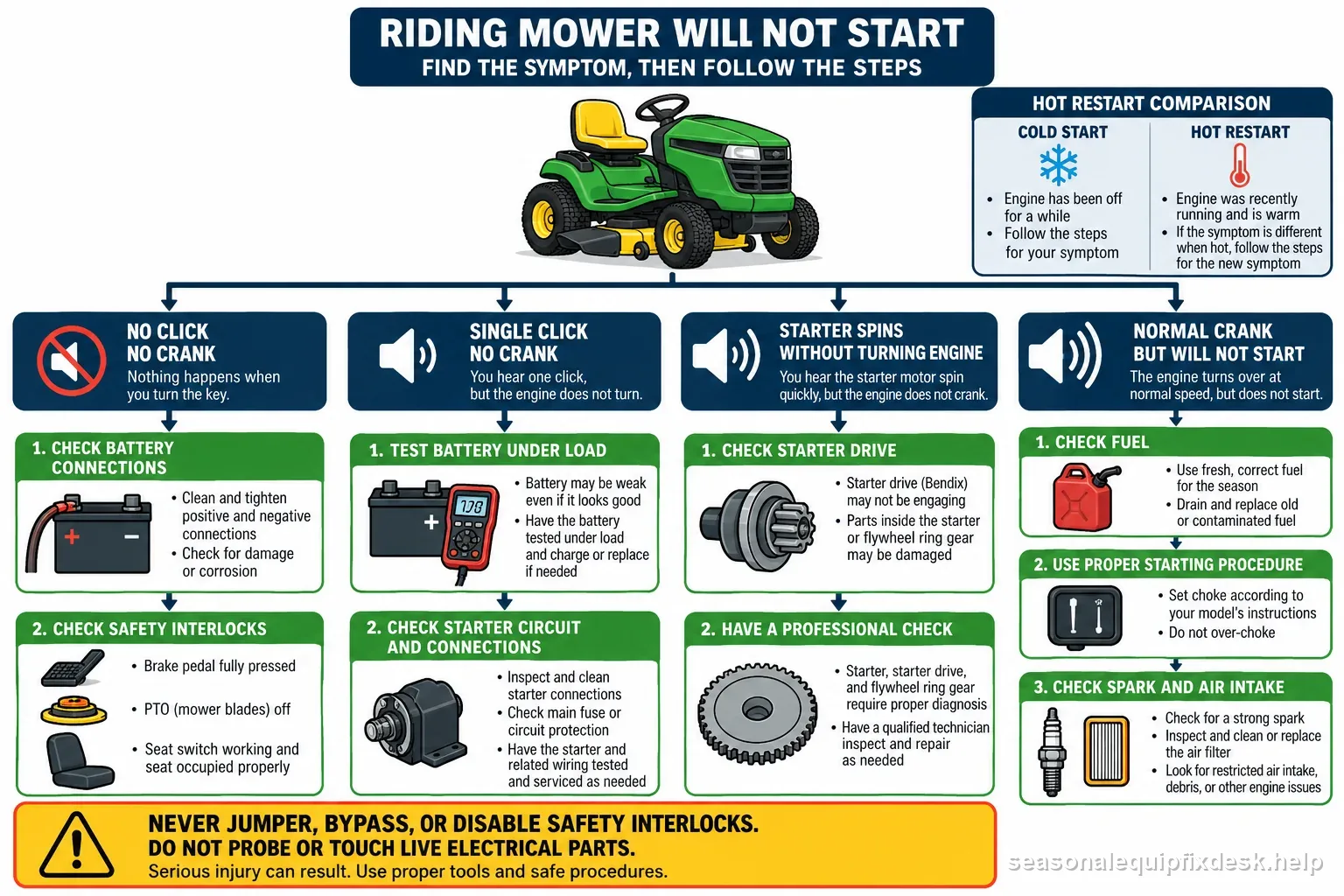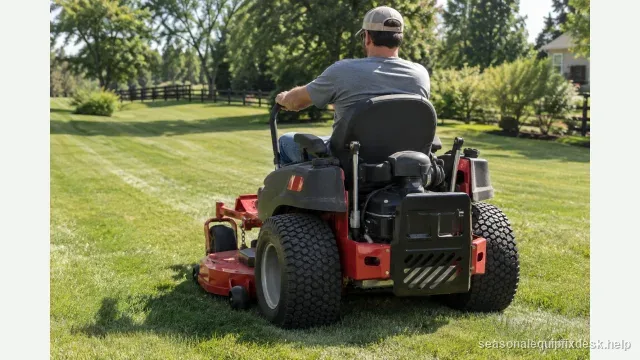
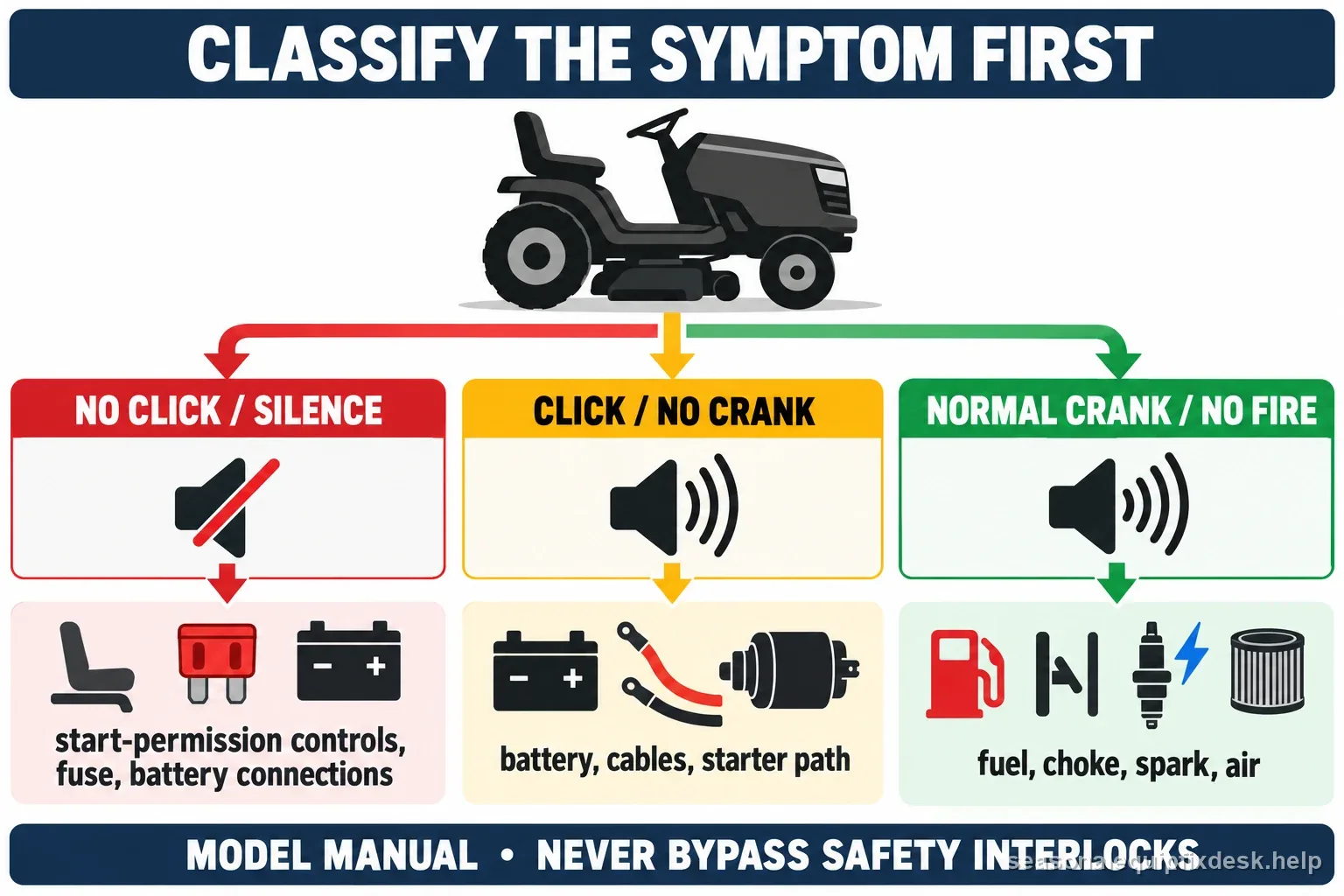
Quick answer: On a riding mower, the first diagnostic split is electrical: nothing happens, one or more clicks, or the engine cranks normally but will not run. Starting interlocks, battery/starter circuits, and engine fuel/spark checks belong to different branches. Keep them separate.
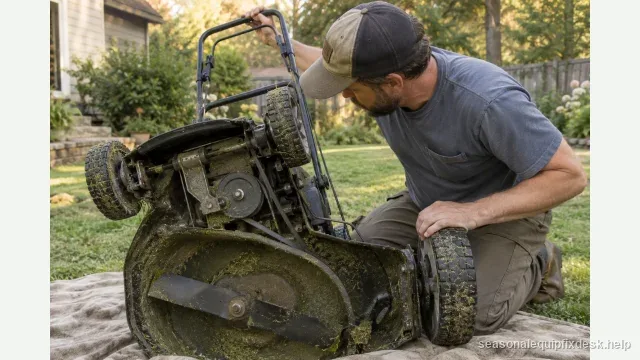
A push mower and riding mower use different interlocks, but stale fuel and a disconnected plug lead can create similar no-start clues. Use the push mower won’t start checklist for the walk-behind branch and its blade-safety boundary.
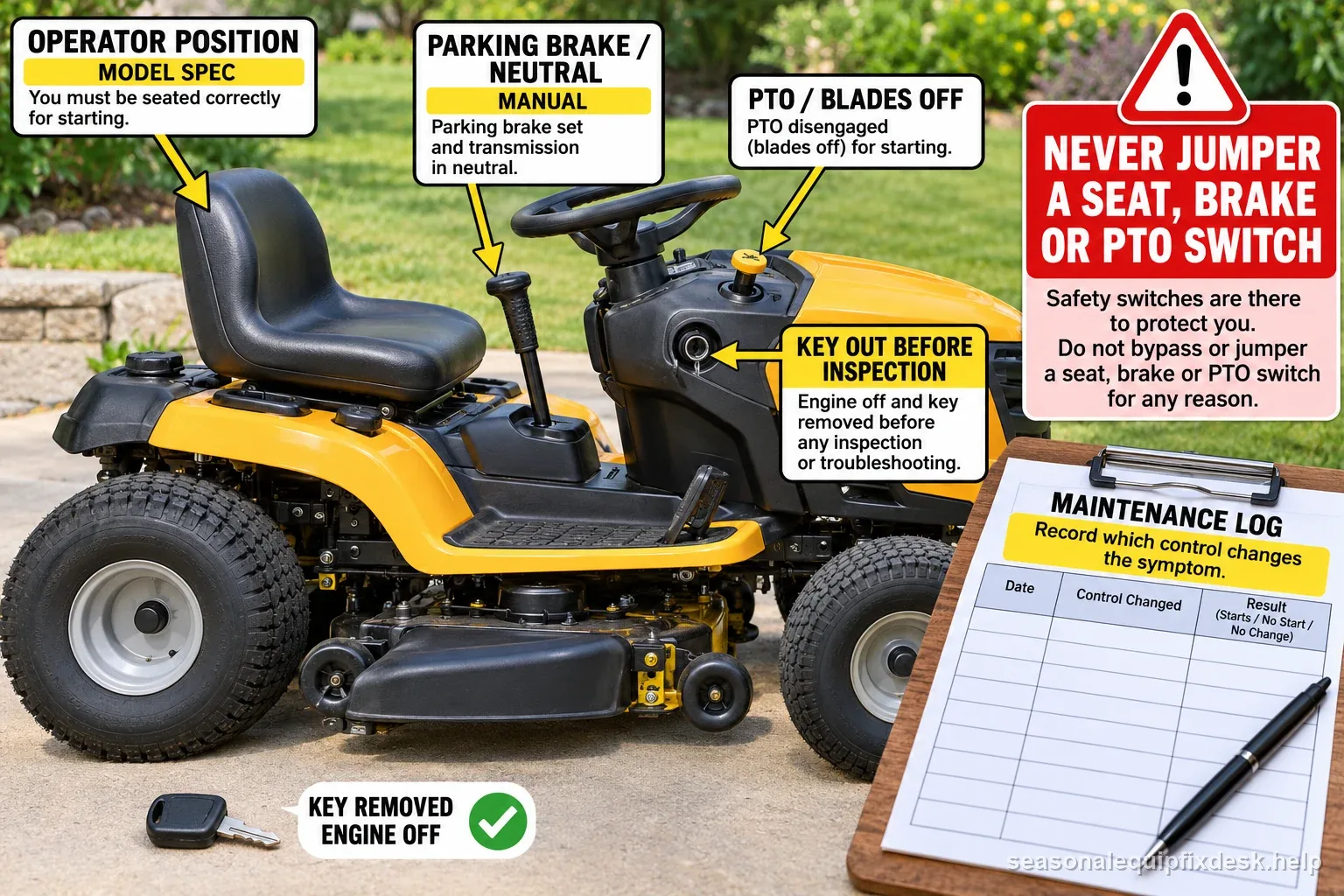
Before inspection: Park on level ground, disengage PTO, set the brake, stop the engine, remove the key, and keep clear of blades and belts. Battery or starter-circuit work must follow the manufacturer’s precautions; stop for heat, smoke, damaged wiring, or a swollen/leaking battery.
The seat, brake, PTO/blade, and steering/park controls are safety systems. Never bypass a switch to make the engine crank. If an interlock is faulty, repair the system before the mower returns to service.
| What happens at key/start | Likely branch | First useful check |
|---|---|---|
| Silence / no click | Start permission, fuse, key/start circuit, battery connection | Verify the model’s normal controls; inspect visible connections with key removed |
| Click but no crank | Battery under load, cables, solenoid/starter, mechanical load | Check battery and terminal condition using the proper procedure |
| Slow crank | Weak supply, cable resistance, starter drag, engine resistance | Stop repeated cranking; document whether it happens cold or hot |
| Normal crank, no fire | Fuel, choke, air, spark, compression | Move to engine checks; do not replace the starter path |
No click at all: prove the start-permission path
Confirm the controls are in the exact start positions shown in the operator manual: operator seated where required, parking brake or steering controls set, blades/PTO disengaged, and transmission/controls in the specified state. A start request that is blocked by one of these conditions can look like a dead battery.
If the correct positions still produce silence, inspect the main fuse, battery connections, key/start circuit, and visible interlock wiring for damage. Do not jumper switches across the harness.
A click with no crank points toward current delivery
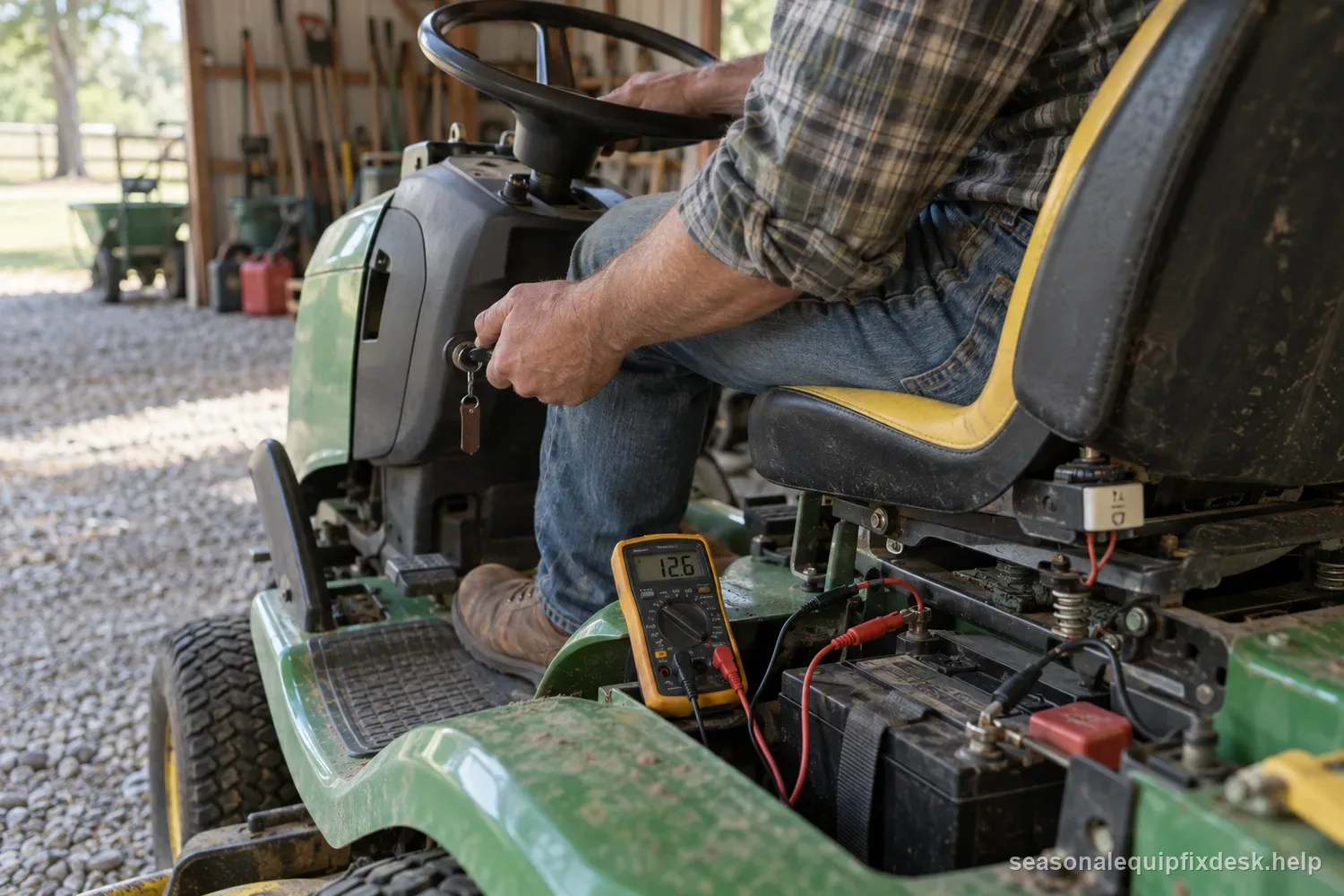
Clicks tell you the start request may be reaching a relay or solenoid, but the starter is not turning the engine normally. Check battery state and clean/tight terminals before condemning the starter. Husqvarna’s current riding-mower support uses battery charging/voltage as an early check for click/no-start complaints.
A voltage reading at rest is only part of the picture; a battery can show acceptable open-circuit voltage yet collapse under starter load. Use the battery and charger procedures specified by the manufacturer.
Starter spins but the engine cannot rotate normally
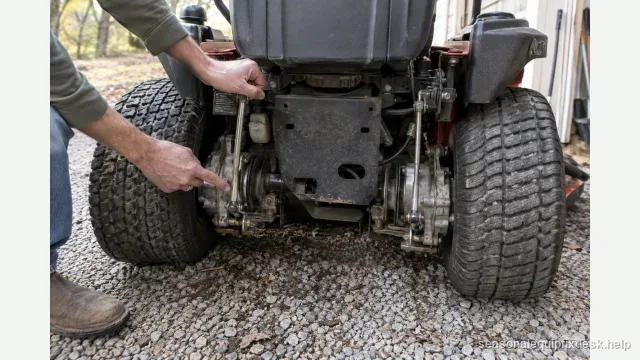
If the starter motor turns but the engine does not, or if the engine stops against a hard mechanical point, stop repeated cranking. With ignition isolated and the spark plug handled according to the engine manual, determine whether the engine itself can rotate.
Mechanical binding, starter-drive trouble, excess liquid in the cylinder, or internal engine damage is a different repair from a fuel no-start. Do not keep holding the key in START against a stalled starter.
Normal cranking means it is time for engine checks
Once the engine cranks at normal speed, shift away from the battery/interlock branch. Verify fresh correct fuel, fuel valve position, filter condition, choke use, air filter, and spark-plug connection. Husqvarna’s current four-stroke support similarly separates a cranking engine into fuel, filter, choke, air-filter, and spark-plug checks.
If the plug is wet and the engine was repeatedly choked, allow for flooding before adding more fuel. If the plug stays dry, inspect fuel delivery rather than replacing the starter circuit that has already proven it can crank the engine.
Interlock behavior after starting still matters
A mower that starts does not automatically have a healthy safety system. Operator-presence logic should stop or inhibit functions in the conditions defined by the manual. Husqvarna’s support documentation, for example, directs repair when the operator-presence system does not behave as specified.
Do not “adjust” a seat or brake switch solely to keep the engine running. Confirm the switch, actuator, wiring, and control position are correct, and send an unresolved safety-circuit fault to qualified service.
Use one symptom table instead of a parts list
- Silence: start permissions, fuse, key/start circuit, battery connection.
- Click/no crank: battery under load, terminals, solenoid/starter, engine mechanical load.
- Slow crank: battery, cables, starter drag, excessive mechanical resistance.
- Normal crank/no fire: fuel, choke, air, spark, compression.
- Starts only when a control is held abnormally: stop and repair the safety/control system.
A restart test that does not hide the fault
- Charge or replace only the component that failed a real test.
- Restore all interlock connectors and guards.
- Start from the normal seated/operator position with PTO disengaged.
- Confirm the engine starts without prolonged cranking.
- Verify the brake/PTO/operator-presence functions according to the manual before mowing.
If the mower still has an intermittent no-crank after terminals and battery pass, record which controls are active when it fails. An intermittent interlock or harness fault is easier to find when its exact conditions are preserved.
- Exact mower and engine model numbers
- Silence, click, slow crank, normal crank, or hot-only failure
- PTO, brake, neutral, and operator position at the time
- Battery charge/connection findings and any warning indicator
- Any safety-circuit defect, smoke, heat, or wiring damage
Use the normal controls to isolate an interlock—never a jumper wire
A rider may require the brake or parking brake set, PTO disengaged, operator seated, and transmission or motion controls in an allowed state before cranking. Move each normal control through its intended range one at a time and observe whether the symptom changes. That can identify which part of the permission chain deserves inspection without defeating it.
Do not bridge a seat, brake, neutral, or PTO switch to “see if it starts.” Husqvarna’s operator-presence guidance treats these devices as safety functions and calls for repair when they do not operate correctly. A bypass can allow starting or blade motion in an unsafe state and can hide a wiring fault.
Battery voltage alone does not prove the starter has enough current
A battery can show plausible open-circuit voltage and still collapse under starter load. Corroded terminals, loose grounds, damaged cables, or a weak battery can produce a single click, rapid clicking, slow cranking, or a starter that works only after the cables are moved. Inspect and service battery connections with the key removed and follow the battery manufacturer’s safety precautions.
If the electrical supply and permitted-start conditions are sound but the starter still cannot rotate the engine normally, stop treating the problem as an interlock issue. The starter drive, solenoid/current path, engine mechanical load, or internal starting system needs the next model-specific test.
Hot restarts can expose a different electrical or fuel branch
If the tractor starts cold but refuses after mowing, record whether the failure is no-click, click-no-crank, slow crank, or normal crank with no fire while the machine is hot. Repeat the same classification after it cools. That comparison can keep a heat-sensitive starter/current-delivery problem separate from a fuel or ignition complaint.
Do not bypass a hot interlock or keep cranking a slow starter until cables overheat. Let abnormal heat, smoke, melted insulation, or a battery that vents or swells end the test immediately.