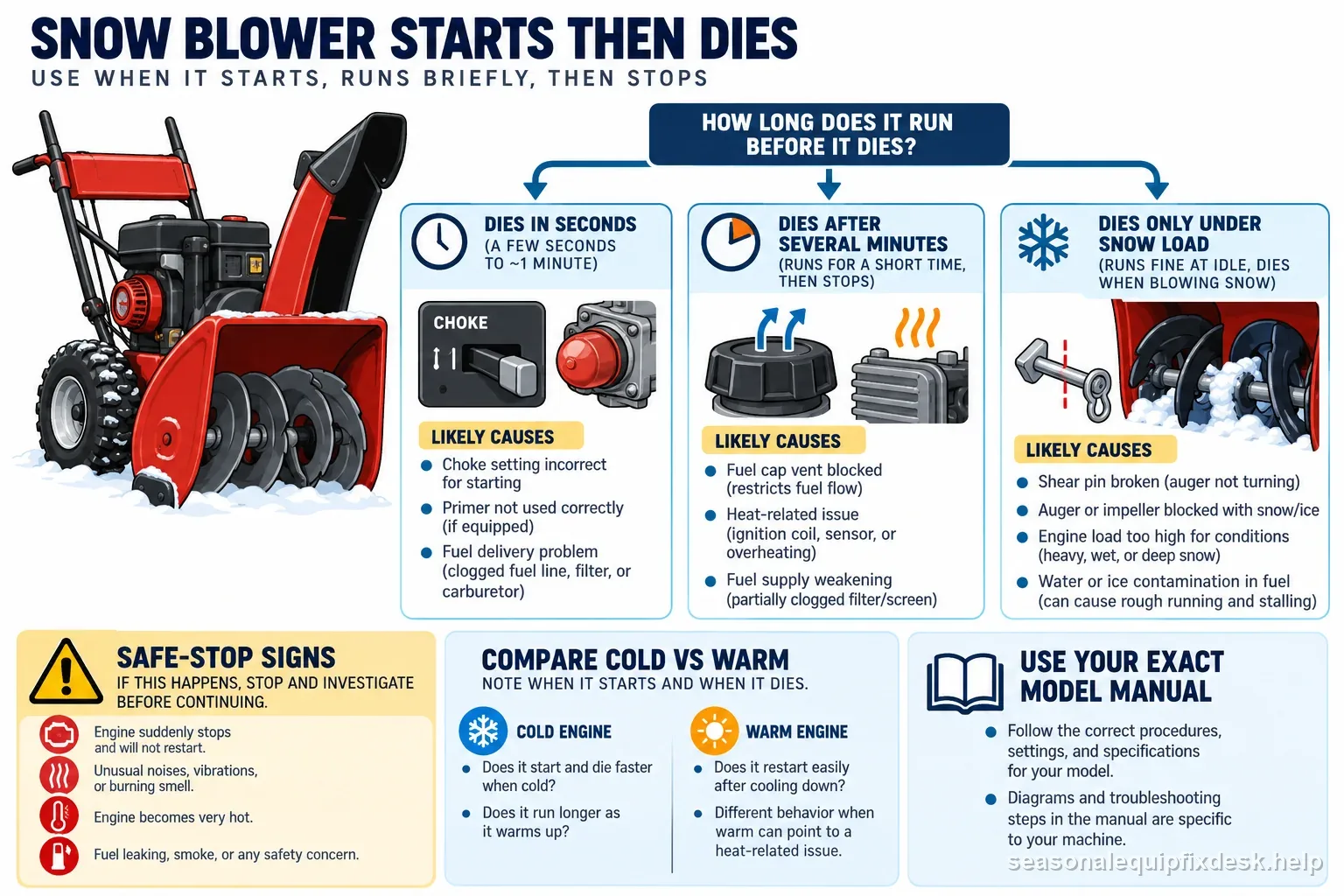
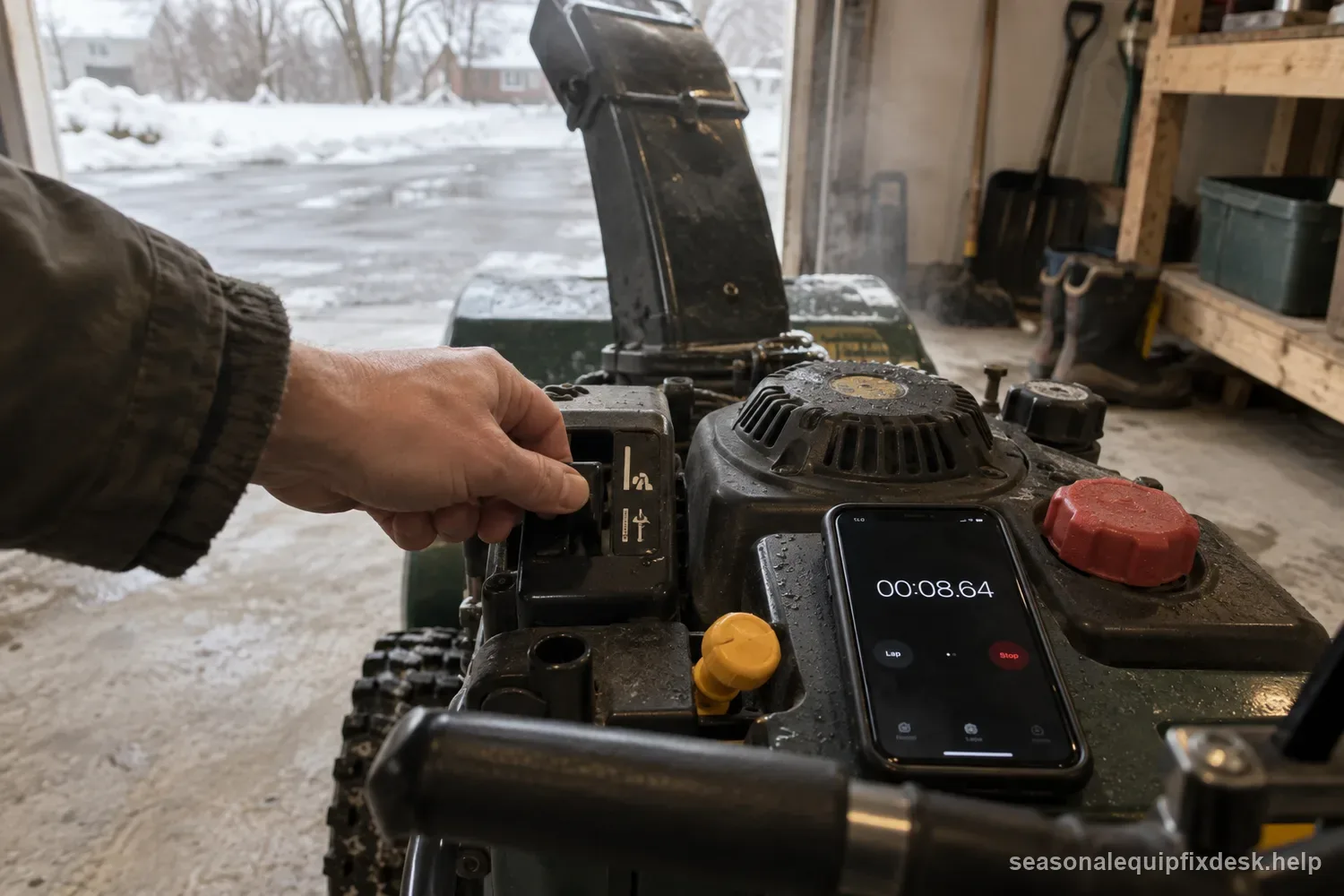
Quick answer: Time how the engine dies. A snow blower that quits three seconds after the choke is opened suggests a different fault from one that runs five minutes and stops as the tank develops vacuum, or one that dies only when the auger is loaded. The survival time is part of the diagnosis.
Safety: Run the machine outdoors only, never in a garage or enclosed area. Before inspection, disengage the auger and drive, stop the engine, remove the key, wait for moving parts to stop, and disconnect the spark plug as the exact manual directs. Do not reach into the auger or touch hot fuel/exhaust parts.
Do the first tests with the auger and traction drive released. The goal is to learn whether the engine can keep itself running before the snow-handling systems add load.
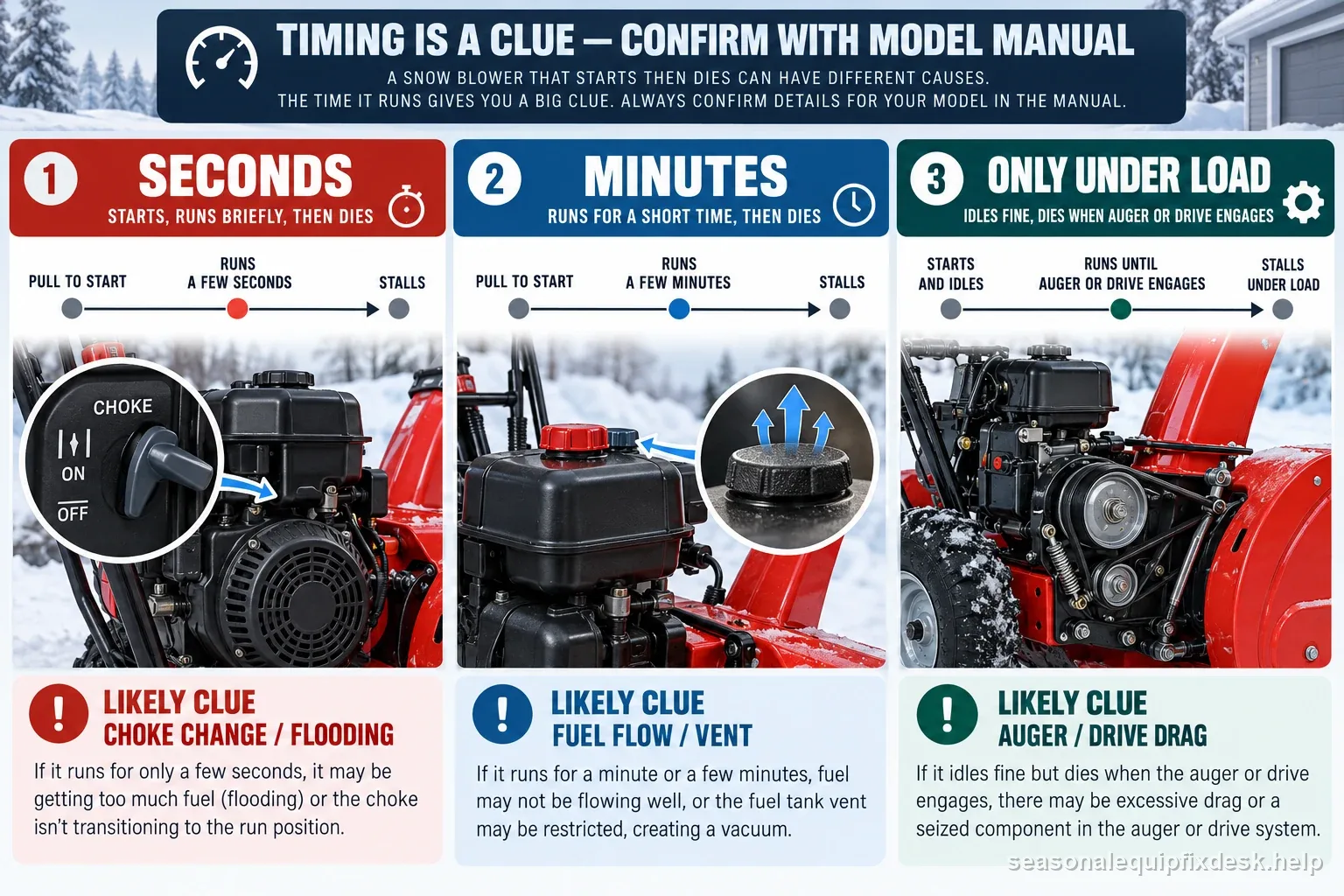
Seconds, minutes, or only under load?
- Dies almost immediately: recheck choke transition, primer use, fuel delivery to the carburetor, and flooding.
- Runs only with partial choke: the engine is asking for enrichment; a restricted fuel-metering path or intake leak is more plausible than a random ignition replacement.
- Runs for several minutes, then fades: fuel-cap venting, restricted tank flow, heat-related ignition, or icing deserve comparison.
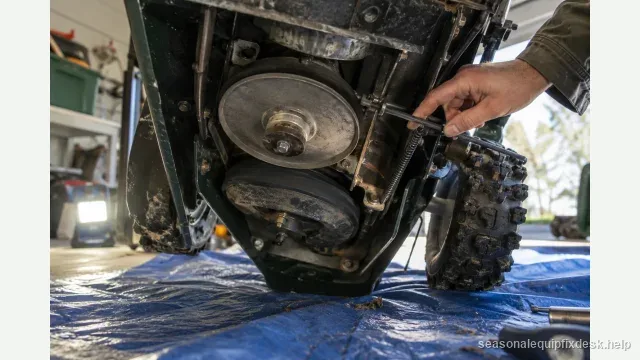
- Idles but dies when the auger engages: separate an overloaded/binding auger system from an engine that cannot make normal power.
| Pattern | What it can suggest | Next safe check |
|---|---|---|
| Dies within seconds | Choke transition, flooding, or fuel metering | Verify the model starting sequence; do not keep priming blindly |
| Fades after minutes | Fuel supply or tank ventilation; heat-related ignition is also possible | Record run time and restart behavior; inspect only after shutdown |
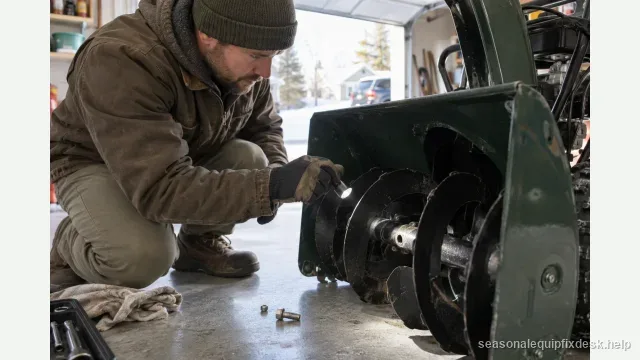
| Dies only when auger/drive engages | Mechanical load or engine power issue | Stop and inspect for binding only with machine disabled |
| Runs only with choke partly closed | Restricted fuel metering or intake issue may be present | Do not use choke as a permanent workaround |
| Observed timing | Record | Safe next step |
|---|---|---|
| Dies just after choke moves toward RUN | Choke position and seconds between change and stall | Use only the manual warm-up sequence; do not hold choke as a workaround |
| Fades after several minutes | Elapsed time, gradual fade or instant stop, and restart history | Let cool; inspect cap/visible fuel system only as the manual allows |
| Dies when auger or drive engages | Which control was engaged and engine sound before stopping | Disable, remove key, wait for motion to stop; check only visible obstruction |
| Fuel leak, severe surge, or new noise | Location and condition from a safe distance | Stop; keep away from ignition sources and arrange service |
Two worked timing examples
These show how to summarize an event that already happened; they are not instructions to repeat a stall. Do not keep running a machine with a leak, unsafe exhaust location, or abnormal noise just to collect a number.
Worked example 1: A cold engine starts at 0:00. The operator moves the choke toward RUN at 0:18, and the engine stops at 0:24. That is 6 seconds after the control change (24 − 18), making the transition a useful service clue but not proof of a carburetor fault. Compare the control sequence with the exact manual.
Worked example 2: A prior record shows a stall after 5 minutes, then a restart after a 12-minute cool-down followed by another stall at about 5 minutes. The repeated run time is a time-dependent pattern worth reporting; it cannot distinguish a vent, fuel-flow, or heat-related fault by itself. Do not reproduce this cycle intentionally.
Use the choke as a diagnostic signal, not a permanent fix
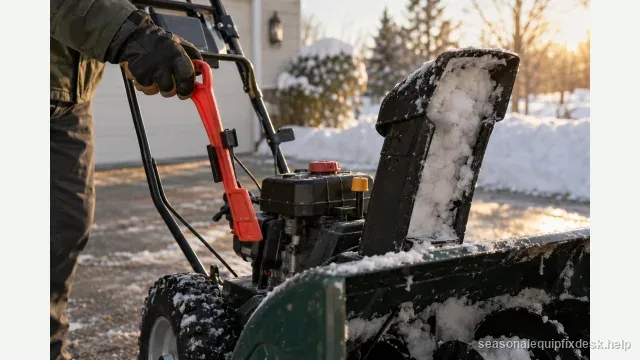
If the engine stays alive only when the choke remains partly closed after warm-up, do not keep operating it that way. Choke changes the air-fuel mixture; needing enrichment after the warm-up period is evidence that the normal running mixture is too lean or fuel flow is restricted.
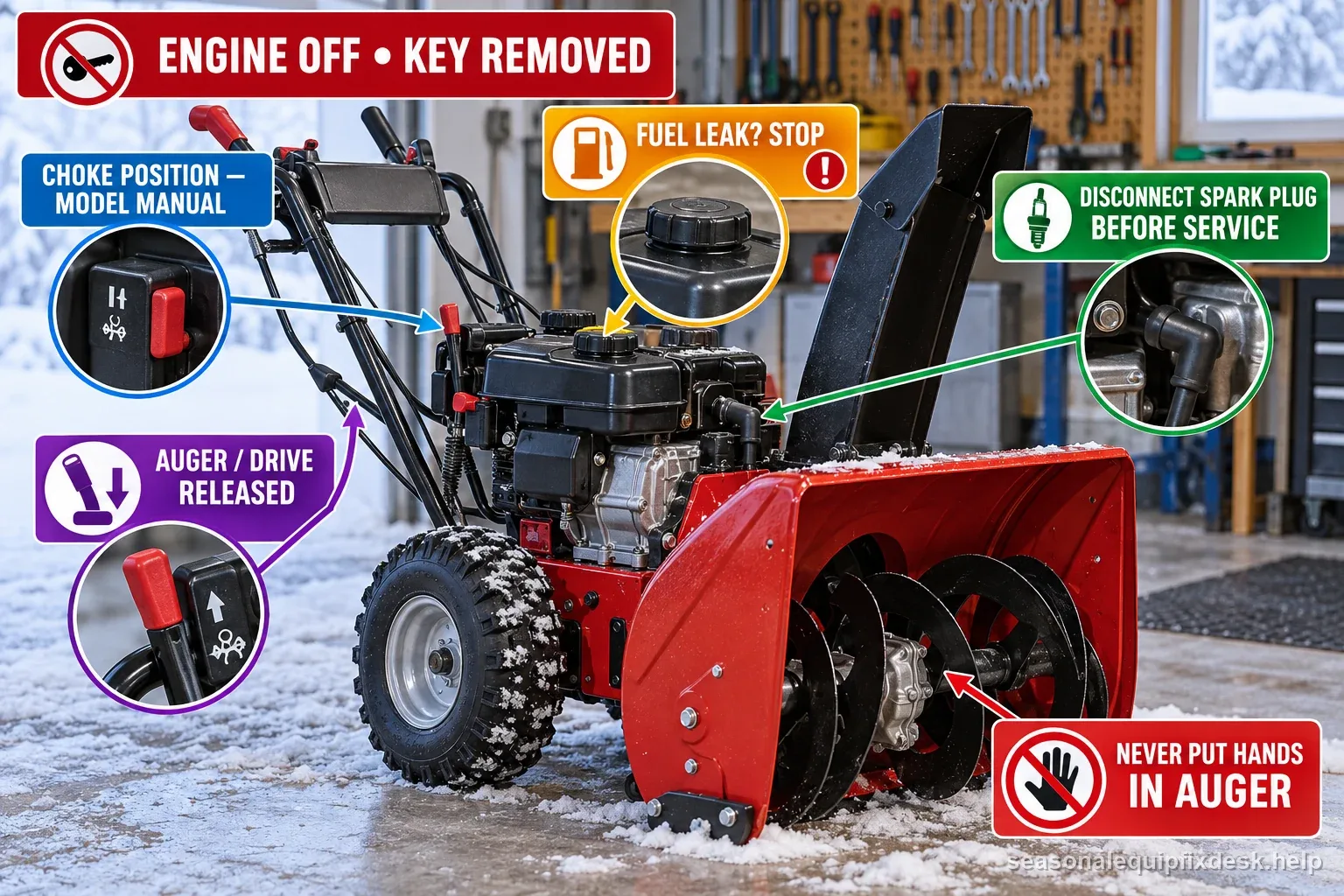
Confirm fresh correct fuel first. Then inspect the accessible filter, shutoff, line, bowl supply, and carburetor passages specified for the engine. Do not compensate by turning an undocumented mixture screw.
A blocked fuel-cap vent often has a clock
Tank vent problems commonly reveal themselves after the engine has consumed fuel for a while. The machine may start normally, lose power gradually, and restart after sitting. If the model’s cap is vented and its manual describes a vent check, let the machine cool, shut it off, and perform the check outdoors away from ignition sources. Do not open a hot tank or spill fuel.
Do not run the machine with a loosened fuel cap as a routine operating condition. A temporary diagnostic observation must not become a fuel-spill hazard. Replace a defective cap with the correct part.
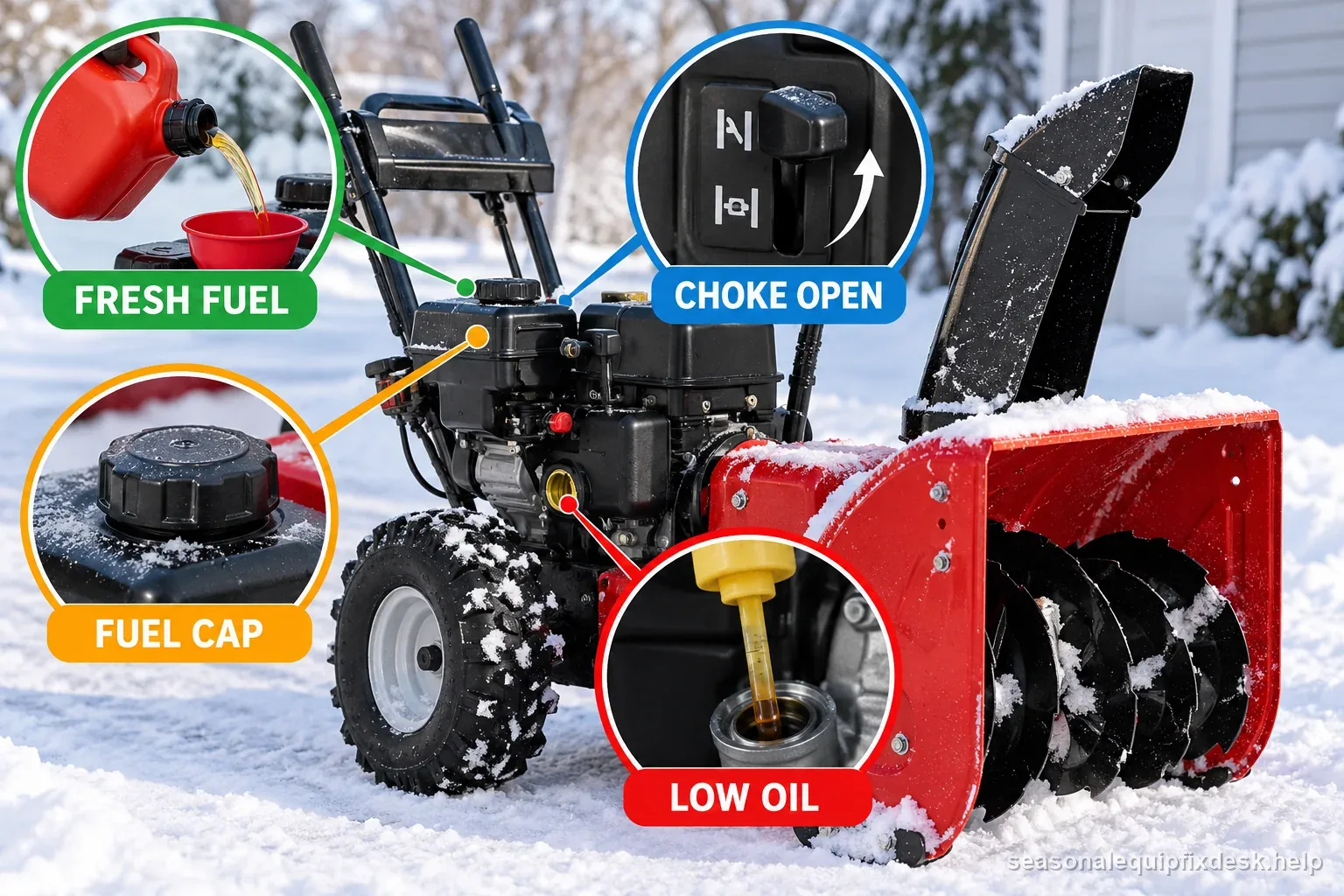
| When it stalls | First clue to record | Possible diagnostic branch |
|---|---|---|
| Immediately after start | Choke position and control sequence | Fuel delivery or flooded start |
| After warm-up | Elapsed minutes and restart behavior | Vent, fuel flow, or heat-related fault |
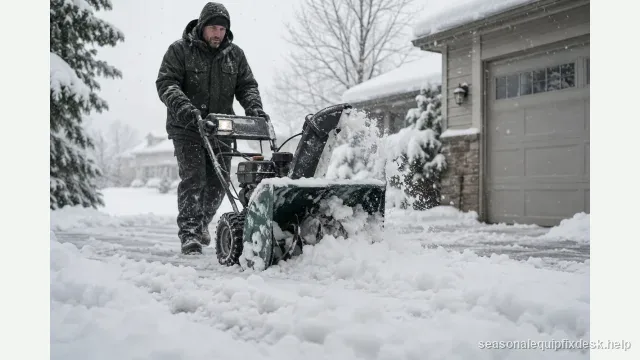
| Only in snow | Depth, pace, and engine sound | Load, shear damage, or operating limit |
When “dies under snow load” is not a carburetor problem
Only operate the auger using the normal controls and the model manual, from the operator position with guards installed and people clear. If the engine falters when the auger or drive engages, stop the engine and remove the key before checking for visible packed snow or damage. Never reach into the auger; use the supplied clean-out tool. Have belt drag, bearings, or internal binding serviced before assuming the carburetor is at fault.
A separate clue is whether engine speed falls smoothly from overload or cuts off abruptly as if an interlock or ignition circuit opened. Preserve that distinction. It determines whether you inspect the rotating system or the stop/ignition circuit next.
Heat-related failures need a hot-versus-cold comparison
An engine that runs ten or twenty minutes before losing spark, then restarts only after cooling, presents a different pattern from stale fuel. If the failure is repeatable, note run time and ambient temperature. A proper spark test immediately after the stall can be more useful than testing again the next morning when the part is cold.
Keep hot muffler and fuel-system hazards in mind. Do not perform improvised ignition tests near a hot engine or spilled gasoline.
- Run time from a cold start and whether the engine fades or cuts out
- Choke position when it stalls and whether it changes the symptom
- Whether auger and drive controls were released
- Restart behavior immediately and after cooling
- Fuel age, storage/refill history, visible leaks, and model number
What to record before touching the carburetor
- How long the engine runs from a cold start.
- Whether moving the choke changes the stall.
- Whether the stall occurs with auger and drive released.
- Whether opening the fuel cap after shutdown reveals a strong vacuum clue, if the manual supports that check.
- Whether the engine restarts immediately, only with prime/choke, or only after cooling.
These five observations turn “starts then dies” into a narrow problem. If fresh fuel, correct controls, tank venting, and external load are ruled out, carburetor service or heat-related ignition testing becomes a reasoned next step rather than parts roulette.
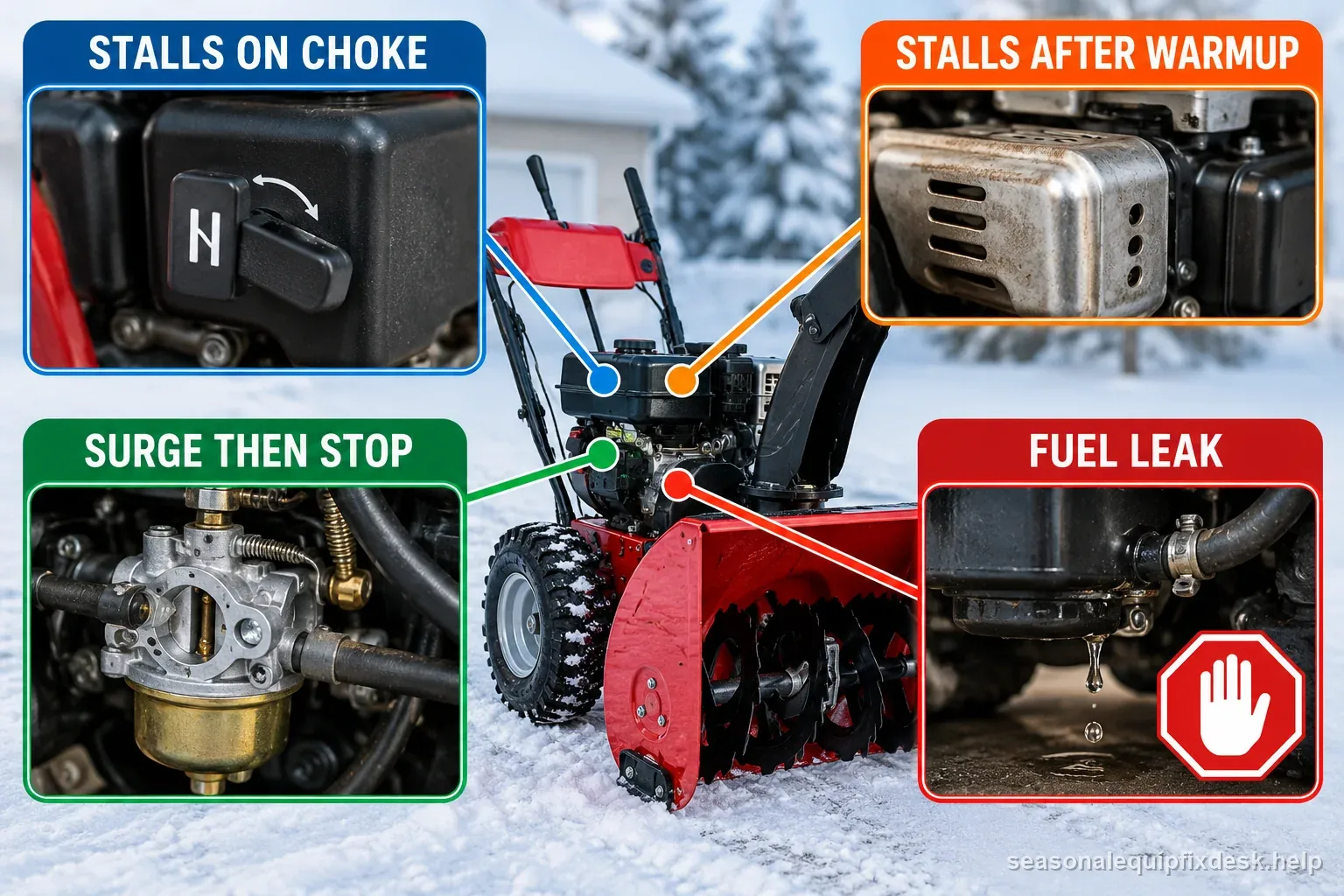
Stop conditions
Stop running the machine if fuel leaks, the muffler area ignites debris, the auger remains engaged when its control is released, or the engine is being dragged by a binding rotating assembly. A machine that dies under abnormal mechanical load should not be forced to keep running simply to complete a fuel test.
Restart behavior can separate supply from heat
After the engine quits, do not immediately prime it again. First note whether it restarts at once with the same choke setting, needs extra choke, or will not restart until it sits for several minutes. An immediate restart that again lasts only a short time is consistent with a repeatable fuel-delivery or control condition. A no-restart-until-cool pattern deserves a separate hot-versus-cold check rather than more carburetor cleaning.
If the machine fades gradually before stopping, watch for the sound of fuel starvation versus an abrupt ignition-like cut. The distinction is not proof by itself, but it tells you which evidence to collect next. Record whether opening the choke slightly changes the fade and whether the tank was recently refilled.
Water, ice, and seasonal fuel contamination deserve their own branch
A snow blower can have fresh gasoline added on top of water or degraded fuel already in the system. If the problem appeared after thaw-freeze cycles, outdoor storage, or a questionable fuel can, inspect the fuel safely according to the engine manual rather than assuming the newest fuel in the tank represents the entire system.
If contamination is found, correct it before judging the carburetor or ignition. Repeatedly running until the engine dies is not a useful test when the fuel source itself is unknown.