Quick answer: If a window AC runs but the room stays warm, confirm it is in Cool mode, set a reasonable target below the room temperature, clean the user-removable filter as its manual directs, and make sure indoor and outdoor air paths are clear. Let it run through one normal cycle and note whether the fan runs, the compressor seems to start, and the outlet air becomes cooler. Ice, a burning smell, a hot or damaged plug, repeated breaker trips, or no improvement after these checks calls for service.
A room air conditioner moves heat from indoors to outdoors. Air must pass over both coil sections and the installation must keep cooled room air from escaping. A running fan therefore does not prove the sealed refrigeration system is cooling. Conversely, a thermostat may cycle the compressor after the room reaches its setpoint, so a quiet compressor at one moment is not automatically a failure. Separate these possibilities before changing settings repeatedly.
Check the mode and the room load
Use the panel or owner manual to select Cool rather than Fan, Dry, Eco, or a schedule that limits operation. Set the target a few degrees below the current room reading for a short observation. This is an example, not a universal setting: controls, sensor locations, and cycle logic vary. Check for a timer, sleep setting, child lock, or remote-control issue. Turning the thermostat to its coldest setting does not make a blocked filter or faulty compressor recover faster.
Close doors and windows, reduce direct sun if practical, and avoid expecting one room unit to cool several rooms through open doorways. An oven, dryer, or unusually hot outdoor weather adds heat. A unit can also be working while warm air leaks through gaps around its window panels. ENERGY STAR says room AC size should match the area; an oversized unit may cool before removing enough humidity, while a small unit may struggle under a high heat load.
Clean only the removable filter
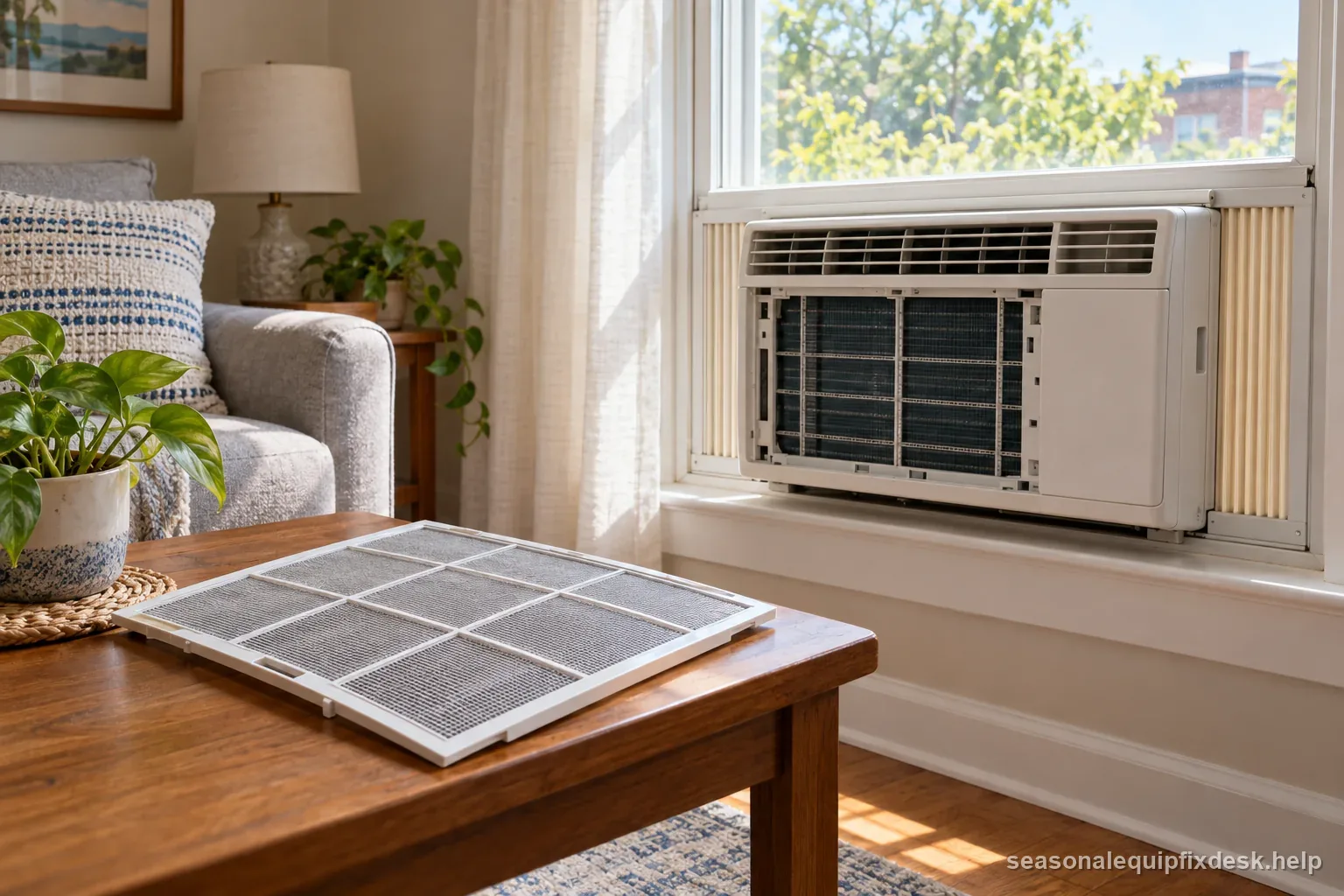
Switch the unit off and follow its instructions to access the washable or replaceable filter. Clean it as directed and let a washable filter dry completely before reinstalling. Do not operate without the filter. The U.S. Department of Energy notes that a clogged filter restricts airflow and reduces cooling performance. Check the visible grille and louvers for curtains, furniture, dust, or packaging, but keep fingers and tools outside the grille.
Do not remove the cabinet, reach into the unit, straighten hidden coil fins, or spray cleaner inside. Coils and electrical parts sit behind guards, and cleaning procedures differ by model. If the filter is damaged or does not fit, use the replacement specified by the model number. A filter that immediately becomes dirty again may reflect dusty room conditions; it is not evidence that the refrigerant system needs a DIY recharge.
Check the window installation from a safe position
From outside or a safe room-side view, confirm the rear portion is not boxed in by a tight cover, leaves, or an object that blocks ventilation. Follow the clearance in the manual. Do not reach through a grille or climb out a window to inspect a raised unit. If the AC has shifted, a bracket is loose, or the unit is unsupported, do not push or reposition it; a heavy window appliance can fall and should be secured by an installer.
Look for visible gaps around the accordion panels and frame. Seal only as the manual allows and do not cover a drain path or condenser opening. Some models call for a slight outward pitch while others specify a different position; do not guess or tilt the unit yourself. Indoor dripping, fresh vibration, or a change in how the AC sits requires attention before another run.
Read the clues before trying a reset
| Observation | Possible direction | Safe next step |
|---|---|---|
| Fan runs; filter is dusty | Restricted room-air flow | Clean the removable filter and repeat one normal cycle |
| Cool outlet air; room stays warm | Heat load, room size, or leakage | Close openings and check visible window seals |
| Ice behind the grille | Airflow or sealed-system fault | Switch cooling off; let ice thaw naturally; call service if it returns |
| Hot plug, odor, or repeated trip | Possible electrical fault | Stop use; do not reset repeatedly |
| No cooling after one clean-filter retest | Sensor, compressor, refrigerant, or control fault | Record the model and request qualified service |
If frost or ice is visible, turn cooling off. Do not chip it, pour hot water inside, or run the compressor against a frozen coil. A dirty filter or blocked airflow can contribute, but a sealed-system fault may also be involved. Let ice thaw naturally with the unit off and use only the restart procedure in the manual. If it returns after airflow is clear, call an HVAC technician rather than opening the cabinet.
Use a short decision path
- Is Cool mode selected and the target below the room reading? If not, correct it using the manual.
- Is the filter dirty or an opening visibly blocked? Switch off and clean only the removable filter or clear the outside of the grille.
- Is there ice, absent airflow, a damaged or hot plug, smoke, or an electrical odor? Stop and arrange service.
- If no warning sign is present, observe one normal cycle and record the room reading at the start and after 30 minutes in the same location away from the cold outlet.
- If the room does not begin to cool, contact a qualified HVAC technician; do not handle refrigerant, wiring, or compressor components.
The 30-minute interval is just an example for comparing conditions, not a pass/fail cooling standard. Record outdoor temperature and whether direct sunlight or open doors add heat. If the unit has a model-specific test duration, use that instead. Changing several settings at once makes it harder to tell whether a filter, timer, or room load was the cause.
Two examples that prevent misdiagnosis
Example 1: dusty filter on a hot afternoon. At 3 p.m. the airflow is weak and the filter is visibly dirty. The owner turns the unit off, cleans and dries the washable filter as directed, then compares the room reading 30 minutes later at the same spot. Airflow improves and the room begins cooling. That supports an airflow restriction; it does not prove that the coils or refrigerant were serviced.
Example 2: ice returns after thawing. The unit produces cold air briefly, then frost appears behind the grille. The owner switches cooling off, waits for natural thaw, confirms the filter is clean, and observes the same ice on the next normal run. The repeated pattern points to a service issue. A refrigerant kit, lower setpoint, or cabinet removal would add risk without diagnosing it.
When to stop and request service
Stop immediately for smoke, a burning or electrical odor, a hot or damaged cord, water reaching electrical parts, loud grinding, a loose installation, or a breaker that trips again. If it is safe and the plug is cool and undamaged, switch off and unplug; otherwise leave it alone and get qualified help. DOE guidance says suspected refrigerant loss requires a trained technician to repair the leak and recharge the system. Do not pierce tubing, add refrigerant, bypass a sensor, or open an electrical compartment.
When you call, provide the brand and model, approximate room area, outdoor conditions, mode and target, filter condition, whether the indoor fan and outdoor fan operate, and when ice or unusual sounds appear. This symptom record helps a technician distinguish maintenance from a sealed-system problem. If the unit is high or loose in the window, ask for safe installation support before doing more troubleshooting.